Frequently Asked Questions About PAN Card Registration
Looking for clarity? Here are the Frequently Asked Questions About PAN Card Registration, answered by the CA experts at CA4Filings.
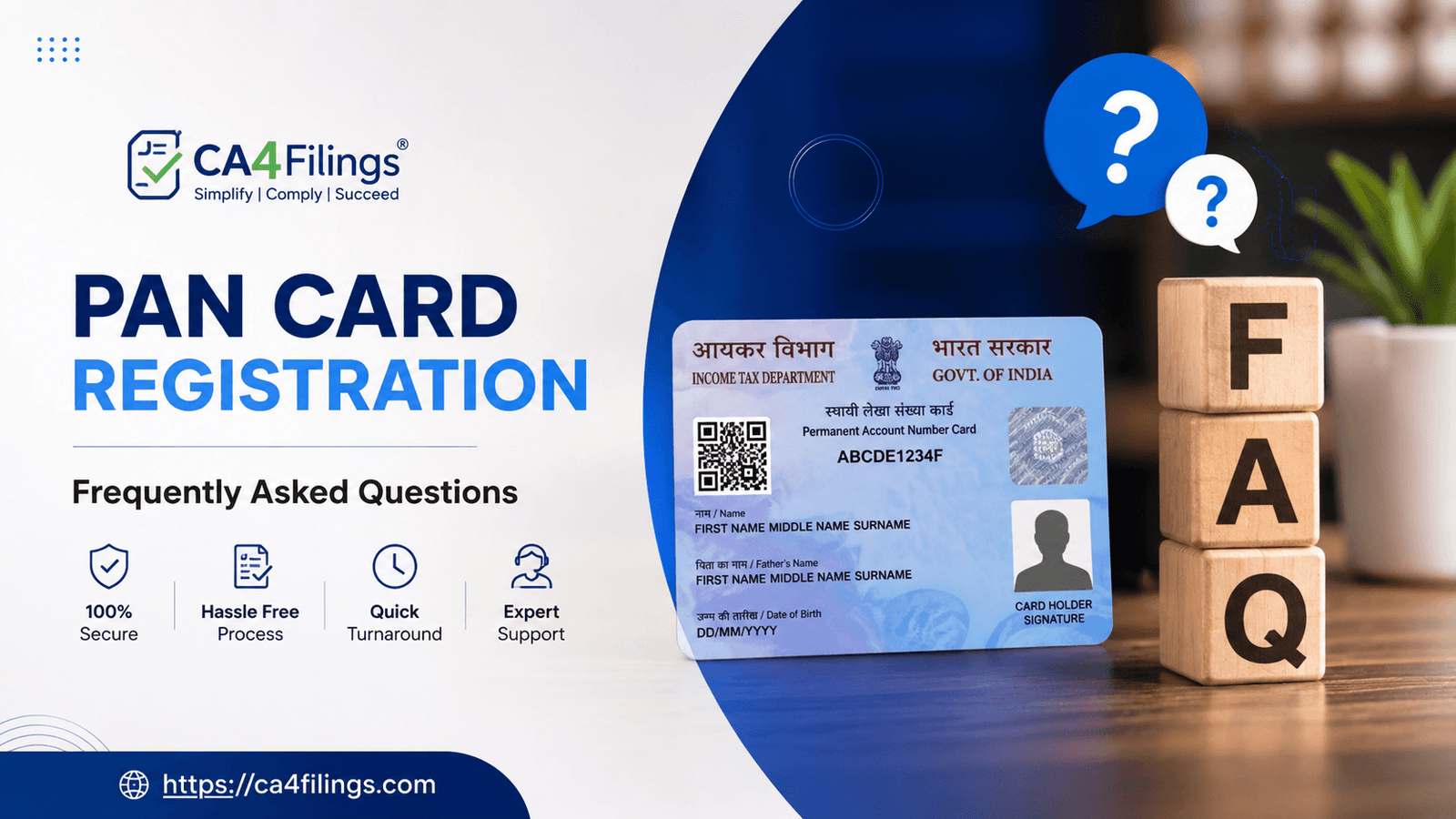
Every single day at CA4Filings, our desk is flooded with a variety of compliance and tax-related inquiries. Among all of them, a significant portion always boils down to one fundamental identity document: the Permanent Account Number card. Whether you are a college student opening your first bank account, a salaried professional joining a new company, or an entrepreneur launching a startup, this 10-digit alphanumeric number is your ultimate financial passport in India. Given how critical it is, we have compiled this comprehensive guide on the Frequently Asked Questions About PAN Card Registration to clear the air once and for all.
If you are a new business owner or an individual looking to get your finances in order, navigating the PAN card process can sometimes feel overwhelming. Many people get stuck wondering about the exact paperwork or the legal implications of making a mistake. To make things incredibly simple, we provide a seamless, hassle-free service for Pan Card Registration that handles everything from document verification to final dispatch, ensuring your application is 100% error-free.
Let’s dive straight into the most common PAN card queries we receive from clients across India.
Who Needs a PAN Card? PAN Card Eligibility Explained
One of the most recurring PAN card FAQs relates to who is actually legally required to hold one. In India, eligibility is incredibly broad, and it is a myth that only tax-paying adults need a PAN.
According to the Income Tax Department, the following categories must go through the PAN card registration protocol:
Salaried and Self-Employed Individuals: Anyone earning an income above the basic exemption limit.
Business Entities: Every partnership firm, LLP, Private Limited Company, Trust, and Society must have a PAN to operate a commercial bank account.
Minors & Students: A minor can apply through a parent or guardian. This is highly recommended if you are planning to open a minor bank account or make investments in their name.
Non-Resident Indians (NRIs) & Foreign Nationals: If an NRI or a foreign citizen wants to invest in Indian mutual funds, buy property here, or open an NRO/NRE account, applying for PAN card access is mandatory.
The Step-by-Step PAN Card Process
The actual PAN card application can be completed either online or offline. While the government provides portals like NSDL (now Protean) and UTIITSL, many applicants run into technical glitches or face rejections due to mismatched signatures and incorrect details.
Here is the simplified journey of an individual PAN card application:
Form Selection: Individuals who are Indian citizens use Form 49A, while foreign citizens and companies use Form 49AA.
Data Entry: Filling in accurate PAN card details, ensuring that your name matches your Aadhaar card exactly to prevent authentication failures.
Document Upload: Submitting your proof of identity, address, and birth date.
Fee Payment: Paying the government-prescribed PAN card fees.
Aadhaar e-KYC / Physical Submission: Verifying the data online via an OTP or courier-shipping the physical acknowledgment receipt.
Once submitted, you can monitor your status using a unique acknowledgement number. Within a couple of weeks, the physical card is delivered right to your doorstep.
Crucial PAN Card Documents Required
To ensure your application doesn't get stuck in bureaucratic red tape, you need to collect the right paperwork before starting. The PAN card documents required change based on the structure of the applicant.
For Individual Indian Citizens
If you are applying as an individual, the easiest route is using your Aadhaar card. It safely acts as:
Proof of Identity (POI)
Proof of Address (POA)
Proof of Date of Birth (DOB)
If Aadhaar is unavailable or has mismatched data, alternative PAN card information documents include a Passport, Voter ID, Driving License, or Matriculation Certificate.
For Companies and Partnership Firms
For business entities, personal IDs won't cut it. You must provide:
Partnership Firms / LLPs: Partnership Deed and Registration Certificate issued by the Registrar of Firms/LLPs.
Companies: Certificate of Incorporation issued by the MCA (Ministry of Corporate Affairs).
Understanding PAN Card Fees
A common area of confusion involves the economic cost of the application. The government-mandated PAN card fees depend strictly on whether you require a physical card and whether your communication address is within India or overseas.
For an Indian Communication Address: The fee is approximately ₹107 (including GST) if you choose to receive both a physical card and an e-PAN.
For a Foreign Communication Address: If you are an NRI or a foreign national requiring the card to be shipped abroad, the fee scales up to roughly ₹1,011 due to international postage charges.
Frequently Asked Questions About PAN Card Registration
To give you a highly precise and easily searchable reference, here are the detailed answers to the specific Frequently Asked Questions About PAN Card Registration that our clients ask us regularly.
Q1: Can I hold more than one PAN card to manage my different businesses?
Absolutely not. Holding more than one Permanent Account Number card is strictly illegal under Section 272B of the Income Tax Act, 1961. If you are caught possessing a duplicate PAN, the Income Tax Department can levy a hefty penalty of ₹10,000. If you accidentally have two, you must surrender the duplicate one immediately.
Q2: My Aadhaar card has a spelling mistake in my name. Can I still apply for a PAN?
We highly advise against it. The modern online portal uses e-KYC to pull data from the UIDAI database. If the name on your application does not match your Aadhaar, the system will reject it. First, update your Aadhaar details, and then proceed with your PAN registration to avoid unnecessary delays.
Q3: Is it mandatory for a housewife or a retired senior citizen to have a PAN?
It is not mandatory unless they have a taxable income. However, practically speaking, it is highly recommended. Without a PAN, they will face higher Tax Deducted at Source (TDS) rates on fixed deposit interest, and they won't be able to buy jewelry over ₹2 Lakhs or open a simple bank account easily.
Q4: What is the validity period of a PAN card? Does it expire?
A PAN card is issued for life. It remains valid across your lifetime and does not require any periodic renewals. The only time you would need to re-engage with the system is if you lose the physical card and need a reprint, or if you need to make changes to your existing PAN card details (like updating a surname after marriage).
Q5: Can I start an online business or sell on e-commerce sites without a PAN?
No, you cannot. E-commerce platforms are legally bound to deduct TDS under GST and Income Tax laws. To register as a seller on platforms like Amazon or Flipkart, providing a valid PAN is a strict prerequisite.
Let CA4Filings Simplify Your Compliance
Securing your Permanent Account Number card is the very first brick you lay when building your financial house in India. While the process appears straightforward on paper, minor slip-ups in documentation or data entry can lead to frustrating rejections or compliance notices down the line.
We hope this ultimate compilation of Frequently Asked Questions About PAN Card Registration has cleared your doubts and given you the confidence to move forward. If you want to skip the confusing forms, avoid portal errors, and get your PAN card processed swiftly by certified professionals, reach out to us today. Let the team at CA4Filings take the compliance burden off your shoulders so you can focus entirely on growing your business!
Latest Updates
ca4filings.com Services

























-registration.png)