FSSAI Registration Requirements for Home-Based Food Businesses
FSSAI Registration Requirements for Home-Based Food Businesses explained simply with eligibility, documents, process, fees, and compliance tips.
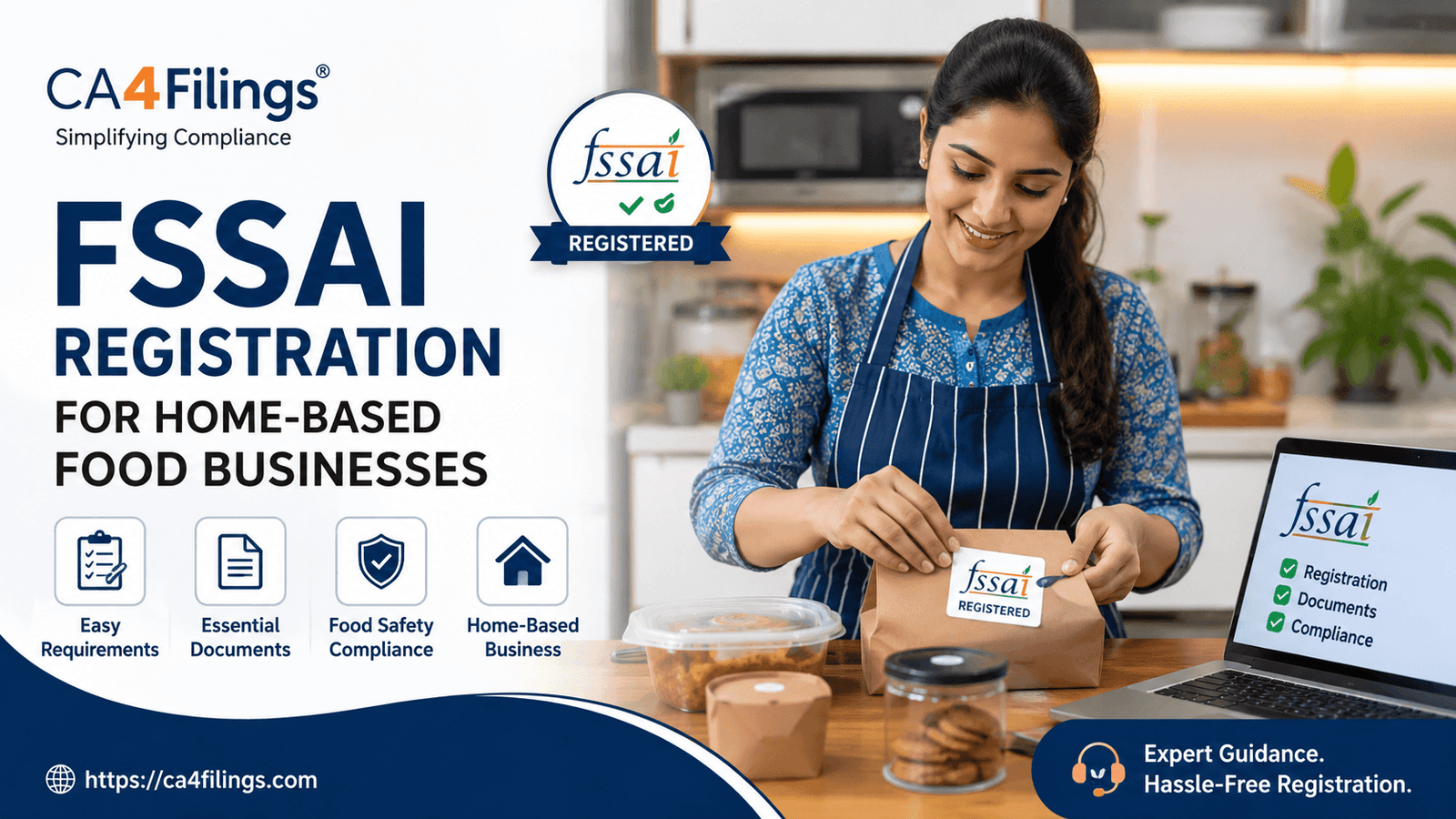
Starting a home-based food business in India has become a popular way for many individuals to turn their cooking passion into a profitable venture. Whether you sell homemade pickles, cakes, tiffin services, snacks, or bakery items, one thing you cannot ignore is the FSSAI Registration Requirements for Home-Based Food Businesses. Food safety compliance is not just a legal requirement; it also builds customer trust and credibility.
At CA4Filings, we regularly help small food entrepreneurs understand the legal process and complete their FSAAI Registration smoothly without unnecessary complications. Many home-based business owners assume that FSSAI registration is only for large restaurants or food factories, but that is not true. Even small-scale home kitchens selling food online or locally may require registration under the Food Safety and Standards Authority of India (FSSAI).
In this guide, we will explain the complete FSSAI Registration Requirements for Home-Based Food Businesses, including eligibility, documents, fees, process, and compliance obligations.
What is FSSAI Registration?
FSSAI Registration is a mandatory food safety certification issued by the Food Safety and Standards Authority of India. It ensures that food businesses follow hygiene and safety standards while preparing and selling food products.
For home-based businesses, this registration acts as legal approval to operate food-related activities. It also helps businesses gain customer confidence, especially when selling through platforms like Swiggy, Zomato, Instagram, or WhatsApp.
The FSSAI Registration Requirements for Home-Based Food Businesses mainly depend on the turnover and nature of the food business.
Why Home-Based Food Businesses Need FSSAI Registration
Many small food entrepreneurs think that operating from home exempts them from licensing requirements. However, under Indian food safety laws, almost every food business operator must obtain FSSAI approval.
Key Reasons Why It is Important
- Legal compliance under FSSAI regulations
- Improves customer trust
- Helps sell on food delivery platforms
- Avoids penalties and legal notices
- Enhances brand image
- Supports future business expansion
For example, if you run a homemade cake business from your kitchen in Delhi and promote your products on Instagram, you still fall under the FSSAI Registration Requirements for Home-Based Food Businesses.
Types of FSSAI Registration for Home-Based Food Businesses
The type of registration depends mainly on annual turnover.
Basic FSSAI Registration
This applies to small food businesses with annual turnover up to ₹12 lakh.
Suitable for:
- Home bakers
- Homemade pickle sellers
- Tiffin services
- Small snack businesses
State FSSAI License
Required for businesses with annual turnover between ₹12 lakh and ₹20 crore.
Suitable for:
- Expanding cloud kitchens
- Medium-scale food production units
- Businesses supplying to multiple cities
Central FSSAI License
Applicable for businesses with turnover above ₹20 crore or businesses operating in multiple states.
Most home-based food businesses initially require Basic Registration only.
Understanding these categories is an important part of the FSSAI Registration Requirements for Home-Based Food Businesses.
Eligibility Criteria for Home-Based Food Businesses
Any individual involved in food preparation, packaging, storage, distribution, or sale from home may require FSSAI registration.
Eligible Businesses Include
- Home bakery businesses
- Tiffin service providers
- Homemade chocolates and sweets sellers
- Pickle and papad makers
- Online food sellers
- Cloud kitchens operating from home
- Catering services
Even if the business is small, obtaining registration is strongly recommended to remain compliant with the law.
Documents Required for FSSAI Registration
One of the most common questions we receive at CA4Filings is about documentation. Thankfully, the documentation process for small home businesses is relatively simple.
Basic Documents Required
- Aadhaar Card or PAN Card
- Passport-size photograph
- Address proof of business premises
- Mobile number and email ID
- Food category details
- Declaration form
Additional Documents for State or Central License
- Business constitution certificate
- Partnership deed or incorporation certificate
- Kitchen layout plan
- List of food products
- Water testing report
Proper documentation is a crucial part of the FSSAI Registration Requirements for Home-Based Food Businesses.
Step-by-Step Process for FSSAI Registration
Step 1: Determine the Correct License Type
Identify whether your business falls under Basic Registration, State License, or Central License based on turnover.
Step 2: Prepare Required Documents
Collect identity proof, address proof, photographs, and business details.
Step 3: File the Application
Submit the application online through the FoSCoS portal.
Step 4: Verification by Authorities
In some cases, authorities may inspect the kitchen premises to verify hygiene conditions.
Step 5: Receive FSSAI Certificate
Once approved, you will receive a 14-digit FSSAI registration number.
The registration number must be displayed on food packages, invoices, or promotional materials.
Fees for FSSAI Registration
The government fees depend on the type of registration.
Approximate Government Fees
- Basic Registration: ₹100 per year
- State License: ₹2,000 to ₹5,000 per year
- Central License: ₹7,500 per year
Professional fees may vary depending on consultant support and documentation assistance.
For small entrepreneurs, the cost of meeting the FSSAI Registration Requirements for Home-Based Food Businesses is quite affordable compared to the legal and business benefits.
Common Mistakes Home-Based Food Businesses Should Avoid
Many food startups make compliance mistakes that later create legal or operational problems.
Avoid These Errors
- Operating without registration
- Choosing the wrong license category
- Providing incorrect turnover details
- Ignoring hygiene standards
- Not renewing the license on time
- Failing to display the FSSAI number
At CA4Filings, we often see businesses face penalties simply because they were unaware of the proper FSSAI Registration Requirements for Home-Based Food Businesses.
Important Compliance Tips for Home Kitchens
Obtaining registration is only the beginning. Food businesses must also maintain basic hygiene and compliance standards.
Best Practices
- Keep cooking areas clean and sanitized
- Use quality raw materials
- Store food properly
- Wear gloves and hair covers while cooking
- Maintain packaging hygiene
- Label products correctly
Customers today are highly conscious about food quality, especially when purchasing homemade food online.
Benefits of FSSAI Registration for Small Food Entrepreneurs
Builds Customer Trust
Customers prefer purchasing food from legally registered businesses.
Easier Online Selling
Most food delivery apps ask for FSSAI details before onboarding sellers.
Business Expansion Opportunities
Registration makes it easier to collaborate with retailers and marketplaces.
Legal Protection
Compliance reduces the risk of penalties and business disruptions.
The FSSAI Registration Requirements for Home-Based Food Businesses are not just legal formalities; they help create a strong business foundation.
FAQs on FSSAI Registration Requirements for Home-Based Food Businesses
Is FSSAI registration mandatory for homemade food businesses?
Yes, in most cases, food businesses operating from home require at least Basic FSSAI Registration.
Can I sell homemade food online without FSSAI registration?
Most online food platforms require FSSAI registration before listing your products.
How long does FSSAI registration take?
Usually, Basic Registration can be completed within 7–15 working days if documents are properly submitted.
What happens if I operate without FSSAI registration?
Authorities may impose penalties, fines, or even business closure for non-compliance.
Is FSSAI registration valid across India?
Yes, FSSAI registration is recognized throughout India, subject to the license category and operational scope.
The demand for homemade food businesses is growing rapidly in India, but compliance cannot be ignored. Understanding the FSSAI Registration Requirements for Home-Based Food Businesses is essential for operating legally, building customer trust, and scaling successfully.
Whether you run a small home bakery, tiffin service, or online snack business, getting FSSAI registration is one of the smartest steps you can take for long-term growth.
At CA4Filings, we help food entrepreneurs complete registrations quickly and accurately while avoiding unnecessary complications. If you are planning to start or regularize your food business, our experts are ready to guide you through the entire process with professional support and practical advice.
Latest Updates
ca4filings.com Services























-registration.png)