Step-by-Step Guide to Registering a Private Limited Company in India
Step-by-Step Guide to Registering a Private Limited Company in India with legal process, documents, costs, and expert tips.
Starting a business in India is an exciting journey, but choosing the right business structure is equally important. Among all business entities, a private limited company remains one of the most preferred options for startups, entrepreneurs, and growing businesses because of its credibility, limited liability protection, and scalability.
In this Step-by-Step Guide to Registering a Private Limited Company in India, we will explain the complete registration process in simple language so that entrepreneurs can confidently start their business without confusion. At CA4Filings, we regularly assist startups and business owners with Private Limited Company Registration and understand the common challenges faced during incorporation.
Whether you are a first-time entrepreneur, freelancer, consultant, or startup founder, this detailed guide will help you understand every step involved in company registration in India.
What is a Private Limited Company?
A Private Limited Company is a business entity registered under the Companies Act, 2013. It is privately held by shareholders and offers limited liability protection to its owners.
Key Features of a Private Limited Company
- Separate legal identity
- Limited liability protection
- Easy transfer of ownership
- Better funding opportunities
- Higher business credibility
- Perpetual succession
For startups planning long-term growth, a private limited company is usually the most practical structure.
Step-by-Step Guide to Registering a Private Limited Company in India
If you are planning to start your own company, following the proper legal process is essential. Below is the complete Step-by-Step Guide to Registering a Private Limited Company in India explained in detail.
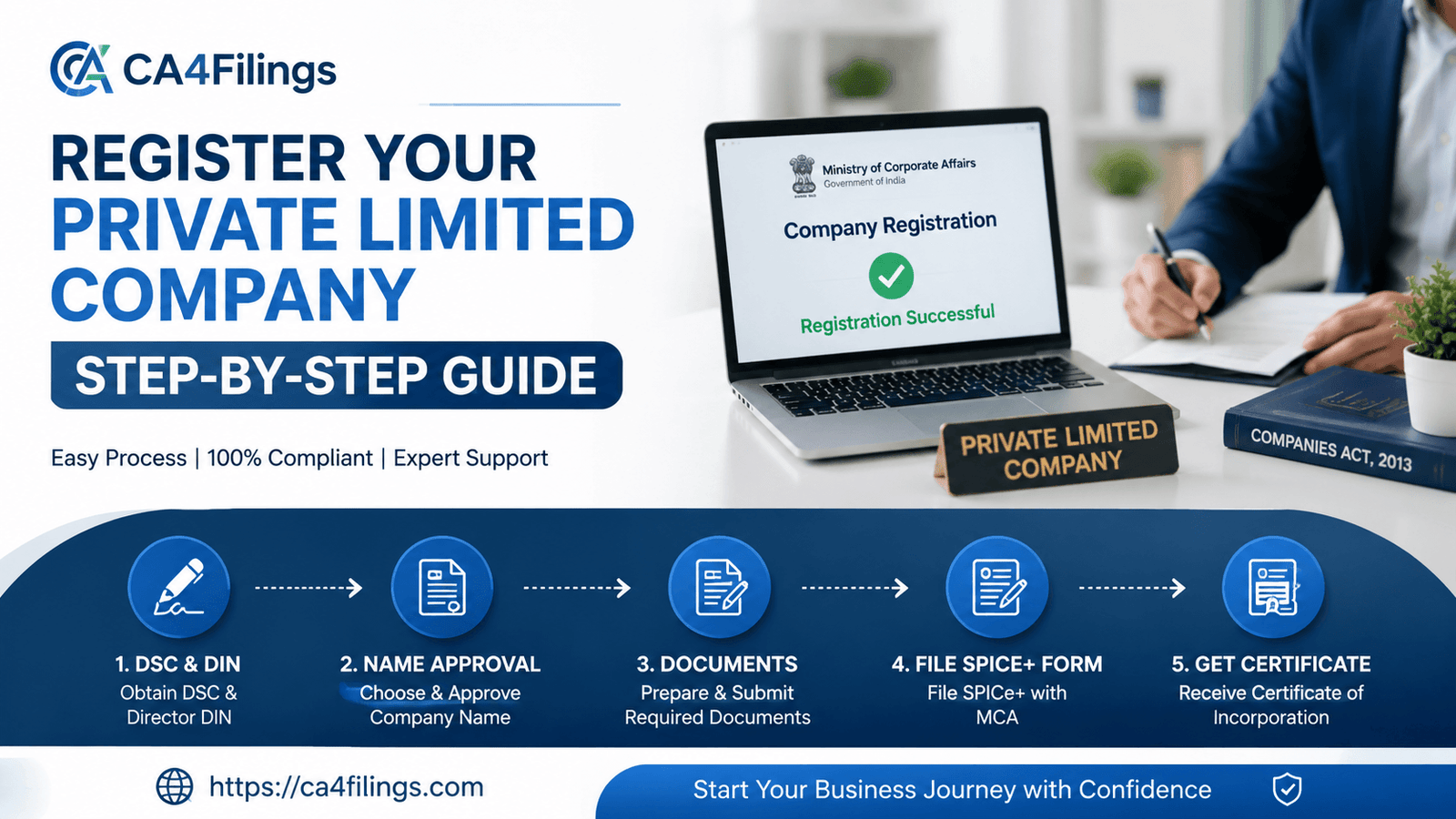
Step 1: Obtain Digital Signature Certificate (DSC)
The first step in the Step-by-Step Guide to Registering a Private Limited Company in India is obtaining a Digital Signature Certificate (DSC).
Since the registration process is completely online, all proposed directors must digitally sign the incorporation documents.
Documents Required for DSC
- PAN card
- Aadhaar card
- Passport-size photo
- Mobile number and email ID
Usually, DSC approval takes 1–2 working days.
Step 2: Apply for Director Identification Number (DIN)
The next step in the Step-by-Step Guide to Registering a Private Limited Company in India is obtaining the Director Identification Number (DIN).
Every director of the company must have a DIN issued by the Ministry of Corporate Affairs (MCA).
Important Point
You can apply for DIN directly while filing the SPICe+ incorporation form, which simplifies the process.
Step 3: Choose a Unique Company Name
Choosing the right company name is one of the most important parts of the Step-by-Step Guide to Registering a Private Limited Company in India.
Your company name should:
- Be unique
- Not match existing registered companies
- Avoid trademark conflicts
- Reflect your business activity
Example
If you are starting a software company, names like:
- TechNova Private Limited
- Innovix Solutions Private Limited
may work better than generic names.
Tips for Faster Approval
- Avoid abbreviations
- Use meaningful words
- Check trademark availability before applying
The MCA may reject names that are too similar to existing companies.
Step 4: Prepare Required Documents
The next stage in the Step-by-Step Guide to Registering a Private Limited Company in India involves preparing incorporation documents.
Documents Required from Directors and Shareholders
Identity Proof
- PAN Card (mandatory for Indian nationals)
- Passport (for foreign nationals)
Address Proof
- Aadhaar Card
- Voter ID
- Driving License
- Bank Statement
Registered Office Proof
- Electricity bill
- Rent agreement (if rented)
- NOC from property owner
Ensuring accurate documentation helps avoid unnecessary delays.
Step 5: File SPICe+ Form with MCA
This is the most crucial step in the Step-by-Step Guide to Registering a Private Limited Company in India.
The SPICe+ (Simplified Proforma for Incorporating Company Electronically Plus) form is an integrated web form introduced by MCA for company incorporation.
The SPICe+ Form Covers
- Company incorporation
- DIN allotment
- PAN application
- TAN application
- GST registration (optional)
- EPFO registration
- ESIC registration
Forms Included
- SPICe+
- e-MOA
- e-AOA
- AGILE-PRO
A professional CA or consultant can help ensure accurate filing and compliance.
Step 6: Certificate of Incorporation Issued by MCA
Once the documents are verified and approved, the MCA issues the Certificate of Incorporation (COI).
This is the final stage in the Step-by-Step Guide to Registering a Private Limited Company in India.
The Certificate Includes
- Company name
- CIN (Corporate Identification Number)
- Date of incorporation
After receiving the COI, your company becomes legally registered.
Step 7: Open a Business Bank Account
After incorporation, opening a current bank account in the company’s name is essential.
Common Documents Required
- Certificate of Incorporation
- PAN card
- MOA & AOA
- Board resolution
- KYC documents
Separating personal and business transactions helps maintain proper accounting records.
Estimated Cost of Private Limited Company Registration
The registration cost depends on several factors such as:
- Number of directors
- Professional fees
- State-wise stamp duty
- Authorized capital
Generally, the cost may range between ₹6,000 to ₹15,000 for most startups.
Time Required for Registration
Under normal circumstances, the entire process may take around 7–15 working days, depending on:
- Document readiness
- MCA approval timelines
- Name approval status
Proper documentation significantly reduces delays.
Benefits of Registering a Private Limited Company
Understanding the advantages is important while following this Step-by-Step Guide to Registering a Private Limited Company in India.
Limited Liability Protection
Shareholders are liable only up to their share capital contribution.
Better Funding Opportunities
Investors and venture capital firms usually prefer private limited companies.
Improved Business Credibility
Clients and vendors often trust registered companies more than proprietorships.
Easy Ownership Transfer
Shares can be transferred easily, making succession planning simpler.
Separate Legal Entity
The company can own assets and enter contracts in its own name.
Common Mistakes to Avoid During Registration
Many entrepreneurs make avoidable mistakes during incorporation.
Choosing a Similar Company Name
Always conduct proper name and trademark checks.
Incorrect Documentation
Mismatched signatures, blurred documents, or incorrect addresses may lead to rejection.
Using Residential Address Without NOC
If the office is rented, obtaining an NOC is important.
Ignoring Compliance Requirements
Registration is only the beginning. Annual filings and tax compliance are equally important.
Why Professional Assistance Matters
Although the MCA process is online, many applications face rejection due to technical or legal errors.
Professional guidance helps with:
- Proper documentation
- Faster approvals
- Compliance support
- Avoiding legal mistakes
- Post-incorporation guidance
At CA4Filings, we assist businesses throughout the registration journey and ensure a smooth incorporation experience.
FAQs on Step-by-Step Guide to Registering a Private Limited Company in India
Can one person register a private limited company?
No. A minimum of two directors/shareholders is required for a private limited company.
Is GST mandatory after company registration?
GST registration is mandatory only if your business crosses the prescribed turnover limit or falls under mandatory GST categories.
Can NRIs register a private limited company in India?
Yes. NRIs and foreign nationals can become shareholders or directors subject to FEMA guidelines.
What is the minimum capital requirement?
There is no mandatory minimum paid-up capital requirement under current laws.
Is physical presence required for company registration?
No. The entire process is online and can be completed remotely.
This Step-by-Step Guide to Registering a Private Limited Company in India simplifies the incorporation process for aspiring entrepreneurs and startups. Registering a private limited company offers legal protection, business credibility, and long-term growth opportunities.
However, successful registration requires proper planning, accurate documentation, and timely compliance. That is where expert assistance becomes valuable.
At CA4Filings, we help entrepreneurs complete the registration process smoothly while ensuring full compliance with MCA regulations. If you are planning to start your business, connect with CA4Filings today and take the first step toward building a legally strong and growth-ready company.
Latest Updates
ca4filings.com Services



























-registration.png)