How to Update Your Business Information on the GST Portal
Learn How to Update Your Business Information on the GST Portal with this step-by-step CA guide by CA4Filings. Ensure flawless GST compliance today!
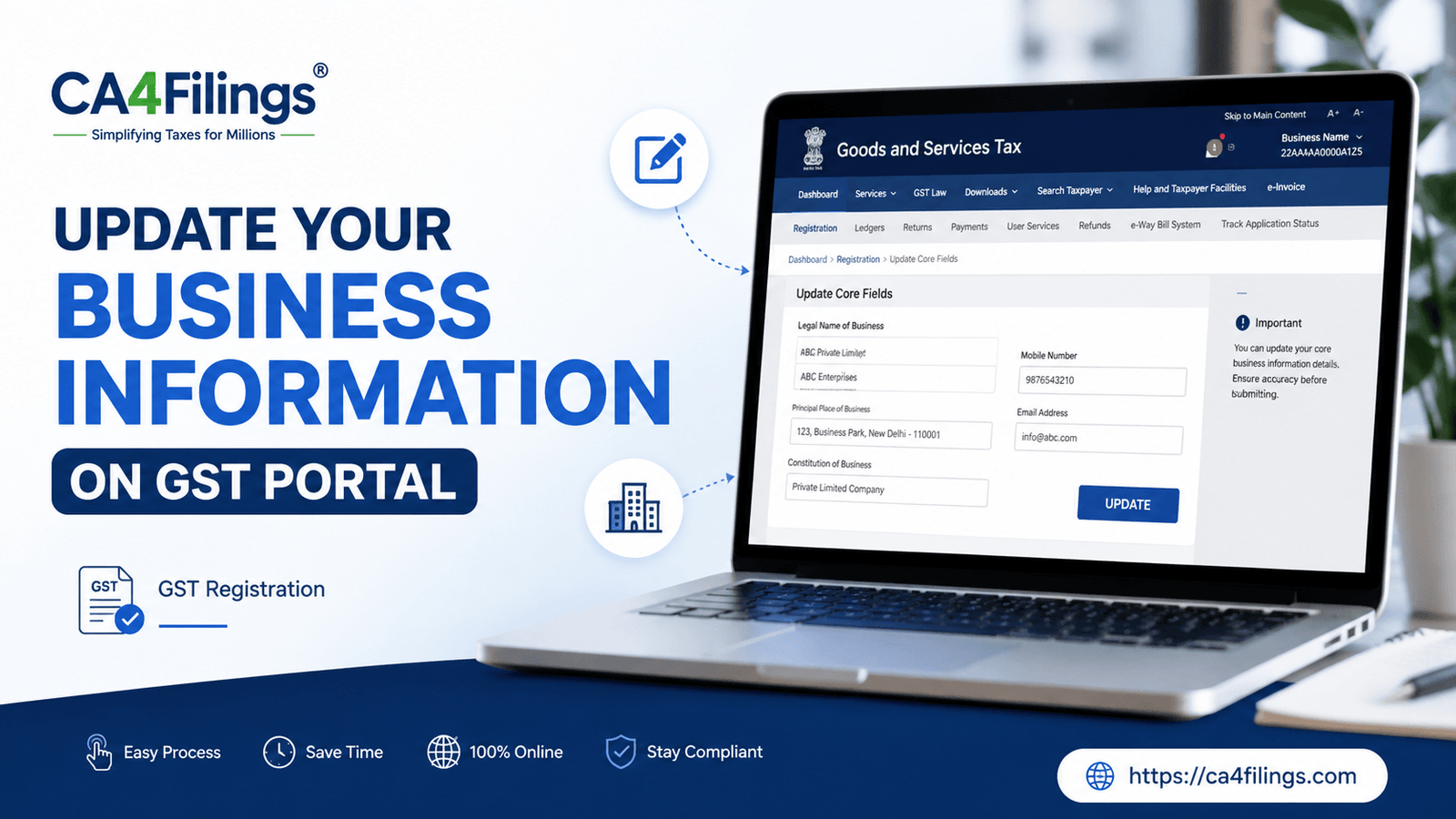
Running a business in India is a dynamic journey. As your venture grows, things change—you might move to a bigger warehouse, onboard new partners, add a fresh line of products, or update your primary contact number. While these changes are signs of progress, they also bring a crucial administrative responsibility: keeping your tax records aligned with reality. If you are wondering How to Update Your Business Information on the GST Portal, you have come to the right place.
At CA4Filings, we interact with hundreds of taxpayers daily, and a common misconception we encounter is that once a business secures its initial GST Registration, the paperwork is done forever. In reality, keeping your business profile update accurate is a legal necessity under the GST law. Failing to update business details in a timely manner can result in missed communications, blocked input tax credit (ITC), and unnecessary compliance notices. In this comprehensive guide, we will break down the entire process into simple, actionable steps so you can confidently manage your updating GST information requirements.
Why Keeping Your GST Details Updated is Non-Negotiable
Before we dive into the technical "how-to," let us understand the "why." The GST portal acts as the single source of truth for the tax department. Every notice, OTP, system-generated reminder, and registration certificate relies entirely on the data present in your digital business profile.
Consider a real-world scenario we handled last year. A manufacturing client changed their principal place of business but forgot to initiate a business address change on the GST portal. The tax department issued a routine physical verification notice, which went unanswered because it was sent to the old address. Consequently, their GSTIN was provisionally suspended, completely disrupting their ability to issue e-way bills and file returns.
Maintaining proper GST compliance is not just about avoiding penalties; it is about protecting your business continuity. Whether you are filing GST returns or issuing tax invoices to clients, your registered data must reflect your current operational reality.
Understanding the Core Fields: Core vs. Non-Core Amendments
The GST portal divides your registration details into two main categories: Core Fields and Non-Core Fields. This classification dictates whether your requested changes will require approval from a tax officer or if they will be updated instantly through system automation.
1. Core Fields (Requires Tax Officer Approval)
Core fields represent the foundational pillars of your GST registration details. Any modification here triggers an approval workflow at the department's end. These fields include:
The legal or trade name of the business (provided there is no change in PAN).
The principal place of business or any additional place of business (e.g., a business address change).
The addition, deletion, or retirement of stakeholders, such as partners, directors, promoters, or the karta of a Hindu Undivided Family (HUF).
2. Non-Core Fields (Instant Auto-Approval)
Non-Core fields are operational details that do not fundamentally alter the legal identity of the business. Changes in these fields are updated immediately upon submitting the application on the portal. Examples include:
Authorized signatory details (like changing a mobile number or email address, provided it is not the primary signatory).
Details of the bank accounts associated with the business.
The specific nature of business activities or changes to the HSN/SAC codes of goods and services you deal in.
Step-by-Step Guide: How to Update Your Business Information on the GST Portal
Let us walk through the actual procedure for updating your data. Ensure you have your login credentials, updated supporting documents (like a new rent agreement or a resolution copy), and your registered mobile phone nearby to receive OTPs.
Step 1: Log In and Navigate to Amendments
First, visit the official GST portal guidelines and log into your dashboard using your valid credentials. Go to the top navigation bar and select Services > Registration > Amendment of Registration Core Fields (or Non-Core Fields, depending on what you want to change).
Step 2: Edit the Relevant Tabs
The portal will display your existing registration details spread across multiple tabs like Business Details, Promoters/Partners, Principal Place of Business, and Additional Places of Business. Select the specific tab you wish to modify. Click on the 'Edit' button, make the necessary corrections, and input the effective date of amendment.
Step 3: Upload Supporting Documents
For core fields, documentation is everything. If you are executing a business address change, you must upload a valid proof of possession for the new premises. This could be a registered lease agreement, a recent electricity bill, or a No Objection Certificate (NOC) from the property owner. Ensure the document is clear, legible, and within the file size limits permitted by the portal.
Step 4: Verification and Submission
Once the changes are saved, head over to the Verification tab. Check the declaration box, select your authorized signatory from the dropdown menu, and enter the place. You can submit the application using either an Electronic Verification Code (EVC) sent to your registered mobile/email or via a Digital Signature Certificate (DSC), which is mandatory for companies and LLPs.
Upon successful submission, the system will generate an Application Reference Number (ARN) sent via text and email. You can use this number to track the status of your request on the portal.
Common Pitfalls to Avoid During a Business Information Update
As CAs, we frequently rectify errors made by taxpayers during self-filing. Here are a few critical mistakes you should actively avoid:
Delaying the Application: The GST law prescribes a strict timeline of 15 days from the date of the actual change to file your amendment application. Delaying beyond this can attract late fees and compliance complications.
Mismatched Address Proofs: When updating address details, ensure that the name on the electricity bill or property tax receipt perfectly matches the legal name of the business or the landlord's name mentioned in the lease deed. Minor typographical errors can lead to immediate rejection by the tax officer.
Incomplete Authorized Signatory Updates: If the primary authorized signatory leaves your company, always designate a new primary signatory before deleting the old one. If you delete the only active signatory, you may lock yourself out of the portal entirely.
Frequently Asked Questions (FAQs)
Q1. How long does it take for a business profile update to reflect on the GST portal?
For Non-Core fields, the update is instantaneous once you submit the form via EVC or DSC. For Core fields, the tax officer generally reviews and approves the application within 15 working days. If they require further clarification, they will issue a show-cause notice (SCN) online.
Q2. Can I change my PAN through the GST business information update process?
No, you cannot change your PAN using an amendment form. Because a GSTIN is structurally linked to a specific PAN, any change in ownership or legal constitution that alters the PAN (such as converting a sole proprietorship into a private limited company) requires you to cancel your existing registration and apply for a fresh one.
Q3. Will a business address change affect my pending input tax credit (ITC)?
No, updating your operational address within the same state does not impact your electronic credit ledger or accrued ITC. However, if you move your business operations to an entirely different state, it constitutes an inter-state migration, requiring a new registration and a formal transfer of ITC.
Q4. What should I do if my amendment application is rejected?
If a tax officer rejects your application, they will issue an online order stating the specific reasons for rejection. You can rectify the errors, gather the missing documentation, and submit a fresh amendment application on the portal addressing those specific concerns.
Achieve Flawless GST Compliance with CA4Filings
Knowing How to Update Your Business Information on the GST Portal is an invaluable skill for any modern entrepreneur. Keeping your registration details precise and current safeguards your business from penalties, fosters trust with your vendors, and ensures that your everyday operations run without a hitch.
While the digital portal is designed to be user-friendly, navigating the nuances of legal documentation, choosing correct HSN codes, or resolving tax officer queries can occasionally feel overwhelming. If you want to eliminate the guesswork and ensure that your updates are processed seamlessly without any technical delays, the expert team at CA4Filings is here to handle it for you. Reach out to us today, and let our professional chartered accountants manage your compliance journey while you focus entirely on scaling your business!
Latest Updates
ca4filings.com Services
























-registration.png)