How to Register for GST as a Job Worker
Are you a job worker confused about tax laws? Learn how to register for GST as a job worker in India with our expert guide at CA4Filings.
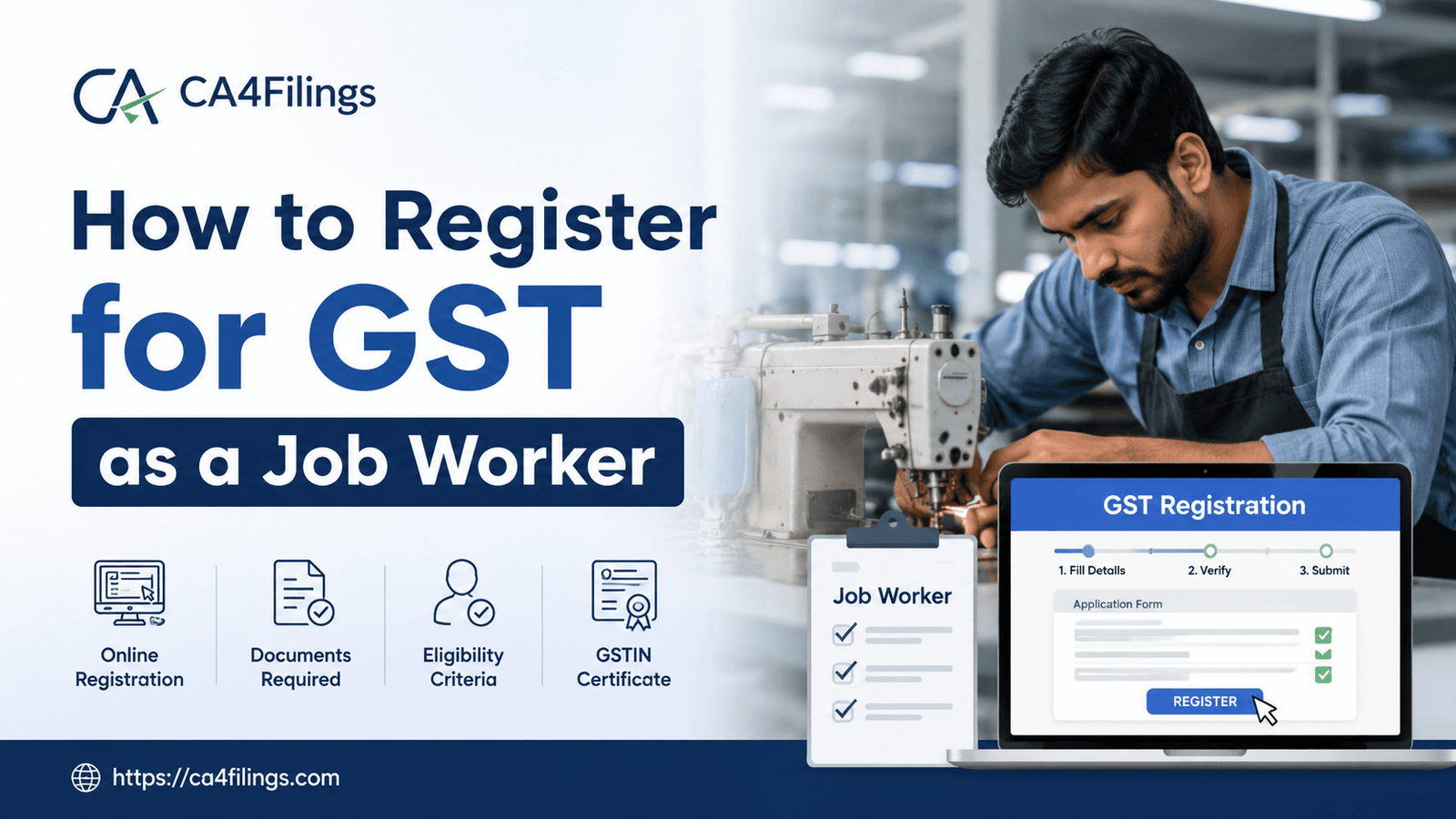
If you are involved in the business of processing, manufacturing, or treating goods that belong to another person, you are performing "job work." As an entrepreneur in this space, one of the most common questions we hear at CA4Filings is how to register for GST as a job worker. Navigating the complexities of tax compliance can be daunting, but getting your GST Registration in place is the first step toward scaling your operations and building trust with your principals.
In the Indian tax landscape, a "job worker" is defined as someone who undertakes any treatment or process on goods belonging to another registered person (the "principal"). Whether you are into packing, labeling, or complex manufacturing, understanding your tax obligations is vital for your business's health.
Is GST Registration Mandatory for a Job Worker?
Many small business owners often ask if they must register. The answer depends on your total annual turnover. In India, a job worker is generally required to register for GST if their aggregate turnover exceeds:
₹20 Lakhs: For most states in India.
₹10 Lakhs: For special category states.
However, there are exceptions. If you engage in inter-state supplies, registration may become mandatory regardless of your turnover, unless you fall under specific government exemptions. Even if your turnover is below these limits, many professionals choose to register voluntarily. Doing so allows you to claim input tax credit (ITC) on the raw materials and services you purchase, which can significantly reduce your tax burden.
When Should You Consider Voluntary Registration?
Even if you aren't legally required to register, learning how to register for GST as a job worker voluntarily can be a strategic move. By opting for voluntary tax registration, you establish yourself as a professional entity. Principals often prefer working with registered job workers because it simplifies their own compliance, such as the filing of Form ITC-04. When you are registered, you can issue tax invoices, charge GST, and maintain a cleaner audit trail.
Step-by-Step: How to Register for GST as a Job Worker
The registration process is entirely digital and conducted through the official GST portal. Here is a straightforward guide to help you get started:
1. Preparation of Documentation
Before visiting the portal, ensure you have these documents ready:
PAN Card: Of the business or the proprietor.
Aadhaar Card: Of the authorized signatory for authentication.
Business Proof: Incorporation certificate, partnership deed, or registration documents.
Address Proof: Utility bills, rent agreement, or electricity bill for the place of business.
Bank Details: A cancelled cheque or bank statement showing the account number and IFSC.
2. Generating the TRN (Temporary Reference Number)
Navigate to the GST portal and select "New Registration." You will fill out Part-A of the form, where you provide your PAN, mobile number, and email ID. You will receive an OTP on both your mobile and email. Once verified, the system generates a Temporary Reference Number (TRN).
3. Filling Part-B of the Application
Log in using your TRN to complete Part-B. This section requires detailed information about your business, the nature of your job work services, authorized signatories, and bank accounts. Ensure all details match your legal documents exactly to avoid rejection.
4. Aadhaar Authentication and Submission
With the move toward digital verification, you will likely need to perform Aadhaar authentication. After submitting the form with a Digital Signature (DSC) or Electronic Verification Code (EVC), you will receive an Application Reference Number (ARN). You can track your application status using this number.
Key Compliance Tips for Job Workers
Once you have completed your online registration, your journey into compliance begins. Here are a few things to keep in mind:
Maintain Records: Always keep a detailed register of goods received from the principal and the processed goods sent back.
Documentation: Ensure that every movement of goods is supported by a delivery challan. This is a critical requirement under GST law.
Timely Filing: Stay updated on your tax filing deadlines. Regular returns, such as GSTR-1 and GSTR-3B, must be filed to avoid penalties.
Input Tax Credit: As a registered entity, ensure you are capturing all your invoices to effectively claim ITC on your business expenses.
Frequently Asked Questions
Is the job worker liable for tax on the goods belonging to the principal?
No, the job worker is only liable to pay GST on the service charges or the value of their own materials used in the process. The principal remains the owner of the goods.
Can I operate as a job worker without registration?
Yes, provided your annual turnover is below the threshold limit of ₹20 lakhs (or ₹10 lakhs for special category states) and you are not making mandatory inter-state taxable supplies.
What happens if I fail to register for GST?
Operating beyond the threshold without a valid GSTIN can lead to heavy penalties and interest on the unpaid tax. It also disqualifies you from claiming any input tax credit.
Does the registration process involve any government fees?
No, there are no government fees for the registration itself on the GST portal. However, you may incur costs if you hire a professional to manage the documentation and filing for you.
Expert Support from CA4Filings
Understanding how to register for GST as a job worker is just the beginning of your compliance journey. At CA4Filings, we specialize in making tax processes simple for business owners. From handling your initial registration to ensuring your quarterly filings are accurate and timely, our team of expert Chartered Accountants is here to support your growth.
Latest Updates
ca4filings.com Services


























-registration.png)