Key Deadlines for DIR-3 KYC Compliance
Master the Key Deadlines for DIR-3 KYC Compliance under MCA's new 3-year cycle. Avoid a ₹5,000 penalty and DIN deactivation with our expert CA guide.
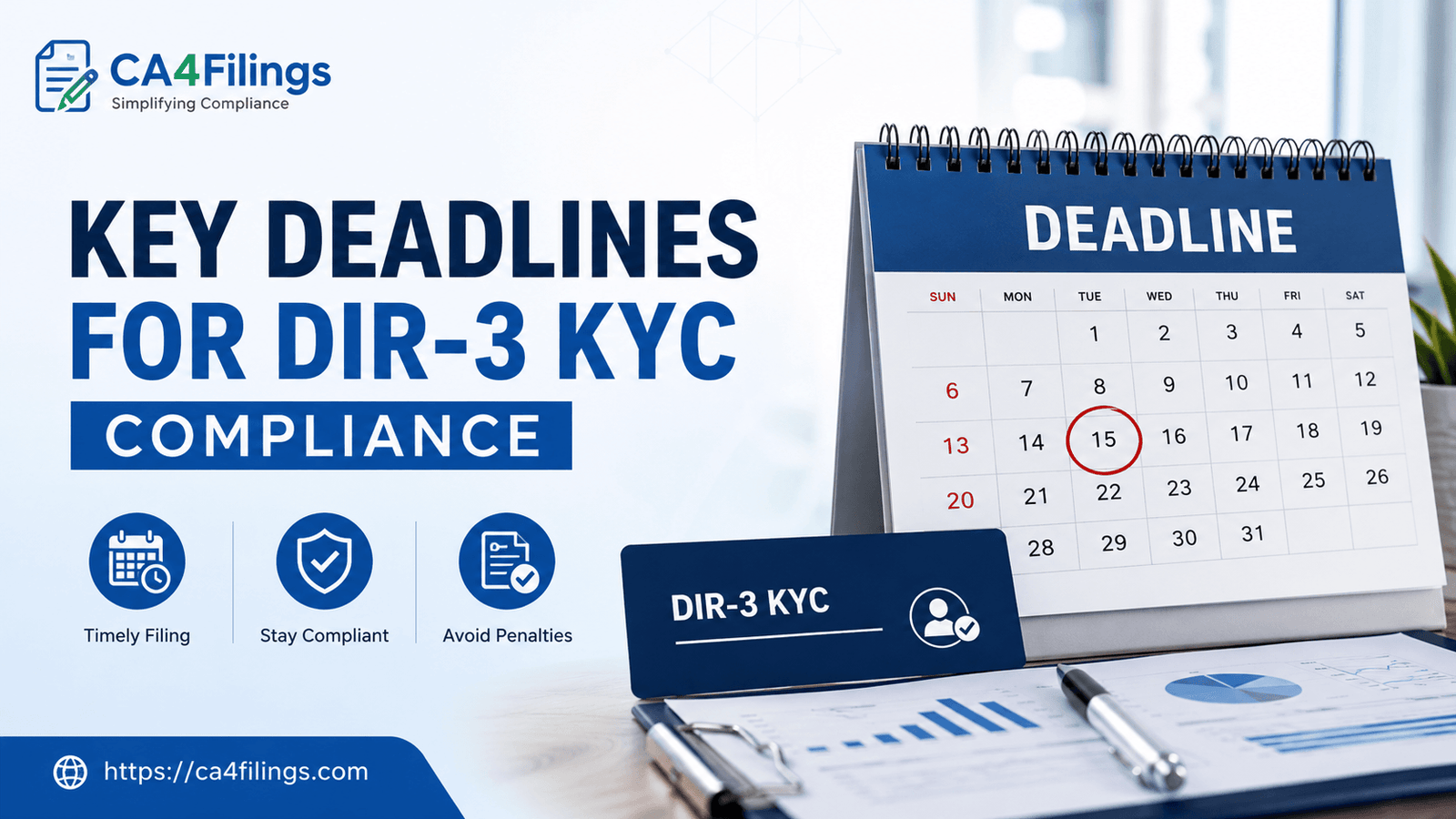
Running a business in India comes with its fair share of responsibilities, and ensuring that your company’s directors remain legally compliant is right at the top of that list. If you hold a Director Identification Number (DIN) or operate a company, you are likely familiar with the term "Director KYC". However, the Ministry of Corporate Affairs (MCA) has completely overhauled the system, turning what used to be a tedious yearly chore into a streamlined process. Navigating these changes successfully requires a clear understanding of the Key Deadlines for DIR-3 KYC Compliance.
We often see business owners rushing at the eleventh hour, dealing with server glitches, or paying steep, entirely avoidable fines. At CA4Filings, we firmly believe that proactive corporate governance shouldn't be stressful. To keep your business running seamlessly, it is essential to align your company calendar with the newly amended triennial (three-year) cycle and event-based updates. If you want to ensure your business remains fundamentally compliant without any last-minute administrative headaches, you can securely handle your DIR-3 KYC verification directly through our professional corporate compliance panel. Let’s break down exactly what the new framework looks like, how the cycle is calculated, and the vital dates you need to track.
The New Era of DIR-3 KYC Compliance: What Changed?
For years, every individual holding a DIN had to undergo an annual verification process by September 30th. It didn't matter if your address, phone number, and email ID were exactly the same as the year before—you still had to file. Recognizing this repetitive administrative burden, the Ministry of Corporate Affairs introduced a major compliance reform via Notification No. G.S.R. 943(E).
Under this new framework, the dual-system of standard e-forms and separate web forms has been entirely consolidated into a single, streamlined interface: the unified DIR-3 KYC Web form.
Instead of an annual requirement, routine filing is now based on a three-year compliance cycle. However, this relaxation comes with a catch: the MCA has shifted the structural focus heavily toward real-time accuracy. If any of your director KYC details change mid-cycle, you can no longer wait until the end of the financial year to report it.
Decoding the Key Deadlines for DIR-3 KYC Compliance
The triennial cycle depends entirely on when your DIN was allotted and when your last compliance check occurred. Missing these windows can quietly halt your corporate operations. Here is a breakdown of how the key deadlines function under the new framework:
1. The Routine 3-Year Filing Window
For routine updates where your personal information remains unchanged, you are required to submit the unified web form once every three consecutive financial years. The deadline for this milestone is on or before 30th June of the relevant assessment year.
2. The 30-Day Event-Based Deadline
If there is any change in a director’s active mobile number, personal email address, or residential address, an event-based update is triggered. You must complete the filing within 30 days of the modification.
To make these timelines clear, let's look at how the transition applies to different scenarios:
| Director Scenario | Current Status | Next Crucial Compliance Deadline |
|---|---|---|
| Existing Directors (DIN allotted on/before March 31, 2025; KYC updated for FY 2025–26) | No immediate filing needed for FY 2026-27 or FY 2027-28. | April 1 to June 30, 2028 (FY 2028–29) |
| New Directors (DIN allotted during FY 2025–26) | First compliance window anchors to the allotment year. | April 1 to June 30, 2029 (FY 2029–30) |
| Mid-Cycle Changes (Any active director updating phone, email, or address) | Triggered immediately upon change of particulars. | Within 30 days of the actual change |
Step-by-Step Verification and Filing Requirements
Even though the process has moved entirely to the web portal, gathering the necessary documentation beforehand ensures a smooth transaction. For routine triennial filings with no data modifications, no Digital Signature Certificate (DSC) or external professional attestation is required.
However, if you are filing an event-based change or reactivating a lapsed DIN, you must follow these step-by-step filing requirements:
Step 1: Data Alignment: Ensure that your Permanent Account Number (PAN) details perfectly match your Aadhaar Card information. Minor spelling discrepancies will cause the MCA portal to reject the submission.
Step 2: Address Verification: Obtain a recent utility bill (electricity, gas, or water) or a bank account statement. The document must clearly display the director's name and current residential address, and it cannot be older than two months.
Step 3: Identity Documentation: For Indian nationals, a self-attested copy of the PAN card is mandatory. For foreign nationals holding directorships in Indian entities, an apostilled or notarized passport copy is required.
Step 4: Secure Digital Signatures: Ensure the director’s personal DSC is active and mapped correctly to the portal for change-based submissions.
Step 5: Dual OTP Authentication: Access the portal to pull up the pre-filled records. Generate and verify real-time One-Time Passwords (OTPs) sent simultaneously to the director's unique mobile number and email ID.
Why Timely Compliance Matters: Fines and Restrictions
Many business owners treat director KYC as a minor administrative detail, but a delay carries swift operational consequences. The Ministry of Corporate Affairs enforces these timelines strictly to clean up the registry and eliminate shell configurations.
Avoid Penalties and Sudden Costs
If you file within the designated three-year window or report a change within 30 days, the government fee is Nil. However, if you miss the deadline, your DIN will automatically be flagged as "Deactivated due to non-filing of DIR-3 KYC". To reactivate a deactivated status, the MCA levies a strict, non-negotiable late fee penalty of ₹5,000 per director.
Corporate Paralysis
The financial cost is often less damaging than the operational disruption. A deactivated DIN causes immediate complications for the entire company:
The director cannot digitally sign or submit any statutory e-forms (such as AOC-4 for financial statements or MGT-7 for annual returns) with the Registrar of Companies (ROC).
The company cannot approve crucial board resolutions, register capital modifications, change its office address, or execute legitimate share transfers.
The system blocks the affected individual from accepting new directorships or setting up new business entities.
Banking institutions and institutional investors checking MCA records may freeze active corporate credit lines or put funding rounds on hold until the registry shows clean compliance.
Frequently Asked Questions (FAQs)
Q1: I am a director in a dormant company that has no business operations. Do I still need to file?
Yes, absolutely. The requirement is tied directly to the individual holding the Director Identification Number (DIN), not the status of the company. Even if your company is completely inactive, or if you have resigned from a board but still hold an active DIN, you must maintain your compliance timeline to prevent your ID from being blocked.
Q2: Does an event-based filing for an address change reset my 3-year routine cycle?
No, it does not. If you update your mobile number, email, or address mid-cycle, you must report it within 30 days. However, this event-based filing functions independently and does not reset your original triennial clock. Your next routine filing window remains anchored to its original schedule.
Q3: What happens if my mobile number and email ID change and I cannot receive the OTP?
If you no longer have access to your registered contact details, you cannot use the simple online web validation. You will need to file an update to modify your credentials on record. This requires submitting physical identity proofs, linking an active DSC, and getting the filing certified by a practicing professional like a CA or CS.
Q4: Can a modified DIR-3 KYC Web form be revised if I make a mistake?
No. Once a web submission is successfully uploaded and an System Request Number (SRN) is generated, it cannot be revised or recalled. Any error discovered afterward will require a fresh application to update details, which carries an processing fee of ₹500 per subsequent filing. Always review your details carefully before generating your final OTP.
Let CA4Filings Manage Your Corporate Compliance
Staying on top of regulatory updates while managing day-to-day business operations can be a balancing act. A single missed date can trigger unnecessary penalties, disrupt your board room authorizations, and stall critical corporate moves.
At CA4Filings, we take the guesswork out of corporate governance. Our dedicated team tracks your specific triennial cycle timelines, validates your identity proofs against the MCA database, and manages your web portal submissions smoothly. Let us handle the paperwork so you can focus entirely on growing your business. Reach out to the experts at CA4Filings today, and secure your company's compliance status ahead of the rush!
Latest Updates
ca4filings.com Services
























-registration.png)