Startup Registration for Biotech and Medtech Innovators: Regulatory Essentials
Startup registration for biotech and medtech innovators explained, covering regulatory compliance, IP protection, clinical trials and company formation.
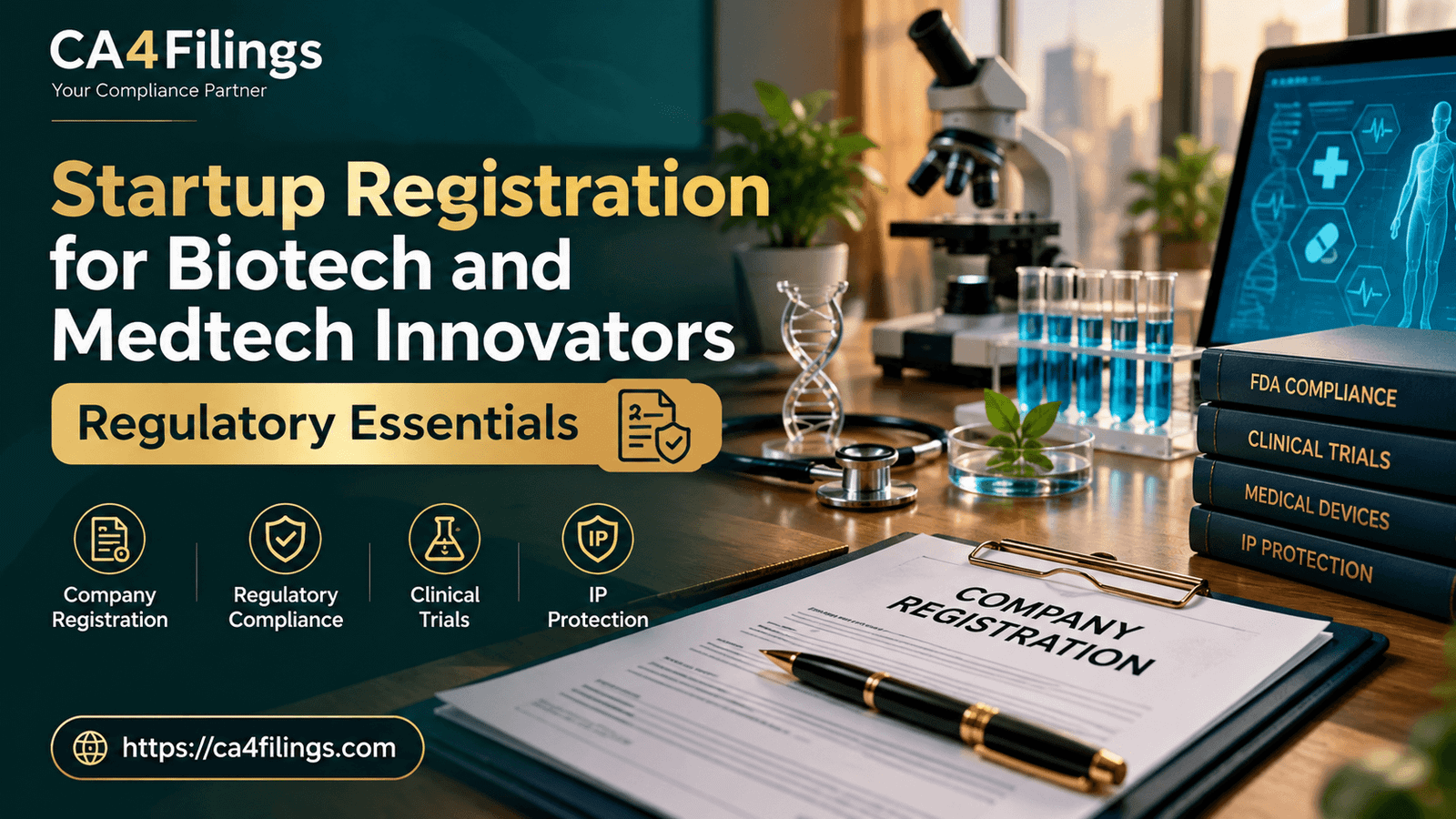
India’s biotech and medtech sectors are attracting founders, researchers, doctors, engineers, and investors who want to turn scientific ideas into commercial solutions. But transforming an innovation into a successful business involves much more than developing a product. Proper startup registration, regulatory planning, intellectual property protection, taxation, and compliance should be considered from the beginning. For founders, completing the right Company Registration can provide a structured legal foundation for raising funds, entering partnerships, and building credibility with customers and investors.
At CA4Filings, we often see innovators focus heavily on technology while treating legal and financial compliance as something to handle later. In regulated sectors such as biotechnology and medical technology, that approach can create unnecessary delays. A well-planned startup registration strategy helps ensure that the business structure, regulatory obligations, ownership, and intellectual property are aligned with the product being developed.
Why Startup Registration Matters for Biotech and Medtech Businesses
A biotech or medtech venture may begin with a laboratory concept, prototype, research project, or medical solution. Once commercialisation begins, however, the founder needs a proper legal entity.
For many startups, a private limited company is considered because it provides a separate legal identity and can be suitable for bringing in investors. Depending on the business model, founders may also evaluate an LLP or other appropriate structure.
The right startup registration structure can help with:
- Opening a business bank account
- Signing contracts with hospitals, laboratories, suppliers, and distributors
- Bringing in co-founders and investors
- Protecting business assets separately from personal assets
- Applying for eligible government schemes and registrations
- Managing equity ownership
- Establishing credibility with customers and strategic partners
For a life sciences startup, choosing the structure should be based on its funding plans, ownership model, regulatory requirements, and long-term commercial objectives.
Startup Registration and Regulatory Planning
Unlike many conventional businesses, biotech and medtech companies can face sector-specific regulations. Incorporation is only the beginning.
A founder should first identify what the business actually does. For example, a company developing diagnostic kits may have very different regulatory obligations from one providing laboratory software. Similarly, a medical device manufacturer can have requirements that do not apply to a healthcare consulting company.
Before completing startup registration, founders should map:
- The product or service being developed.
- Whether it falls under a regulated category.
- The applicable central and state-level authorities.
- Manufacturing, testing, import, or distribution requirements.
- Clinical or laboratory validation requirements.
- Data protection and patient confidentiality obligations.
- Intellectual property considerations.
This early assessment can prevent the company from selecting a business structure or operational model that later becomes difficult to modify.
Medical Device Entity Formation: What Founders Should Consider
Medical device entity formation requires particular attention because the regulatory obligations can depend on the type and intended use of the device.
For example, consider a startup developing a wearable device that monitors health parameters. The founders should not assume that incorporating a company automatically gives them permission to manufacture or market the product. The regulatory position may depend on the device's intended purpose, classification, manufacturing process, claims, and distribution model.
During startup registration, founders should therefore keep their proposed activities accurately described in the company's constitutional documents and registrations.
It is also sensible to maintain proper documentation covering:
- Product specifications
- Testing and validation records
- Supplier information
- Manufacturing processes
- Quality-control procedures
- Product claims and intended use
- Regulatory correspondence
Good documentation is not merely paperwork. It can become valuable evidence when dealing with regulators, investors, auditors, or potential business partners.
FDA Compliance and Indian Regulatory Requirements
Founders sometimes search for “FDA compliance” when planning to sell healthcare products internationally. It is important to understand that FDA requirements generally relate to products intended for the United States market, while products sold in India may be governed by Indian regulatory frameworks.
Therefore, a medtech founder should distinguish between domestic compliance and international market-entry requirements.
For an Indian operation, the applicable requirements may depend on the nature of the product, manufacturing activity, import arrangements, and intended use. If the startup plans to export, additional country-specific requirements should be assessed before entering that market.
A practical approach is to prepare a regulatory checklist covering every market where the company expects to sell its product rather than assuming that one approval works everywhere.
Clinical Trial Legalities for Biotech Innovators
Biotechnology startups working with drugs, diagnostics, therapies, or clinical applications need to pay close attention to clinical trial legalities.
Clinical research can involve multiple stakeholders, including researchers, hospitals, participants, sponsors, laboratories, and regulatory authorities. Ethical approvals, informed consent, documentation, safety monitoring, data handling, and contractual arrangements can all become important.
A startup should establish clear responsibilities before commencing clinical activities. Agreements should ideally address:
- Ownership of research data
- Confidentiality
- Intellectual property rights
- Publication rights
- Participant-related responsibilities
- Safety reporting
- Insurance and indemnity provisions
- Responsibilities of research institutions
The key lesson is simple: do not wait until a clinical project is underway to review the legal framework. Regulatory and contractual planning should happen before significant resources are committed.
IP Protection Should Begin Early
For a biotech or medtech founder, the intellectual property may be one of the company's most valuable assets.
A startup may have developed a novel formulation, device mechanism, software system, laboratory process, brand, design, or technical method. Publicly disclosing certain innovations before appropriate protection is considered can create avoidable complications.
As part of startup registration planning, founders should separately review:
- Patents
- Trademarks
- Copyright
- Designs
- Trade secrets
- Confidentiality agreements
- Employee and consultant IP ownership
For example, if a researcher develops an invention while working with the startup, the company should have appropriate contractual arrangements dealing with ownership and assignment of intellectual property.
IP protection should therefore be treated as a business strategy rather than simply a legal formality.
Startup Registration and Funding Readiness
Investors typically want clarity around ownership, incorporation documents, financial records, intellectual property, contracts, and regulatory status.
A founder who completes startup registration but does not maintain proper records may still face difficulties during due diligence.
Before approaching investors, maintain a basic compliance folder containing:
- Certificate of incorporation
- Constitutional documents
- Founder and shareholder records
- Intellectual property documents
- Material contracts
- Regulatory approvals or applications
- Accounting and tax records
- Employee and consultant agreements
- Board and shareholder resolutions
Keeping these records organised from the beginning can make future fundraising substantially smoother.
Common Mistakes Biotech and Medtech Founders Should Avoid
Many early-stage founders make similar mistakes while concentrating on product development.
1. Incorporating Without a Regulatory Roadmap
The company may be registered correctly but still be unable to commercially launch the product because required approvals were overlooked.
2. Ignoring IP Before Public Disclosure
Presenting technical details at conferences, websites, exhibitions, or investor meetings without considering IP strategy can create problems.
3. Mixing Personal and Business Expenses
Separate banking and accounting records should be maintained from the beginning.
4. Using Generic Agreements
Research collaborations, founder arrangements, employment contracts, and technology licensing agreements should reflect the actual relationship.
5. Treating Compliance as a One-Time Activity
Regulatory obligations can change as the product evolves, new markets are entered, or the company starts manufacturing or exporting.
A Practical Startup Registration Checklist
Before launching a biotech or medtech venture, founders can work through this sequence:
- Define the product, service, and intended market.
- Identify the appropriate legal structure.
- Complete startup registration and obtain the necessary basic registrations.
- Review sector-specific regulatory requirements.
- Create an IP protection strategy.
- Prepare founder, employee, consultant, and collaboration agreements.
- Establish accounting and tax-compliance systems.
- Document testing, validation, and research activities.
- Prepare for future funding and regulatory due diligence.
- Review compliance periodically as the business grows.
This approach helps founders build compliance into the business rather than attempting to fix gaps after commercialisation.
FAQs on Startup Registration for Biotech and Medtech Startups
Is startup registration mandatory for a biotech business?
The appropriate legal registration depends on the business model and structure. However, founders intending to operate commercially, enter contracts, employ people, or raise institutional investment generally need an appropriate legal entity and supporting registrations.
Which company structure is suitable for a medtech startup?
There is no universal answer. A private limited company is commonly considered where founders expect external investment and equity participation, but the appropriate structure should be evaluated according to ownership, funding, operations, and regulatory requirements.
Does company incorporation provide regulatory approval for a medical device?
No. Incorporation establishes the legal entity; it does not automatically authorise the company to manufacture, import, test, or market regulated products.
When should a biotech startup consider IP protection?
Ideally, IP strategy should be considered before publicly disclosing potentially protectable technical information. Founders should obtain professional advice based on the nature of the innovation.
Can CA4Filings help with startup registration?
Yes. CA4Filings can assist founders with company incorporation, documentation, tax and accounting setup, and broader compliance planning while coordinating with appropriate legal or regulatory professionals where specialised approvals are involved.
Plan Startup Registration Before You Scale
For biotech and medtech innovators, startup registration is not simply a formal incorporation exercise. It is the starting point for building a legally organised, investment-ready, and compliance-conscious business.
From medical device entity formation and FDA compliance considerations to clinical trial legalities and IP protection, each decision can influence the company's ability to commercialise its innovation. Planning these requirements early can save time, reduce avoidable compliance risks, and make future fundraising easier.
At CA4Filings, we help entrepreneurs approach startup registration with a practical business perspective. If you are developing a biotech, healthcare, diagnostic, or medtech venture, connect with CA4Filings to get your business structure and compliance roadmap organised from the beginning.
Latest Updates
ca4filings.com Services


























-registration.png)