How to Registration Company Bylaws: Crafting an Ironclad Operating Agreement
Learn how to registration company bylaws, draft an effective operating agreement, define ownership rights, and protect your business with CA4Filings.
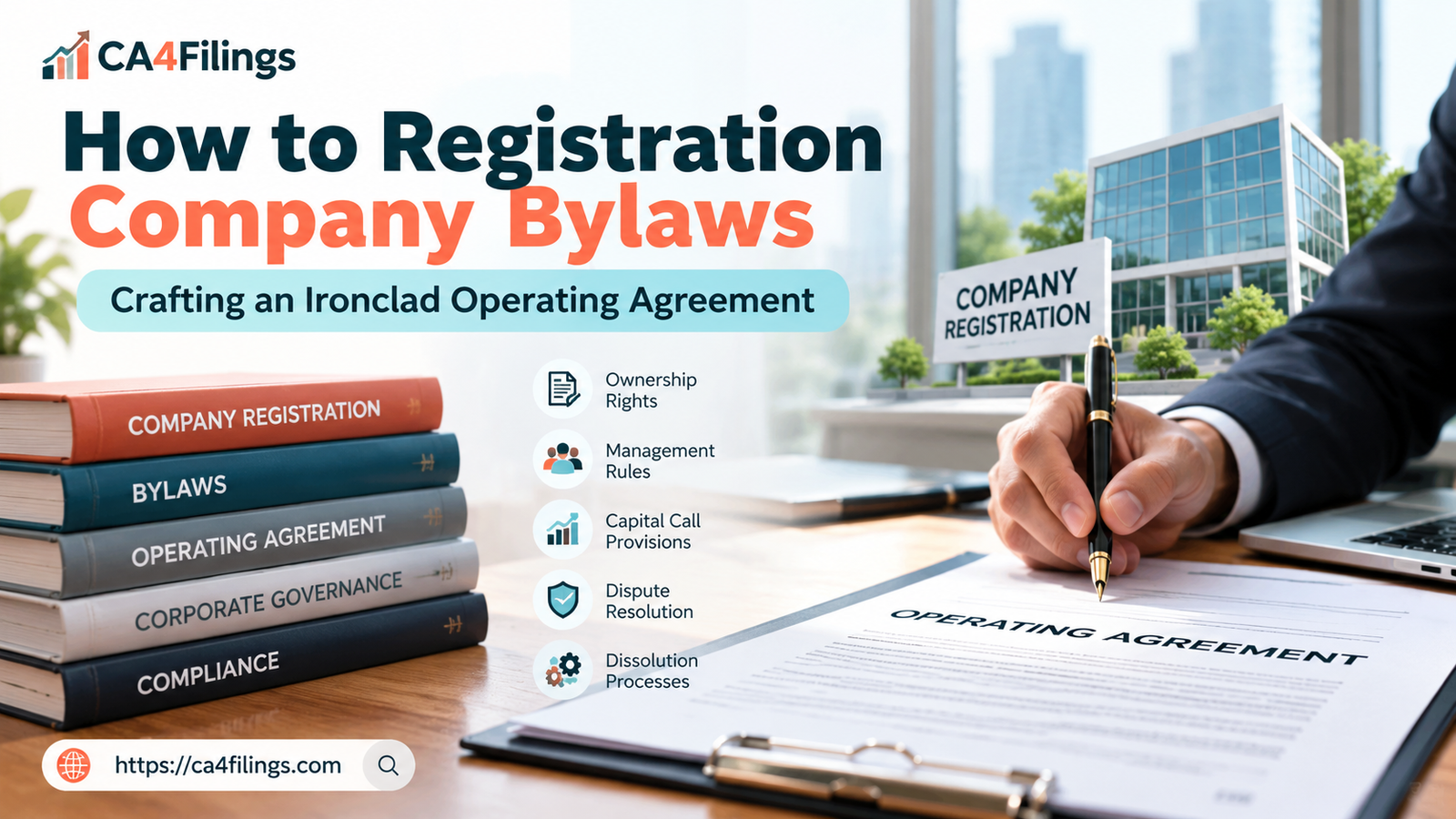
Starting a business involves more than choosing a name and completing legal formalities. Understanding how to registration company procedures work is equally important when establishing clear rules for ownership, decision-making, and daily operations. Whether you are launching a startup, forming a private limited company, or entering a business partnership, having well-drafted governing documents can help prevent misunderstandings and costly disputes.
At CA4Filings, we believe that proper documentation is the foundation of a well-managed business. Along with completing Company Registration, entrepreneurs should understand which constitutional documents apply to their chosen business structure and how these documents protect their interests. In India, companies generally operate under their Memorandum of Association (MOA), Articles of Association (AOA), and applicable provisions of the Companies Act, 2013. An operating agreement, meanwhile, is commonly associated with limited liability companies in jurisdictions such as the United States.
Understanding these distinctions helps business owners prepare the right documents from the beginning.
How to Registration Company: Understanding Bylaws and Operating Agreements
When researching how to registration company requirements, entrepreneurs often come across terms such as bylaws, articles of association, and operating agreements. Although these documents serve similar purposes, their legal application differs depending on the jurisdiction and business structure.
Company bylaws generally establish internal rules covering meetings, director responsibilities, voting procedures, and governance. In India, the AOA performs a comparable role for companies, subject to the Companies Act, 2013.
An operating agreement typically defines the relationship between members of a limited liability company (LLC), including ownership percentages, profit distribution, management responsibilities, and dispute resolution.
For Indian business owners, the key takeaway is simple: choose documents that match your legal structure instead of relying on terminology or templates intended for another country.
Why Are Governing Documents Important?
Clear governing documents provide a practical framework for running a business. Without them, even small disagreements can turn into serious disputes.
Consider two founders who establish a technology startup. One contributes ₹10 lakh, while the other manages daily operations. If they never document their ownership rights, responsibilities, or exit arrangements, disagreements about profits and decision-making may become difficult to resolve.
Well-prepared governing documents help address these risks by establishing:
Ownership rights: Clearly recording shareholding or membership interests.
Management responsibilities: Defining who can make operational and financial decisions.
Profit distribution: Establishing how profits, dividends, or distributions are handled under applicable law.
Dispute resolution: Providing procedures for addressing disagreements.
Exit arrangements: Explaining what happens when an owner retires, transfers an interest, or leaves the business.
When considering how to registration company formalities, entrepreneurs should treat these documents as long-term business safeguards rather than routine paperwork.
How to Registration Company: Essential Clauses to Include
A well-drafted governing document should reflect the company's actual business requirements. The following clauses deserve particular attention.
1. Ownership and Capital Contributions
Record each owner's financial contribution, ownership percentage, and applicable rights. For an Indian company, share ownership and related rights should be reflected in the appropriate statutory records and constitutional documents.
For example, if two founders hold 60% and 40% of a company, their respective rights and responsibilities should be documented consistently across relevant agreements and company records.
2. Corporate Governance Clauses
Effective corporate governance clauses explain how the business will make decisions and exercise authority.
Consider including provisions covering:
Appointment and removal of directors, where applicable.
Board meetings and voting procedures.
Approval of significant contracts and expenditure.
Conflict-of-interest disclosures.
Access to financial statements and business records.
These provisions support transparent internal company management and help reduce uncertainty when important decisions arise.
3. Capital Call Provisions
Capital call provisions explain whether and how owners may be required to contribute additional funds when the business needs more capital.
For example, a startup might require additional funding to purchase equipment or expand its operations. The governing documents should clarify the approval process, contribution obligations, applicable deadlines, and consequences of non-payment.
In India, these arrangements must be structured consistently with the applicable company law, share issuance requirements, and contractual obligations. A provision should not be treated as automatic authority to demand additional share capital without considering the relevant legal requirements.
4. Profit Distribution and Financial Responsibilities
Specify how profits, dividends, and other distributions will be considered and approved. For Indian companies, dividend payments must comply with the Companies Act, 2013, and applicable financial requirements.
It is also advisable to establish financial reporting responsibilities, accounting procedures, and approval limits for business expenses.
5. Dispute Resolution and Transfer of Ownership
Disagreements can arise even between close business associates. Your documents should explain how disputes will be addressed, whether through negotiation, mediation, arbitration, or other legally appropriate procedures.
Ownership transfer provisions should also specify applicable restrictions, approval requirements, and procedures for valuing shares or other interests.
6. Dissolution Processes and Exit Arrangements
Dissolution processes explain how the business will be wound up when continuation is no longer practical or legally possible.
Relevant provisions may address outstanding liabilities, asset distribution, settlement of accounts, and the responsibilities of owners during closure. In India, company winding-up procedures must follow the applicable statutory framework; private contractual terms cannot override mandatory legal requirements.
Step-by-Step Guide to Preparing Your Company Documents
If you are exploring how to registration company documentation should be prepared, follow these practical steps.
Step 1: Identify your business structure. Determine whether you are establishing a private limited company, LLP, partnership, or another entity. Each structure has different legal requirements.
Step 2: Define ownership and responsibilities. Document the founders' contributions, ownership interests, management duties, and decision-making authority.
Step 3: Prepare the required legal documents. For an Indian company, ensure that the MOA and AOA are appropriately drafted and filed. An LLP or partnership may require different agreements.
Step 4: Include practical safeguards. Address funding, voting, financial controls, transfers, disputes, and exit arrangements according to your business needs.
Step 5: Review the documents professionally. A qualified professional can identify inconsistencies, unclear clauses, and potential compliance issues before they become expensive problems.
Step 6: Complete applicable approvals and filings. Follow the relevant incorporation, execution, registration, and record-keeping requirements for your business structure.
Should You Use Standard Templates?
Standard templates can help business owners understand common clauses and organise their initial requirements. However, they should not automatically be treated as legally sufficient.
A template designed for a US LLC, for example, may contain terminology and provisions that do not fit an Indian private limited company.
Before using standard templates, check whether they reflect:
Indian corporate law and your entity type.
Your actual ownership and management arrangements.
Applicable tax, accounting, and reporting requirements.
Relevant dispute resolution and transfer provisions.
At CA4Filings, we recommend adapting documentation to the business rather than changing the business to fit a generic document.
Common Mistakes to Avoid
When preparing governing documents, business owners should avoid these frequent errors:
Copying foreign operating agreements without checking their legal relevance in India.
Leaving ownership contributions or responsibilities unclear.
Ignoring future funding requirements and exit arrangements.
Including conflicting provisions across agreements and constitutional documents.
Failing to update records after changes in ownership or management.
Treating contractual clauses as substitutes for mandatory statutory compliance.
A periodic legal review can help keep your documents aligned with changes in the business and applicable regulations.
Latest Updates
ca4filings.com Services