How to Company Registration Failures Can Result in Personal Liability
Learn how to company registration failures can create personal liability, expose assets, and cause tax issues, with expert guidance from CA4Filings.
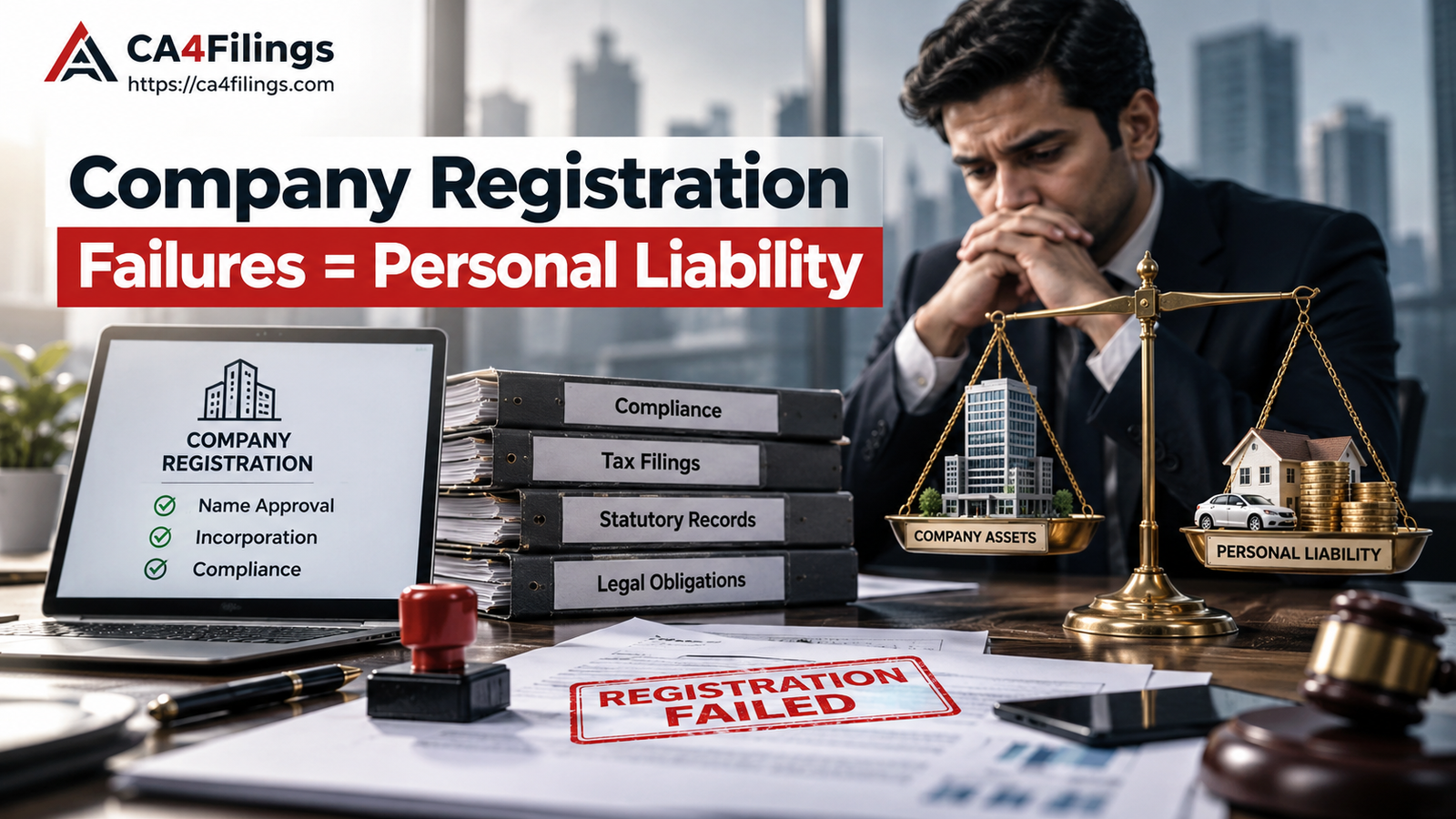
Starting a business is an exciting step, but a small mistake during incorporation can create serious legal and financial problems later. Understanding how to company registration should be approached correctly is essential for entrepreneurs who want to protect their personal assets and establish a legally compliant business. Many founders assume that registering a company automatically protects them from business debts and legal claims. However, this protection depends on proper incorporation, accurate documentation, and ongoing compliance.
At CA4Filings, we regularly emphasise that business owners should understand their legal responsibilities before commencing operations. Professional guidance on Company Registration can help entrepreneurs avoid documentation errors, select a suitable business structure, and meet statutory requirements under Indian law.
When registration is incomplete, information is inaccurate, or legal obligations are ignored, directors and promoters may face unexpected personal liability. Let us explore how these failures happen, why they matter, and what business owners can do to minimise their risks.
How to Company Registration Errors Can Lead to Personal Liability
A company registered under the Companies Act, 2013, generally has a separate legal identity from its shareholders. This means the company can own property, enter into contracts, and incur debts in its own name. Shareholders generally enjoy limited liability, subject to applicable legal exceptions.
However, this protection is not absolute. Mistakes during incorporation or improper conduct afterwards can expose individuals to financial and legal consequences.
Common registration-related failures include:
Incorrect incorporation details: Providing inaccurate information about directors, shareholders, or the registered office can result in regulatory action.
Defective documentation: Incomplete or inconsistent incorporation documents may delay registration or create legal disputes.
Misrepresentation: Knowingly submitting false declarations can expose responsible individuals to penalties and other legal consequences.
Operating without proper authorisation: Conducting activities without mandatory licences or approvals may create personal exposure under applicable laws.
Ignoring statutory requirements: Failure to complete required filings, maintain records, or meet compliance obligations can lead to penalties.
Understanding how to company registration works is therefore about more than obtaining a Certificate of Incorporation. It also involves establishing a legally sound foundation for business operations.
Major Registration Failures That Can Expose Your Personal Assets
1. Incorrect Information During Incorporation
During incorporation, promoters must provide accurate information and submit the prescribed documents through the Ministry of Corporate Affairs (MCA) system.
Errors in director details, registered office information, shareholding arrangements, or declarations can create compliance issues. Deliberately submitting false information is particularly serious.
Practical example: Suppose a founder knowingly provides incorrect information about a proposed director to complete incorporation faster. If the misrepresentation is discovered, the individuals responsible may face legal consequences depending on the circumstances.
The best approach is to verify every declaration and supporting document before submission.
2. Entering Contracts Before Incorporation
A proposed company does not automatically have the same legal status as an incorporated company. Contracts signed by promoters before incorporation may create personal obligations, depending on the contract, the applicable law, and whether the company subsequently adopts or replaces those arrangements through legally effective documentation.
For example, an entrepreneur might sign an office lease in the proposed company's name before receiving the Certificate of Incorporation. If the agreement makes the promoter personally responsible, the landlord may pursue the promoter for unpaid rent.
To reduce this risk:
Confirm that incorporation is complete before entering ordinary company contracts.
Identify the correct contracting party in every agreement.
Clearly document who bears liability for pre-incorporation expenses.
Obtain appropriate legal advice for agreements signed before incorporation.
3. Ignoring Post-Incorporation Compliance
Understanding how to company registration also means recognising that legal responsibilities continue after incorporation.
Depending on the company's circumstances, important obligations may include:
Filing the declaration for commencement of business under Section 10A, where applicable.
Holding required board and shareholder meetings.
Maintaining statutory registers and accounting records.
Filing annual returns and financial statements with the MCA.
Meeting applicable income tax, GST, TDS, and other regulatory requirements.
Failure to comply can result in additional fees, penalties, and proceedings against the company or responsible officers where the law provides for them.
Regular compliance tracking helps businesses identify deadlines early and avoid preventable defaults.
Corporate Negligence and the Risk of Losing Limited Liability
Corporate negligence occurs when those managing a business fail to exercise the care, diligence, or legal responsibility expected of them. Poor record-keeping, misleading financial statements, misuse of company funds, and repeated statutory defaults can create significant legal exposure.
However, a compliance mistake does not automatically make every director or shareholder personally responsible for all company debts. Liability depends on the relevant legal provision, the person's role, their conduct, and the facts of the case.
Understanding the Alter Ego Doctrine
The alter ego doctrine is a legal concept under which a court may, in appropriate circumstances, look beyond a company's separate identity when it has been used as an instrument for improper conduct.
For example, a promoter might use a company to conceal personal transactions, divert company money for private use, or mislead creditors. Depending on the evidence and applicable law, a court may consider whether the corporate structure has been misused and whether personal liability or other remedies are justified.
This is closely related to the broader concept of lifting or piercing the corporate veil. It is not an automatic consequence of poor management or registration errors; the relevant legal grounds must be established.
Business owners should therefore maintain separate bank accounts, preserve transaction records, and avoid mixing personal and corporate finances.
Unpaid Corporate Taxes and Personal Asset Risk
Tax defaults can create another source of liability. Unpaid corporate taxes may lead to interest, penalties, recovery proceedings, and other consequences under the applicable tax legislation.
Although the company is ordinarily responsible for its own tax liabilities, certain laws provide specific circumstances in which directors or other responsible individuals may face personal consequences.
For instance, Section 179 of the Income-tax Act, 1961, contains provisions concerning the recovery of certain tax dues from directors of a private company when the statutory conditions are satisfied. Other provisions may apply to tax deducted at source, GST compliance, fraud, or other defaults, depending on the circumstances.
This makes it important to:
Reconcile tax records with accounting books regularly.
Deposit TDS and GST amounts within the applicable deadlines.
File income tax and GST returns accurately and on time.
Investigate tax notices promptly.
Maintain evidence of payments and filed returns.
Taking action early is generally more effective than waiting until a demand escalates into recovery proceedings.
How to Company Registration Correctly and Reduce Liability Risks
A structured approach can prevent many avoidable problems. Here are practical steps business owners should follow.
Step 1: Choose the Appropriate Business Structure
Evaluate whether a private limited company, LLP, partnership, or another structure suits your business goals. Consider ownership, funding requirements, compliance costs, and liability exposure.
Step 2: Verify Documents Before Submission
Check identity documents, address proofs, director details, proposed company names, and declarations carefully. Resolve inconsistencies before filing incorporation forms.
Step 3: Obtain Applicable Registrations and Approvals
Identify additional requirements based on your business activities, including GST registration, professional tax, industry-specific licences, and other applicable approvals.
Step 4: Establish an Internal Compliance Calendar
Create a schedule for MCA filings, tax payments, board meetings, financial reporting, and licence renewals. Assign responsibility for each obligation and review completion regularly.
Step 5: Maintain Clear Financial Separation
Use company bank accounts for business transactions, maintain accurate books, document director reimbursements, and avoid using company funds for unexplained personal expenses.
Step 6: Seek Professional Review
A qualified Chartered Accountant or company law professional can review your incorporation documents, identify compliance gaps, and recommend corrective action before issues become more serious.
Latest Updates
ca4filings.com Services

































