Deep Tech and SpaceTech: Leveraging the Extended Window of Startup India Registration
Explore startup india registration for DeepTech and SpaceTech ventures, extended eligibility windows, funding opportunities and compliance tips.
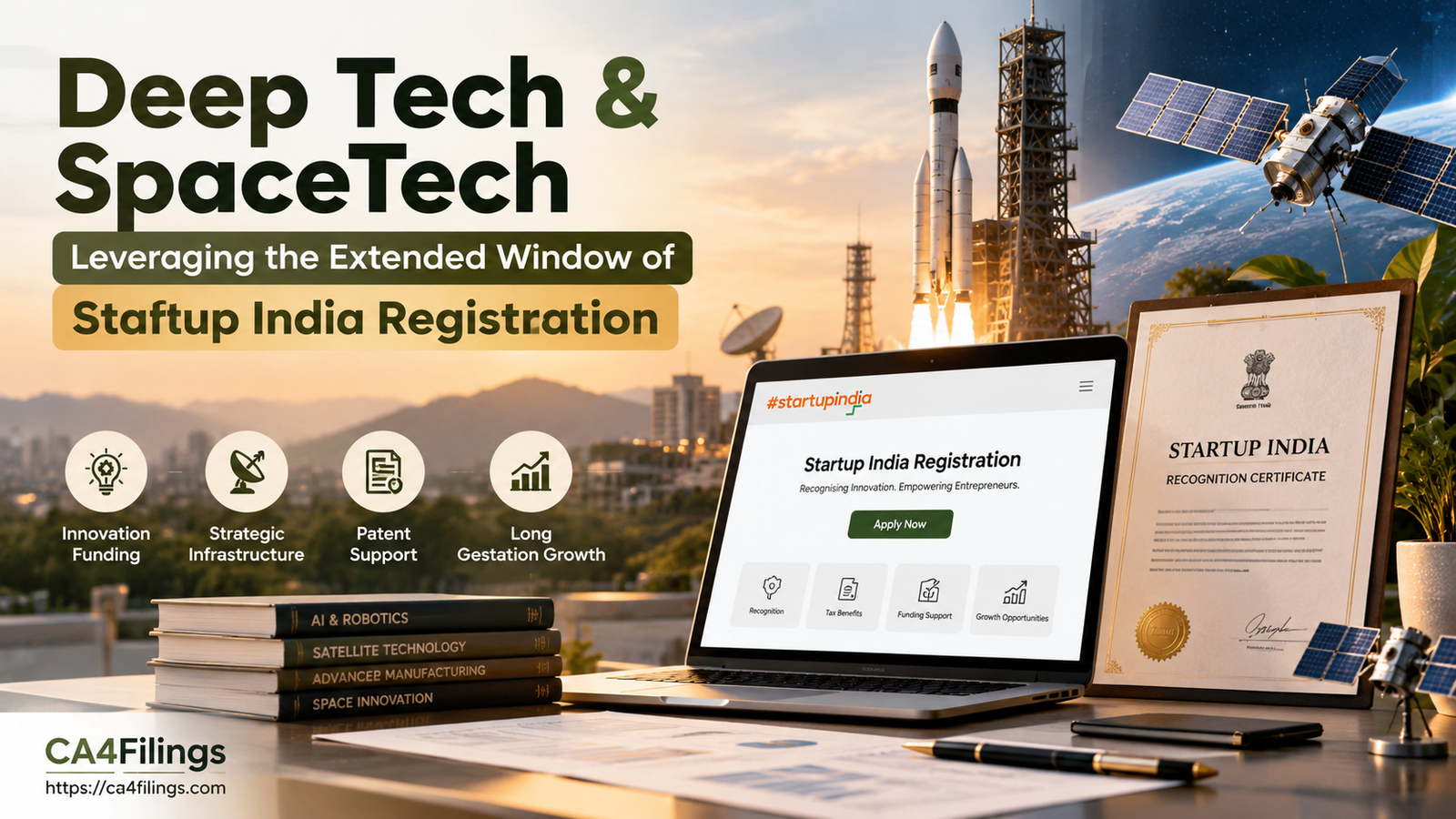
India's DeepTech and SpaceTech ecosystem is entering an exciting phase, with innovation in artificial intelligence, robotics, semiconductors, satellite technology and advanced materials creating new business opportunities. However, these ventures often require years of research, expensive testing and substantial capital before generating commercial revenue. This is where startup india registration becomes an important consideration for eligible founders seeking government-backed recognition and access to startup support.
Unlike conventional businesses, technology-intensive startups may spend several years developing a working prototype before they can approach customers. An extended eligibility window, where applicable under the relevant government rules, can provide these ventures with more time to build their technology and establish commercial viability. Founders should also establish the right legal structure through Company Registration before pursuing recognition and funding opportunities.
At CA4Filings, we believe founders should treat startup recognition as part of a broader business strategy rather than simply a registration exercise. Understanding eligibility, intellectual property, funding requirements and regulatory compliance early can help DeepTech and SpaceTech entrepreneurs build sustainable businesses.
Understanding Startup India Registration for DeepTech and SpaceTech
Startup India is a Government of India initiative designed to encourage innovation, entrepreneurship and scalable business development. Eligible businesses can apply for recognition through the Department for Promotion of Industry and Internal Trade (DPIIT), subject to the applicable rules.
For DeepTech and SpaceTech ventures, the process deserves particular attention because their development cycles differ considerably from those of traditional startups.
What Makes DeepTech Startups Different?
DeepTech businesses generally develop products or services based on substantial scientific or engineering innovation. Examples include:
Artificial intelligence systems for industrial automation.
Semiconductor chips and advanced computing technologies.
Robotics, precision engineering and advanced manufacturing.
Biotechnology, quantum computing and new materials.
Patent-intensive systems designed for specialised commercial applications.
These businesses often require a multi-year validation roadmap covering research, prototype development, laboratory testing, field trials, certification and commercial deployment.
Why SpaceTech Needs a Different Approach
SpaceTech ventures face additional challenges, including satellite development costs, launch dependencies, stringent technical requirements and long procurement cycles.
For example, a startup developing an earth-observation satellite may need several years to validate its sensors, establish data-processing capabilities and demonstrate the reliability of its technology. Revenue may arrive much later than the initial investment.
A suitable startup recognition strategy can help founders explore eligible support mechanisms while they work towards commercial readiness.
How the Extended Window Can Benefit DeepTech Founders
The term "extended window" should be understood in the context of the specific eligibility rules and government notifications applicable to a startup. Founders must not assume that every DeepTech or SpaceTech venture automatically receives an extended registration period.
Where a longer eligibility period or a specific DeepTech framework applies, it may provide meaningful advantages.
1. More Time to Validate Technology
Scientific innovation cannot always follow conventional business timelines. Hardware testing, research failures and redesigns can delay product launches.
An extended window, where officially available, can help qualifying ventures plan their milestones without assuming that commercial revenue must begin immediately.
2. Better Access to Relevant Funding
Eligible startups may explore government research grants, innovation programmes, incubator support and other funding opportunities, depending on the scheme's criteria.
DeepTech founders should distinguish between grants, equity investments, loans and procurement contracts. Each has different eligibility conditions, reporting requirements and financial implications.
3. Support for Intellectual Property Development
Patent-intensive systems can require considerable expenditure on research, documentation, testing and intellectual property protection. Startup recognition may help eligible businesses explore applicable intellectual property support programmes.
Founders should maintain proper records of invention disclosures, patent applications, research expenditure and ownership rights.
4. Greater Scope for Strategic Partnerships
SpaceTech and DeepTech companies often collaborate with universities, research institutions, manufacturers and government organisations. Recognition can strengthen a startup's profile when applying for certain programmes, although it does not guarantee contracts or partnerships.
Building a Multi-Year Validation Roadmap
A structured development plan is essential when pursuing startup india registration for a technology-intensive business. It helps founders demonstrate that their venture is working towards measurable outcomes rather than conducting open-ended research.
A practical roadmap may include the following stages:
Stage 1: Research and feasibility
Define the technical problem, conduct feasibility studies and identify the proposed innovation. Assess whether existing solutions already address the same requirement.
Stage 2: Prototype development
Build a proof of concept and document technical performance. Estimate the costs of materials, equipment, specialist staff and testing.
Stage 3: Validation and testing
Conduct laboratory assessments, field trials and reliability testing. For space-related products, account for launch schedules, payload integration and mission-specific approvals wherever relevant.
Stage 4: Intellectual property and compliance
Review patentability, ownership of research outputs, contractual obligations and applicable regulatory permissions. Establish a clear record of intellectual property created by employees, founders and external collaborators.
Stage 5: Commercialisation
Identify prospective customers, pricing models, manufacturing partners and realistic revenue milestones. Government procurement may be an opportunity, but founders should not rely on it as their only route to market.
This roadmap also provides useful evidence when applying for funding or explaining the business's progress to investors.
Funding DeepTech and SpaceTech: What Founders Should Know
One of the biggest challenges in advanced technology is arranging long gestation funding. Conventional investors may expect quicker commercial returns, while scientific development often requires sustained investment before a product becomes market-ready.
Founders should evaluate a combination of funding sources.
Government Research Grants
Research grants may help finance eligible research, prototype development or technology validation. Applicants must review the scheme's purpose, eligible costs, milestones, documentation and reporting requirements before applying.
Incubators and Innovation Programmes
Recognised incubators and specialist research centres may provide laboratory access, mentorship, technical infrastructure and connections to potential funders.
Private Investment and Strategic Partnerships
Venture capital, angel investment and corporate partnerships can support growth where the technology has a credible commercial opportunity. However, founders should understand dilution, governance conditions, investor rights and milestone-linked funding terms before accepting capital.
Strategic Infrastructure
DeepTech businesses may require testing facilities, specialised equipment, secure computing environments or access to research laboratories. Partnerships that provide such strategic infrastructure can reduce upfront capital requirements.
CA4Filings recommends preparing a detailed financial forecast that separates research expenditure, capital expenditure, operating costs and expected funding inflows. This helps founders estimate their cash runway and avoid funding gaps during critical testing stages.
Step-by-Step Process for Startup India Registration
Although the precise requirements depend on the applicable framework, founders can prepare through the following steps.
Establish the eligible business structure: Confirm that the entity falls within an eligible category, such as a private limited company, registered partnership firm or limited liability partnership, as applicable under current rules.
Review the eligibility criteria: Check the latest DPIIT recognition requirements, including applicable incorporation-age limits, turnover conditions and innovation or scalability criteria.
Organise business documents: Keep incorporation records, PAN details, founder information and a concise business description ready. Additional documents may be requested under the current process.
Explain the innovation clearly: Describe the technical problem, proposed solution, competitive advantage, development stage and commercial potential. Support claims with relevant evidence.
Submit the application through the official process: Use the current government portal and follow its instructions for startup recognition.
Maintain ongoing compliance: Keep statutory filings, accounting records, intellectual property documentation and funding records updated. Apply separately for any tax benefits or government schemes for which the business qualifies.
Approval is subject to government assessment. Registration or recognition alone does not guarantee a grant, tax exemption, investment or procurement opportunity.
Common Mistakes Founders Should Avoid
DeepTech entrepreneurs can reduce delays and compliance risks by avoiding these mistakes:
Assuming that all startups automatically qualify for an extended window.
Describing a conventional business as DeepTech without demonstrating genuine innovation.
Overlooking intellectual property ownership agreements.
Depending entirely on grants without a backup funding plan.
Ignoring annual filings and other statutory obligations.
Confusing DPIIT recognition with eligibility for separate tax incentives or funding schemes.
Before applying, founders should verify the latest government notifications rather than relying solely on older articles or informal advice.
Latest Updates
ca4filings.com Services

































