The Basics of Sole Proprietorship Registration: A Step-by-Step Guide
Master The Basics of Sole Proprietorship Registration: A Step-by-Step Guide to legally launch your business in India with CA4Filings.
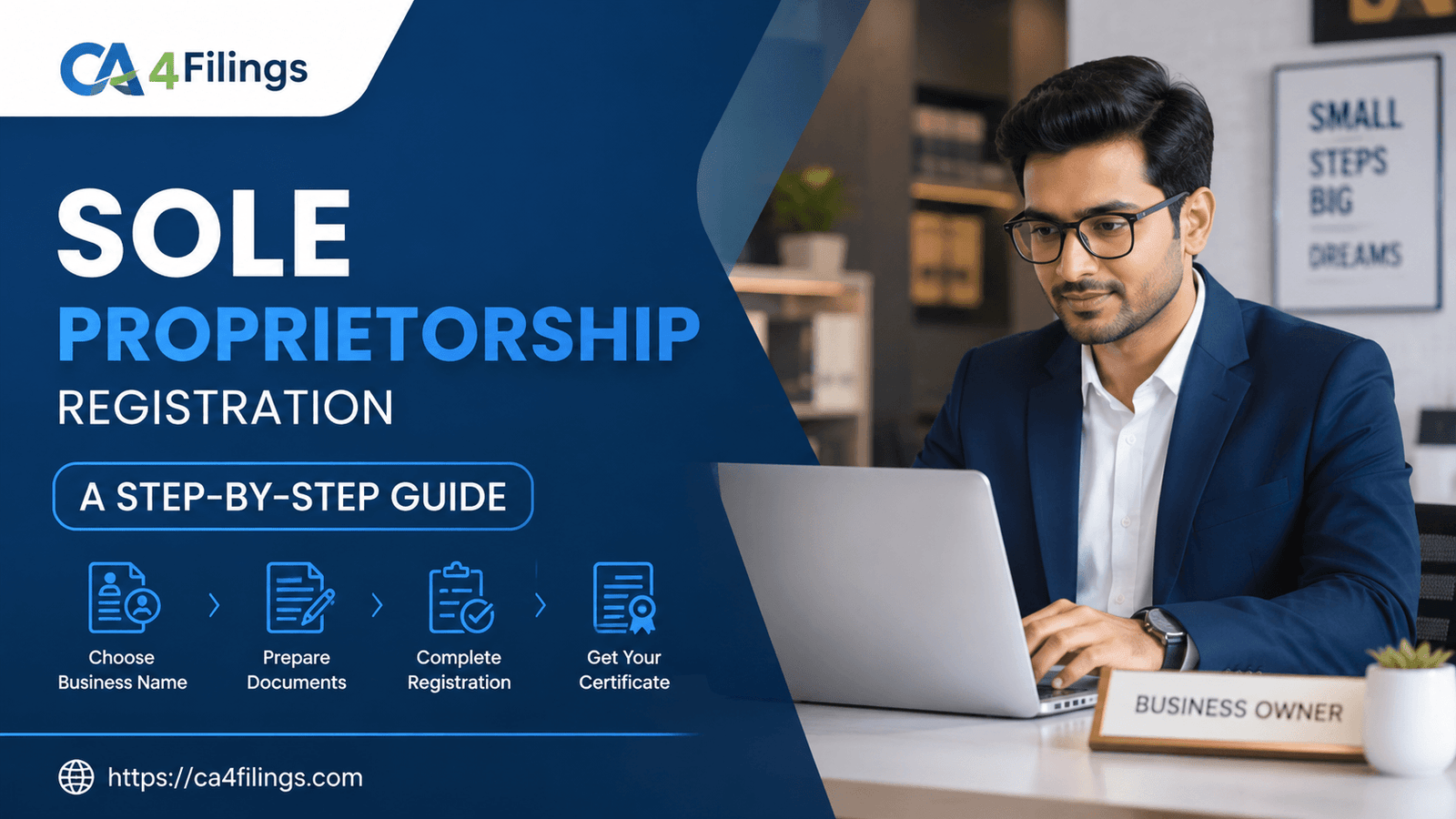
Starting your own business is an exhilarating journey. Every week at CA4Filings, we meet passionate individuals—freelancers, local retailers, and tech consultants—who are eager to turn their ideas into reality. When you are taking your first steps into entrepreneurship, you want a structure that is simple, low-cost, and entirely under your control. That is exactly why understanding The Basics of Sole Proprietorship Registration: A Step-by-Step Guide is the perfect starting point for your business start-up. It is the easiest way to transform from an individual with an idea into a legitimate business owner.
In India, a sole proprietorship business is the most popular form of business organization. Why? Because it requires minimal compliance and gives you absolute ownership of your profits. However, a common point of confusion for many beginners is that there is no single, centralized "proprietorship act" in India. Instead, establishing your firm involves getting specific government registrations depending on the nature of your business. To help you navigate this effortlessly, we have put together this definitive start-up guide so you can master the business registration process without any legal headaches. If you want to skip the paperwork entirely, you can opt for professional help with your Sole Proprietorship Registration through CA4Filings to get up and running smoothly.
Understanding the Sole Proprietorship Basics
Before diving into the registration steps, let's look at the core traits of starting a sole proprietorship. In the eyes of the law, a sole proprietorship business and its owner are considered a single legal entity.
This brings both benefits and responsibilities:
Total Control: You make 100% of the decisions and keep 100% of the profits.
Unlimited Liability: Because you and the business are one, your personal assets can be used to clear business debts if things go wrong.
Simple Taxation: The business income is treated as your personal income. You file taxes using your personal PAN card under standard individual income tax slabs.
The Basics of Sole Proprietorship Registration: A Step-by-Step Guide
Setting up your enterprise does not have to be overwhelming. Let’s break down the exact path to legally running a sole proprietorship in India.
Step 1: Strategic Business Name Selection
The very first step in your journey is business name selection. Since a proprietorship does not have a separate legal identity, you can choose almost any name you like, provided it does not infringe on existing trademarks.
Expert CA Tip: Choosing a name like "Infosys Consulting" will get you into legal trouble. Pick something unique that reflects your brand. Also, remember that a fancy name doesn't mean a separate legal entity; your personal name will still be tied to all official financial liabilities.
Step 2: Collecting Essential KYC Documents
You cannot register a business without proof. As a business owner, you need to gather your personal and business address documents. You will need:
The owner’s PAN Card and Aadhaar Card.
A recent passport-sized photograph.
Proof of business address (Electricity bill, property tax receipt, or a rent agreement along with a No Objection Certificate from the landlord).
Step 3: Obtaining Mandatory Business Licenses and Permits
Because there is no standalone certificate called a "Proprietorship Certificate," you establish your business by obtaining various government registrations. To satisfy banks for opening a current account, you generally need at least two of the following permits for sole proprietorship:
Udyam Registration (MSME): This is a free, digital registration provided by the Ministry of Micro, Small, and Medium Enterprises. It acts as an excellent proof of business existence and unlocks various government schemes and cheaper bank loan rates.
Shop and Establishment Act License: Issued by your local municipal authority, this is mandatory for physical shops, godowns, or commercial offices.
GST Registration: If your annual turnover exceeds ₹40 Lakhs (₹20 Lakhs for services) or if you engage in e-commerce and interstate sales, getting a GSTIN is mandatory.
Step 4: Opening a Dedicated Business Bank Account
Never mix personal and business funds. Once you receive your sole proprietorship permits, take your MSME registration, GST certificate, or Shop Act license to a bank to open a Current Account under your business name. This keeps your bookkeeping clean and makes tax filing seamless.
Comparing Your Licensing Options
Depending on your specific industry, you will need different business licenses. Here is a quick reference table to help you identify what applies to your small business registration.
| License / Registration | Who Needs It? | Primary Benefit |
|---|---|---|
| Udyam (MSME) Registration | All micro and small businesses | Easier access to bank credits, government tenders, and subsidies. |
| GST Registration | Businesses crossing turnover thresholds or doing interstate trade | Allows you to collect GST from customers and claim Input Tax Credit. |
| Shop & Establishment License | Anyone operating a physical commercial workspace or retail outlet | Ensures compliance with local municipal labor and operating hours laws. |
| FSSAI License | Restaurants, cloud kitchens, bakeries, and food traders | Mandatory compliance for health and food safety standards. |
Common Pitfalls to Avoid for Business Owners
While starting a sole proprietorship is highly accessible, we frequently see new entrepreneurs make avoidable mistakes. First, ignoring local compliance can lead to unexpected fines. Ensure you check if your local municipality requires specific sole proprietorship permits for your line of work.
Second, failing to register for GST early can hurt your growth. Even if your turnover is below the legal limit, voluntary GST registration allows you to deal with larger corporate clients who strictly demand tax invoices.
Frequently Asked Questions
1. Is it mandatory to register a sole proprietorship in India?
Legally, there is no single mandatory registration for a proprietorship. However, practically speaking, you must register under statutory authorities (like MSME or GST) because banks will not open a business current account without official registration certificates.
2. Can I convert my sole proprietorship into a Private Limited Company later?
Yes, absolutely. As your business grows, your turnover increases, and you look to raise external funding, you can smoothly transition your firm into a Limited Liability Partnership (LLP) or a Private Limited Company.
3. How long does the business registration process take?
If your documentation is perfectly in order, basic registrations like Udyam (MSME) and GST can be completed within 3 to 7 working days.
4. What are the tax benefits of running a sole proprietorship?
There is no separate corporate tax rate for a proprietorship. You are taxed based on individual income tax slabs. Furthermore, you can claim business expenses like rent, internet, fuel, and depreciation to lower your taxable income.
Take Action with CA4Filings
Understanding The Basics of Sole Proprietorship Registration: A Step-by-Step Guide empowers you to take charge of your entrepreneurial destiny securely and legally. By following this step-by-step guide, you secure the right permits for sole proprietorship, establish a clean financial footprint, and position your brand for sustainable growth.
While the process is straightforward, dealing with government portals, choosing the correct business codes, and ensuring error-free submissions can take up valuable time that you should be spending on building your brand. Let our team of expert Chartered Accountants handle the legal legwork for you. Contact CA4Filings today, and let's get your business officially registered and ready for success!
Latest Updates
ca4filings.com Services




















-registration.png)