Understanding the Process for ROC Registration of Charges
Understanding the Process for ROC Registration of Charges in India, including forms, timelines, penalties, and compliance requirements.
For companies raising funds through loans or secured borrowings, understanding the legal formalities attached to such transactions is extremely important. One of the most critical compliance requirements under the Companies Act, 2013 is Understanding the Process for ROC Registration of Charges. Many business owners focus only on obtaining finance and often overlook the mandatory filing requirements with the Registrar of Companies (ROC).
At CA4Filings, we regularly guide startups, private limited companies, and growing businesses through ROC-related compliances to help them avoid unnecessary penalties and legal complications. Whether a company takes a loan from a bank, financial institution, or even creates security against its assets, charge registration becomes mandatory in most cases. Businesses already using our ROC Compliance Service often seek clarity on charge filing procedures because even a small delay can lead to additional fees and compliance issues.
In this article, we will simplify Understanding the Process for ROC Registration of Charges, explain applicable forms, timelines, penalties, and practical compliance tips for Indian companies.
What is ROC Registration of Charges?
Before fully Understanding the Process for ROC Registration of Charges, it is important to understand what a “charge” means under company law.
A charge refers to a security created by a company on its assets or property in favor of a lender or creditor. This security acts as protection for the lender against the loan provided to the company.
Common Examples of Charges
A company may create a charge in situations such as:
- Bank loan against factory premises
- Working capital loan secured by inventory
- Loan against machinery
- Hypothecation of receivables
- Mortgage on company-owned property
Once such a charge is created, the company must register it with the ROC within the prescribed timeline.
Why is ROC Registration of Charges Important?
One of the key aspects of Understanding the Process for ROC Registration of Charges is knowing why this compliance matters.
Legal Recognition
ROC registration provides legal recognition to the lender’s security interest over company assets.
Transparency
It ensures transparency for stakeholders, investors, and creditors by making the company’s liabilities publicly available.
Protection for Lenders
In case of default or winding up, registered charges protect the lender’s rights over secured assets.
Avoidance of Penalties
Failure to register charges can result in heavy additional fees and penalties under the Companies Act, 2013.
Types of Charges Under the Companies Act
While Understanding the Process for ROC Registration of Charges, companies should know the different types of charges commonly registered.
Fixed Charge
A fixed charge is created on specific identifiable assets such as:
- Land
- Building
- Machinery
- Vehicles
The company cannot sell or dispose of these assets without lender approval.
Floating Charge
A floating charge is created on fluctuating assets such as:
- Stock
- Inventory
- Debtors
- Current assets
The company can continue using these assets in normal business operations until the charge crystallizes.
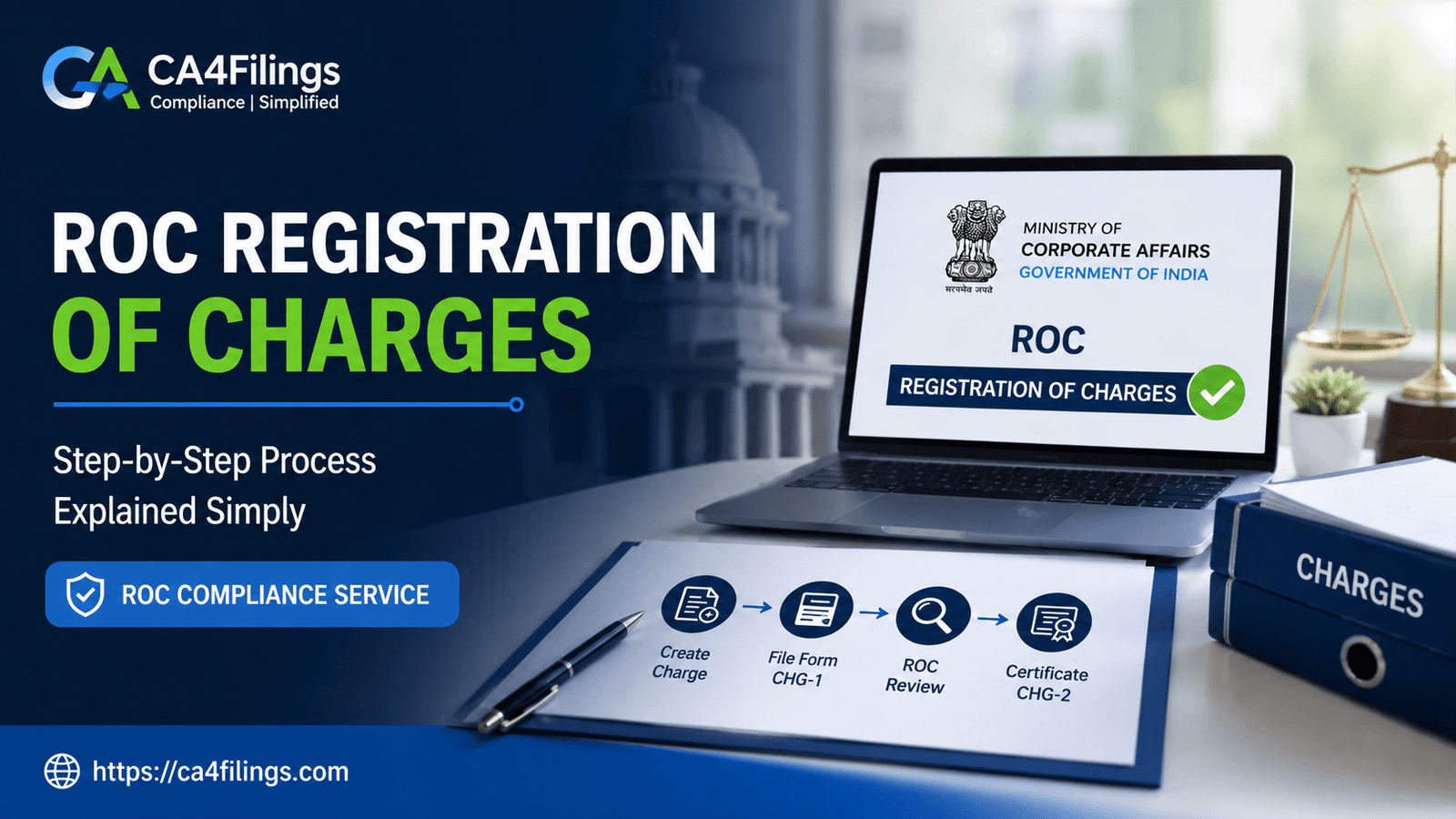
Understanding the Process for ROC Registration of Charges Step by Step
Now let us discuss the actual process involved in detail.
Step 1: Creation of Charge
The process begins when a company enters into a loan agreement or security arrangement with a lender.
Documents Generally Required
- Loan agreement
- Sanction letter
- Deed of hypothecation
- Mortgage deed
- Board resolution
- Details of secured assets
The date of execution becomes the “date of charge creation.”
Step 2: Filing Form CHG-1 or CHG-9
An important part of Understanding the Process for ROC Registration of Charges is selecting the correct ROC form.
Form CHG-1
Filed for:
- Hypothecation
- Mortgage
- Security other than debentures
Form CHG-9
Filed specifically for:
- Debentures
- Debenture-related charges
The form must be digitally signed and submitted on the MCA portal.
Step 3: Payment of ROC Fees
After filing the relevant form, the company must pay prescribed ROC fees based on:
- Authorized capital
- Delay period, if any
Additional fees apply for delayed filings.
Step 4: Verification by ROC
The ROC examines the documents and verifies:
- Accuracy of details
- Validity of security documents
- Compliance with legal requirements
If clarification is required, resubmission may be requested.
Step 5: Certificate of Registration of Charge
Once approved, ROC issues:
Certificate in Form CHG-2
This certificate acts as official proof of charge registration.
This completes the legal process of charge registration.
Time Limit for ROC Registration of Charges
While Understanding the Process for ROC Registration of Charges, timelines are extremely important.
Normal Timeline
A company should register the charge within:
- 30 days from the date of creation
Extended Timeline
If delayed, registration may still be allowed with additional fees and approvals within prescribed extended periods.
However, excessive delay can complicate the process and increase compliance costs significantly.
Consequences of Non-Registration of Charges
Many companies underestimate the seriousness of this compliance.
Charge Becomes Void Against Liquidator
If not registered, the charge may become invalid against:
- Liquidator
- Creditors
Penalties and Additional Fees
The company and officers may face financial penalties.
Difficulty in Future Borrowings
Banks and financial institutions may hesitate to provide future funding.
Poor Compliance Record
Non-compliance affects the company’s overall ROC compliance status.
Modification of Charges
Another important part of Understanding the Process for ROC Registration of Charges is modification filing.
Whenever terms of the loan change, such as:
- Increase in borrowing limit
- Change in security
- Revised repayment terms
the company must file:
Form CHG-1 for Modification
This ensures ROC records remain updated.
Satisfaction of Charges
Once the loan is fully repaid, the charge must be closed officially.
Form CHG-4
This form is filed for satisfaction of charge.
Timeline
The company must file satisfaction within:
- 30 days from repayment
Failure to close satisfied charges may create issues during:
- Due diligence
- Investment rounds
- Future borrowings
Practical Example for Better Understanding
Suppose ABC Private Limited takes a secured loan of ₹50 lakhs from a bank against machinery.
The company creates a hypothecation agreement on 1st June 2026.
To complete compliance:
- Board resolution is passed
- Form CHG-1 is prepared
- Loan documents are attached
- Filing is completed within 30 days
- ROC issues CHG-2 certificate
This is a practical example of Understanding the Process for ROC Registration of Charges in real business situations.
Common Mistakes Companies Should Avoid
At CA4Filings, we often notice businesses making these mistakes:
Delayed Filing
Many companies forget the strict filing timeline.
Incorrect Asset Description
Improper details of secured assets may lead to resubmission.
Wrong Form Selection
Using incorrect forms creates unnecessary delays.
Ignoring Satisfaction Filing
Companies often repay loans but fail to file CHG-4.
Incomplete Documentation
Missing agreements or unsigned documents may result in rejection.
Expert Tips from CA4Filings
When Understanding the Process for ROC Registration of Charges, businesses should adopt a proactive compliance approach.
Maintain Proper Documentation
Always preserve:
- Loan agreements
- Security deeds
- ROC acknowledgments
Track Compliance Deadlines
Use compliance calendars to avoid missing timelines.
Seek Professional Guidance
ROC filings involve technical legal and procedural requirements. Professional support reduces the risk of rejection or penalties.
Regular Compliance Review
Conduct periodic compliance checks to ensure all charges are properly updated and satisfied.
FAQs on Understanding the Process for ROC Registration of Charges
Is charge registration mandatory for all loans?
No. It is generally required when a loan is secured against company assets or property.
Which form is used for charge registration?
Form CHG-1 is commonly used for most secured charges, while CHG-9 is used for debenture-related charges.
What happens if a company misses the filing deadline?
Delayed filing attracts additional fees and may require condonation procedures in certain cases.
Can a company modify an already registered charge?
Yes. Any modification in terms or security must be filed with ROC through appropriate forms.
Is charge satisfaction filing compulsory after loan repayment?
Yes. Companies must file Form CHG-4 after repayment to officially close the charge.
For every company involved in secured borrowing, Understanding the Process for ROC Registration of Charges is essential for maintaining proper legal and financial compliance. Timely registration not only protects lenders but also strengthens the company’s credibility and compliance standing.
Ignoring ROC charge compliance can lead to penalties, legal complications, and financing difficulties in the future. Proper documentation, timely filings, and professional guidance can make the entire process smooth and hassle-free.
At CA4Filings, our experienced professionals help businesses manage ROC filings accurately and efficiently. Whether you need assistance with charge registration, modification, satisfaction, or overall corporate compliance, our team is ready to support your business at every stage.
Latest Updates
ca4filings.com Services




























-registration.png)