Understanding the Audit Requirements for Public Limited Companies
Understanding the Audit Requirements for Public Limited Companies in India, including statutory audits, compliance rules, penalties, and filing obligations.
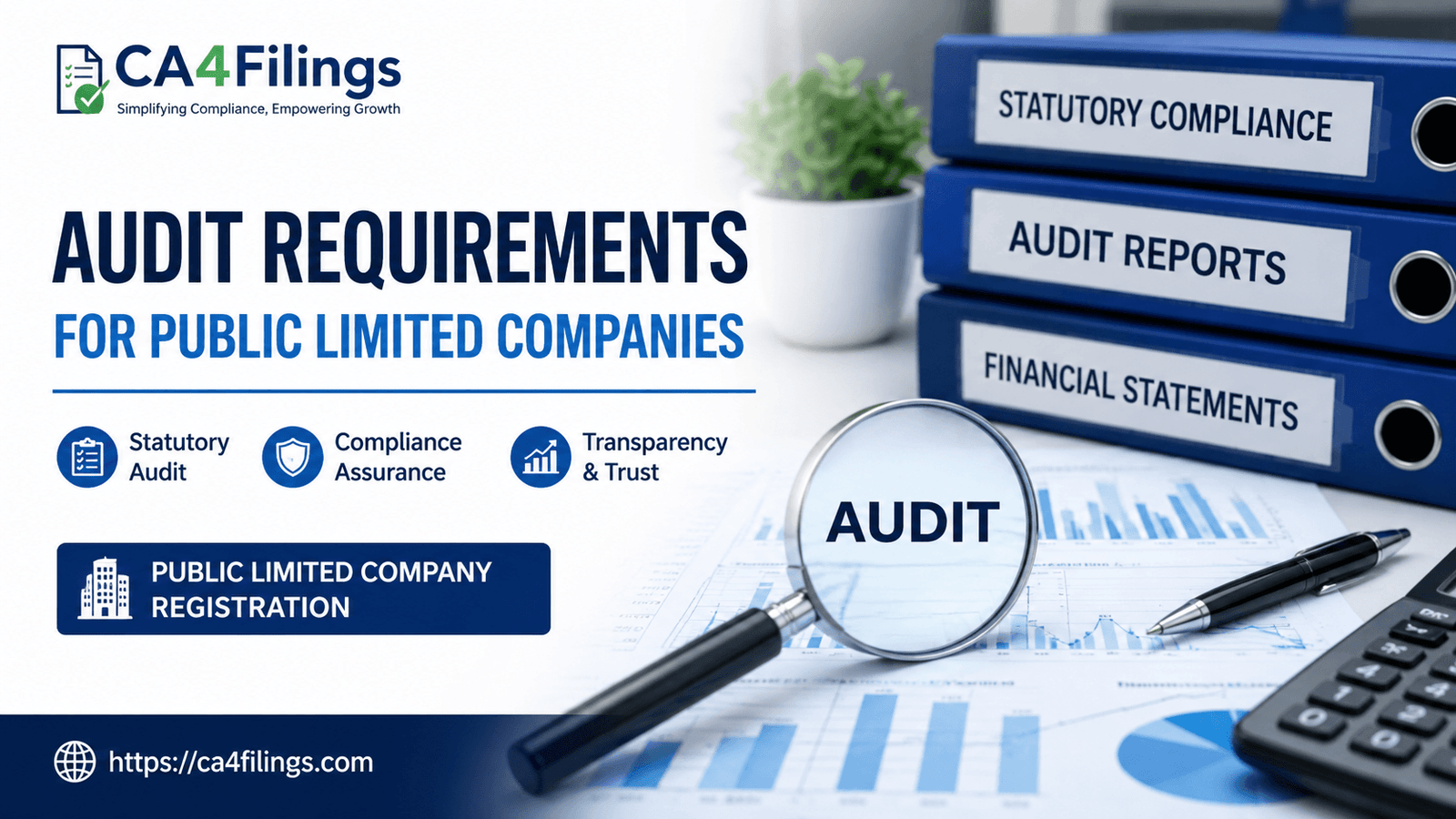
When entrepreneurs decide to expand their business and raise capital from the public, forming a public limited company becomes an attractive option. However, with greater growth opportunities also comes stricter compliance responsibility. One of the most important aspects of corporate compliance is understanding the audit requirements for public limited companies.
At CA4Filings, we regularly guide businesses through incorporation, compliance, and audit-related obligations. Companies planning for growth through Public Limited Company Registration should clearly understand the audit framework under the Companies Act, 2013 to avoid penalties and legal complications.
In this article, we will explain everything about understanding the audit requirements for public limited companies in simple and practical terms.
Why Audit Compliance Matters for Public Limited Companies
Understanding the audit requirements for public limited companies is essential because these companies deal with public investments, shareholders, financial institutions, and regulators. Audits ensure transparency, financial accuracy, and accountability.
An audit helps:
- Verify the correctness of financial statements
- Detect fraud or financial irregularities
- Improve investor confidence
- Ensure statutory compliance
- Build credibility with banks and stakeholders
For public limited companies, audits are not optional. They are legally mandatory under Indian corporate laws.
What Is a Statutory Audit?
A statutory audit is an independent examination of a company’s financial records conducted by a Chartered Accountant in practice.
Under the Companies Act, 2013, every public limited company must get its financial statements audited annually, irrespective of turnover or profit level.
The auditor examines:
- Balance Sheet
- Profit & Loss Account
- Cash Flow Statement
- Books of Accounts
- Financial transactions
- Internal controls
The main objective is to confirm whether the company’s financial statements present a true and fair view of its financial position.
Understanding the Audit Requirements for Public Limited Companies Under the Companies Act, 2013
Appointment of Auditor
One of the first steps in understanding the audit requirements for public limited companies is knowing the rules regarding auditor appointment.
Key Provisions:
- The first auditor must be appointed within 30 days of incorporation.
- Shareholders appoint the auditor during the first Annual General Meeting (AGM).
- The auditor generally serves for a term of 5 years, subject to ratification requirements.
Only a practicing Chartered Accountant or CA firm can act as an auditor.
Mandatory Types of Audits for Public Limited Companies
Statutory Audit
This is compulsory for all public limited companies.
The statutory auditor checks:
- Financial statements
- Accounting standards compliance
- Tax compliance
- Proper maintenance of records
The audit report is submitted along with annual filings to the Registrar of Companies (ROC).
Internal Audit
Understanding the audit requirements for public limited companies also involves internal audit provisions.
Certain public companies must appoint an internal auditor if they meet prescribed thresholds related to:
- Paid-up share capital
- Turnover
- Outstanding loans
- Deposits
The internal auditor reviews operational efficiency, risk management, and internal control systems.
Secretarial Audit
Listed public companies and certain prescribed public companies must conduct a secretarial audit.
A Company Secretary in Practice performs this audit to verify compliance with:
- Companies Act
- SEBI regulations
- Corporate governance norms
- Secretarial standards
This audit improves governance and regulatory discipline.
Tax Audit
If the turnover exceeds the limits specified under the Income Tax Act, the company must also undergo a tax audit.
Currently, tax audit is generally applicable where turnover exceeds prescribed thresholds under Section 44AB of the Income Tax Act.
Auditor Rotation Rules for Public Limited Companies
One important aspect of understanding the audit requirements for public limited companies is auditor rotation.
The Companies Act introduced mandatory auditor rotation to improve independence and transparency.
Rotation Rules:
- Individual auditors can serve for one term of 5 consecutive years.
- Audit firms can serve for two terms of 5 consecutive years each.
- After completion, a cooling-off period applies before reappointment.
This rule helps prevent excessive familiarity between auditors and management.
Financial Statements That Must Be Audited
Public limited companies must prepare audited financial statements every financial year.
These include:
- Balance Sheet
- Profit & Loss Account
- Cash Flow Statement
- Statement of Changes in Equity
- Notes to Accounts
The Board of Directors must approve these statements before submission to auditors.
Annual Filing Requirements After Audit
Understanding the audit requirements for public limited companies is incomplete without knowing ROC filing obligations.
After completion of the audit, companies must file:
Form AOC-4
This form contains audited financial statements and auditor reports.
Form MGT-7
This is the annual return containing company details, shareholders, directors, and compliance information.
These filings must be completed within prescribed timelines after the AGM.
Penalties for Non-Compliance
Failure to comply with audit requirements can lead to serious penalties.
Possible Consequences:
- Heavy monetary penalties
- Disqualification of directors
- ROC notices and scrutiny
- Legal prosecution
- Damage to business reputation
In some cases, auditors can also face penalties for negligence or misconduct.
At CA4Filings, we advise companies to maintain proactive compliance rather than handling issues after receiving notices.
Practical Challenges Faced by Public Limited Companies
Many businesses underestimate the practical difficulties involved in understanding the audit requirements for public limited companies.
Common Challenges:
Poor Record Maintenance
Improper bookkeeping creates audit complications and delays.
Non-Compliance With Accounting Standards
Failure to follow accounting standards may attract qualified audit reports.
Delayed Documentation
Late submission of invoices, agreements, and bank records slows down audits.
Weak Internal Controls
Poor approval systems increase fraud risks and compliance issues.
Best Practices for Smooth Audit Compliance
Maintain Proper Accounting Records
Use professional accounting software and regularly reconcile accounts.
Conduct Periodic Internal Reviews
Quarterly reviews help identify compliance gaps early.
Keep Statutory Registers Updated
Proper maintenance of registers and board resolutions is essential.
Coordinate With Professionals
Regular consultation with Chartered Accountants and Company Secretaries ensures better compliance management.
Avoid Last-Minute Filing
Timely preparation prevents penalties and unnecessary stress.
How CA4Filings Helps Public Limited Companies
At CA4Filings, we understand that compliance can become overwhelming for growing businesses. Our team assists companies with:
- Audit coordination
- ROC filings
- Financial statement preparation
- Internal compliance reviews
- Secretarial support
- Annual compliance management
Our goal is to help businesses stay legally compliant while focusing on growth and expansion.
FAQs on Understanding the Audit Requirements for Public Limited Companies
Is statutory audit mandatory for every public limited company?
Yes. Every public limited company must conduct a statutory audit under the Companies Act, 2013, irrespective of turnover or profit.
Who can conduct the audit of a public limited company?
Only a practicing Chartered Accountant or a registered CA firm can conduct the audit.
What happens if a public company fails to conduct an audit?
The company and its officers may face penalties, legal action, and compliance notices from authorities.
Is internal audit compulsory for all public limited companies?
No. Internal audit applies only to certain public companies meeting prescribed financial thresholds.
Can auditors be changed before completion of their term?
Yes, but the process requires shareholder approval and compliance with legal procedures.
Understanding the audit requirements for public limited companies is crucial for maintaining transparency, legal compliance, and investor confidence. Audits are not merely a legal formality — they are an important tool for strengthening corporate governance and financial discipline.
Public limited companies must stay updated with statutory audit rules, internal audit applicability, filing requirements, and auditor rotation provisions to avoid penalties and operational risks.
At CA4Filings, we help businesses navigate complex compliance requirements with practical and professional guidance. Whether you are starting a new company or managing ongoing corporate compliance, our experts can support you at every stage with reliable and efficient solutions.
Latest Updates
ca4filings.com Services

























-registration.png)