Understanding the Role of Share Certificates in a Private Limited Company
Understanding the Role of Share Certificates in a Private Limited Company: learn importance, legal requirements, and issuance process.
Starting a business in India involves several legal and compliance-related responsibilities, and one aspect that many business owners overlook is the importance of share certificates. When entrepreneurs establish a company, especially during the initial stage, their primary focus often remains on registrations, taxation, and operational planning. However, Understanding the Role of Share Certificates in a Private Limited Company is equally important because these documents act as legal proof of ownership in the business.
At CA4Filings, we regularly assist startups and entrepreneurs with company incorporation and post-incorporation compliances. During the process of Private Limited Company Registration, many founders ask whether issuing share certificates is mandatory and why it matters. The answer is straightforward: share certificates are not merely paperwork; they establish ownership rights and protect shareholders' interests.
Understanding the Role of Share Certificates in a Private Limited Company
To fully understand the importance of share certificates, it is necessary to know what they represent and how they function within a company structure.
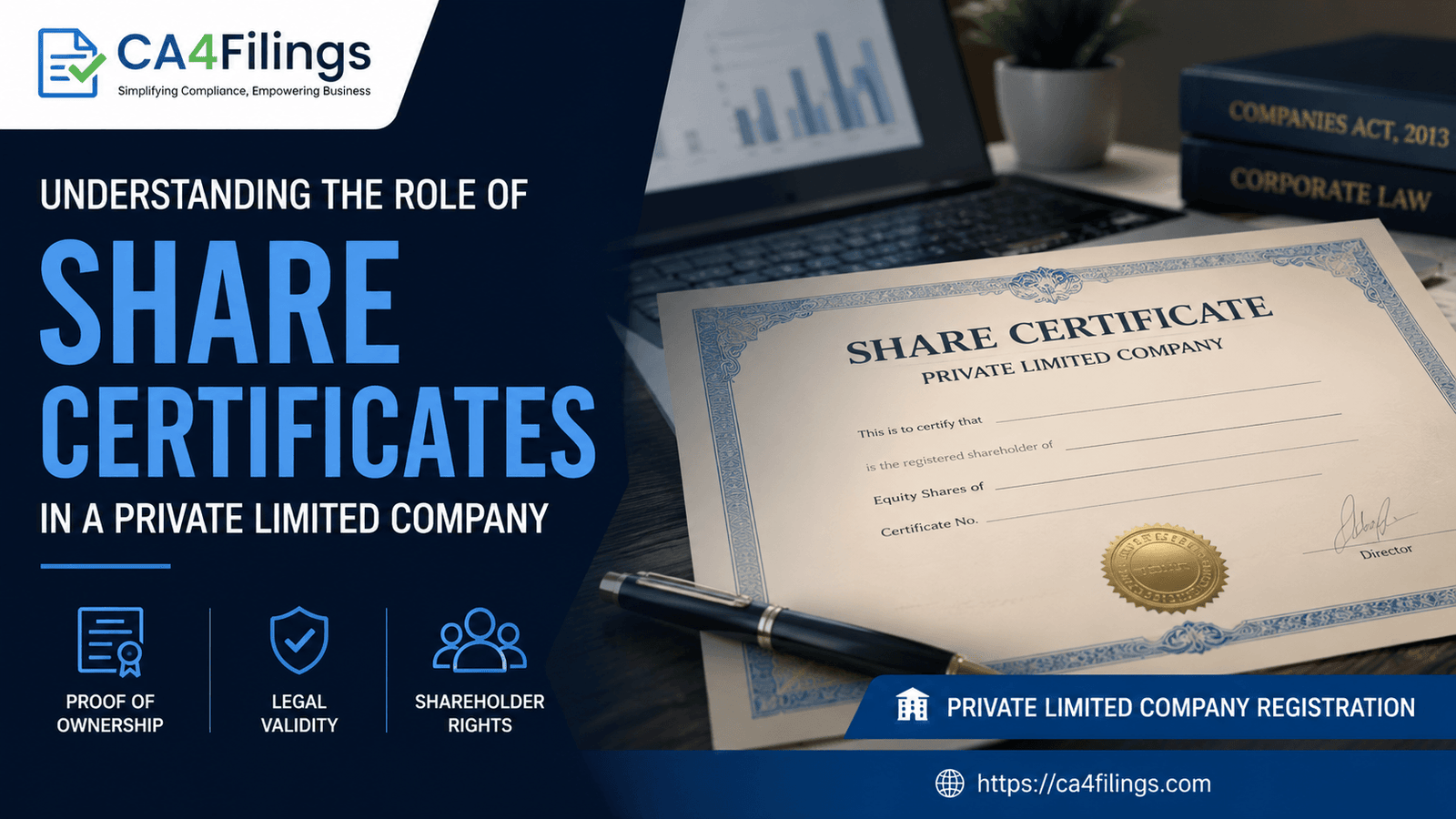
A share certificate is a legal document issued by a company to its shareholders as proof of ownership of shares in the company. It specifies details such as:
- Shareholder's name
- Number of shares allotted
- Face value of shares
- Distinctive numbers of shares
- Certificate number
- Date of issue
- Company's seal and signatures
Under the Companies Act, 2013, every company issuing shares must provide share certificates to shareholders within the prescribed timeline.
Simply put, if an individual invests in a company and acquires shares, the share certificate confirms their ownership legally.
Why Share Certificates Matter in a Private Limited Company
Understanding the Role of Share Certificates in a Private Limited Company becomes easier when you examine their practical significance.
Share certificates perform multiple functions beyond ownership proof.
Evidence of Ownership
The primary purpose of a share certificate is to establish who owns the shares of a company.
For example, suppose two founders start a technology company and agree to hold shares in a 60:40 ratio. The issued share certificates legally validate these ownership percentages.
Without proper documentation, ownership disputes can arise later.
Legal Protection for Shareholders
Share certificates provide legal protection to shareholders by officially recording their rights.
These rights may include:
- Voting rights
- Dividend entitlement
- Right to transfer shares
- Participation in major company decisions
If any dispute occurs regarding ownership, share certificates become important supporting evidence.
Helps During Fundraising Activities
Investors conduct due diligence before investing in startups or companies.
During funding rounds, investors often review:
- Shareholding patterns
- Existing share certificates
- Capital structure
- Share allotment records
Improperly maintained share certificates can create complications during investment discussions.
Supports Regulatory Compliance
Issuing share certificates is not optional. Companies are legally required to issue them after allotting shares.
Failure to comply may result in:
- Penalties on the company
- Additional scrutiny from authorities
- Compliance issues during audits
Legal Provisions Related to Share Certificates
While Understanding the Role of Share Certificates in a Private Limited Company, business owners should also know the legal framework.
As per Section 46 of the Companies Act, 2013:
- Share certificates must be issued within two months from the date of incorporation for subscribers to the Memorandum.
- In case of additional allotment, certificates should be issued within two months from the date of allotment.
- The certificates must be signed by authorized directors and company representatives.
Failure to comply can attract financial penalties.
Process of Issuing Share Certificates
Many entrepreneurs assume that share certificates are automatically generated after incorporation. In reality, companies must follow a proper process.
Step 1: Board Resolution Approval
The company first passes a board resolution approving share allotment and issuance of certificates.
Step 2: Preparation of Share Certificates
The certificates are prepared with details including:
- Name of shareholder
- Number of shares
- Folio number
- Certificate number
- Distinctive share numbers
Step 3: Signatures and Authorization
Authorized directors sign the share certificates.
Step 4: Entry in Statutory Register
Details are entered into the Register of Members.
Step 5: Delivery to Shareholders
The final certificates are issued to shareholders within the prescribed time limit.
Common Mistakes Companies Make While Issuing Share Certificates
At CA4Filings, we have seen several startups make avoidable mistakes.
Delayed Issuance
Many newly incorporated businesses focus on operations and forget issuance timelines.
Delays can lead to legal non-compliance.
Incorrect Information
Minor errors can create significant complications later.
Examples include:
- Incorrect shareholder names
- Wrong number of shares
- Missing certificate numbers
Failure to Maintain Records
Maintaining records is equally important.
Businesses should preserve:
- Board resolutions
- Register of members
- Share allotment details
- Certificate copies
Ignoring Stamp Duty Requirements
Stamp duty requirements vary depending on applicable laws and regulations.
Many companies overlook this aspect.
Understanding the Role of Share Certificates in a Private Limited Company During Share Transfers
Share certificates also become essential during share transfer transactions.
Suppose one shareholder wants to transfer shares to another person.
The process generally includes:
- Submission of transfer request
- Execution of transfer documents
- Verification of original share certificate
- Approval by the board
- Issuance of a new certificate
Without the original certificate, the transfer process may face delays.
Practical Example of Share Certificates in Business
Consider a startup established by three founders:
- Founder A: 50,000 shares
- Founder B: 30,000 shares
- Founder C: 20,000 shares
The company issues separate share certificates reflecting these holdings.
Two years later, an investor wants to acquire equity in the company. During due diligence, investors examine share certificates to verify ownership and capital distribution.
Because documentation is properly maintained, the funding process proceeds smoothly.
This practical situation highlights why Understanding the Role of Share Certificates in a Private Limited Company is important for long-term business growth.
Frequently Asked Questions (FAQs)
1. Is issuing a share certificate mandatory for a Private Limited Company?
Yes. Under the Companies Act, 2013, companies must issue share certificates within prescribed timelines.
2. Can a company issue digital share certificates?
Yes. Subject to applicable laws and procedures, companies may maintain electronic records and issue certificates through permitted systems.
3. What happens if a share certificate is lost?
The shareholder must inform the company and apply for a duplicate certificate following prescribed procedures.
4. Can share certificates be transferred?
Yes. Shares can be transferred according to company rules and legal procedures.
5. What details are included in a share certificate?
Typical details include:
- Shareholder's name
- Share quantity
- Certificate number
- Distinctive numbers
- Date of issue
Understanding the Role of Share Certificates in a Private Limited Company
Understanding the Role of Share Certificates in a Private Limited Company is essential for every entrepreneur, startup founder, and shareholder. These certificates are not just compliance documents; they establish ownership, protect shareholder rights, support investment activities, and maintain legal transparency.
Ignoring proper issuance and maintenance can create unnecessary challenges later, particularly during fundraising, audits, or ownership transfers.
At CA4Filings, we help businesses navigate every stage of company incorporation and compliance with confidence. Whether you are setting up a new company or need assistance with post-incorporation requirements, our experts ensure that your documentation and legal processes remain accurate and compliant. Connect with CA4Filings today and build your business on a strong legal foundation.
Latest Updates
ca4filings.com Services


























-registration.png)