How to Handle PF Disputes and Claims: A Guide for Employers
Learn How to Handle PF Disputes and Claims: A Guide for Employers. Master EPFO audits, 7A proceedings, and resolve claims easily with CA4Filings.
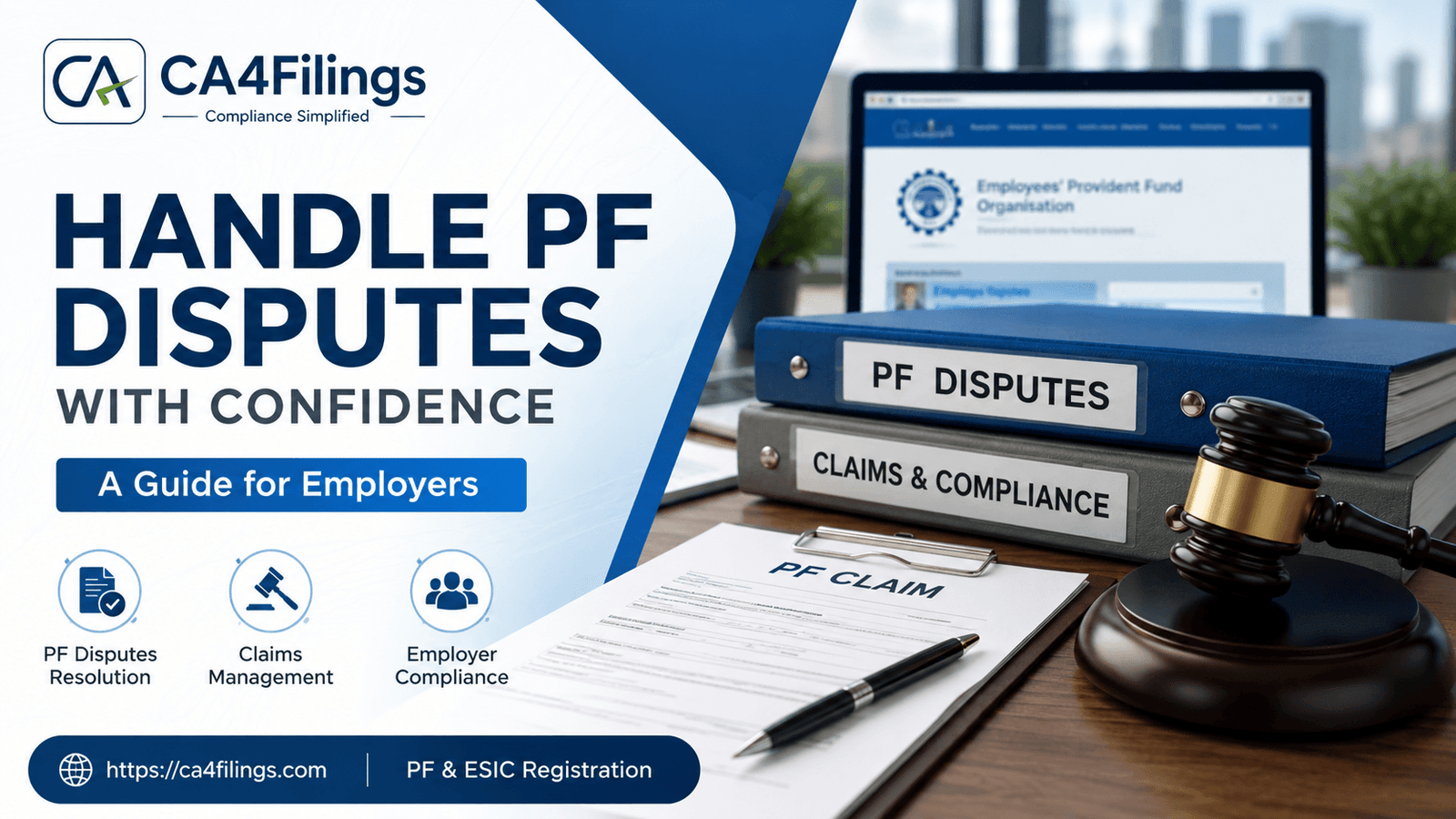
Managing a business in India comes with its fair share of compliance updates, and managing the Employees' Provident Fund (EPF) is often at the top of that list. For many business owners, dealing with employee grievances, mismatched data, or notices from the EPFO can feel overwhelming. Knowing How to Handle PF Disputes and Claims: A Guide for Employers is no longer just an administrative skill—it is a critical legal necessity to shield your business from heavy penalties, damages, and unnecessary litigation.
When you initially set up your business, securing a seamless PF & ESIC Registration is the first step toward building trust with your workforce. However, compliance doesn't end with registration. As your organization grows, discrepancies in employee data, delayed contributions, or joint declaration errors can trigger formal disputes. At CA4Filings, we regularly see employers facing sleepless nights over simple errors that escalate into major legal bottlenecks. This comprehensive roadmap on How to Handle PF Disputes and Claims: A Guide for Employers will break down complex statutory processes into clear, actionable steps for your business.
Common Roots of PF Disputes and Claims
Before diving into resolutions, it is essential to understand why these disputes arise in the first place. Most friction between employers, employees, and the EPFO stems from operational oversights rather than intentional non-compliance.
UAN and KYC Mismatches: The single biggest trigger for PF claim rejections is a mismatch between the employee’s Aadhaar details and the EPFO database. Differences in the spelling of a name, an incorrect date of birth, or father's name errors can stall a claim for months.
Delayed Contributions and Interest Overheads: Depositing PF contributions after the 15th of the month triggers statutory interest under Section 7Q and damages under Section 14B of the EPF Act. Employers often dispute the calculation methods used by the authorities in these instances.
The Exit Date Dilemma: If an HR manager forgets to update an employee’s date of exit in the unified portal, the employee cannot withdraw or transfer their funds. This simple omission frequently leads to official grievances filed against the company.
Exempted Trust Complications: Large organizations managing their own private PF trusts face complex regulatory friction during employee transfers to unexempted sectors.
Step-by-Step Approach on How to Handle PF Disputes and Claims: A Guide for Employers
When an issue lands on your desk—whether it is an employee grievance or an official notice—handling it systematically is key to mitigating compliance risks. Here is how you should approach it:
Step 1: Internal Verification and Root Cause Analysis
Never respond to an employee grievance or an EPFO notice without checking your internal payroll records first. Audit your Electronic Challan-cum-Return (ECR) filings for the disputed period. Verify if the contribution amount matches the actual gross wages paid. Identifying whether the error was administrative, technical, or systemic will dictate your next move.
Step 2: Utilizing the EPF Member Unified Portal
Most routine claims and mismatches can be resolved digitally without visiting the PF office. If an employee's claim is rejected due to data errors, use the "Joint Declaration" digital feature on the Employer Portal. This allows both the employer and employee to jointly submit corrected details (like correct date of joining or exit) with supporting documents directly to the Field Office online.
Step 3: Engaging with the EPF Grievance Management System (EPFiGMS)
If an employee has logged an official grievance via EPFiGMS, the employer is given a designated window to respond. Take these grievances seriously. Provide clear, documentary evidence—such as scanned copies of signed Form 11, payroll sheets, or bank transfer statements—to prove compliance and resolve the issue before it escalates to an official inquiry.
Navigating EPFO Inquiries: Section 7A and 14B Proceedings
If a dispute cannot be resolved through routine corrections, the EPFO may initiate formal legal proceedings. As an employer, you must know how to navigate these statutory challenges.
Understanding Section 7A Inquiries
A Section 7A inquiry is initiated by a PF Commissioner to determine the applicability of the Act to an establishment or to assess the amount due from an employer. Think of it as a quasi-judicial trial.
Action Plan: You will receive a formal summons. Never ignore it. Represent your case through an authorized representative or an expert CA team like CA4Filings. Present clear books of accounts, attendance registers, and salary slips to contest unfair or inflated assessments.
Contesting Section 14B Damages and 7Q Interest
When there is a delay in depositing PF dues, the department issues a demand notice under Section 14B (damages) and 7Q (interest). While 7Q interest is mandatory, Section 14B damages can often be contested or minimized if you can prove valid mitigating circumstances, such as financial distress, a strike, or technical issues on the EPFO portal itself during the payment window.
Best Practices to Prevent Future PF Disputes
An ounce of prevention is worth a pound of cure. Implementing these proactive measures will keep your organization audit-ready and minimize disputes.
Mandatory Form 11 Optimization: Ensure every new hire fills out Form 11 on their very first day of onboarding. Cross-verify their details with their physical Aadhaar card immediately to prevent future KYC failures.
Monthly Reconciliation Rituals: Before hitting the final submit button on your monthly ECR filing, cross-check the portal data with your internal payroll ledger. A 10-minute reconciliation check saves days of rectifications later.
Prompt Grievance Redressal: Build an internal HR mechanism to handle PF issues. If an employee can get their UAN or name error rectified by your internal team, they won't feel the need to escalate it to the portal.
Frequently Asked Questions
Q1: What should an employer do if an employee's PF withdrawal claim is repeatedly rejected?
The employer should check the rejection remark on the portal. It is usually due to a signature mismatch, unapproved KYC, or a name discrepancy. You should initiate a digital Joint Declaration correction or approve the pending KYC on your employer portal to clear the bottleneck.
Q2: Can an employer reduce the basic salary component to lower their PF liability?
No. The Supreme Court's landmark judgment on universal basic wages clarifies that all allowances that are universally, necessarily, and ordinarily paid to all employees across the board must be included for PF computation. Arbitrary restructuring to evade PF can trigger a Section 7A inquiry.
Q3: What is the time limit for an employer to respond to a Section 7A notice?
The notice or summons will specify a hearing date, usually within 15 to 30 days of issuance. It is vital to seek an adjournment formally if your documents are not ready, rather than failing to appear, which could result in an ex-parte order against your company.
Q4: How long must an employer retain payroll and PF records?
Under statutory rules, it is highly recommended to preserve payroll sheets, attendance registers, filed ECRs, and payment challans for at least 3 to 5 years. However, in the event of an ongoing dispute or inquiry, those specific records must be safely archived until final legal closure.
Partner with CA4Filings for Stress-Free Compliance
Mastering How to Handle PF Disputes and Claims: A Guide for Employers is all about being proactive, organized, and legally aware. While routine adjustments can be handled by an alert HR department, complex legal issues like Section 7A summons, high damages assessments, or major data overhauls require professional handling.
Don't let compliance complexities divert your focus from growing your core business. At CA4Filings, we act as your dedicated corporate compliance partners, managing everything from your payroll structuring to resolving knotty regulatory disputes smoothly. Reach out to our seasoned CA expert team at CA4Filings today, and let us handle your regulatory compliance while you build your empire!
Latest Updates
ca4filings.com Services




















-registration.png)