Exploring the Connection Between ESIC and Employee Health Insurance
Exploring the Connection Between ESIC and Employee Health Insurance: Understand benefits, coverage, compliance, and employer responsibilities.
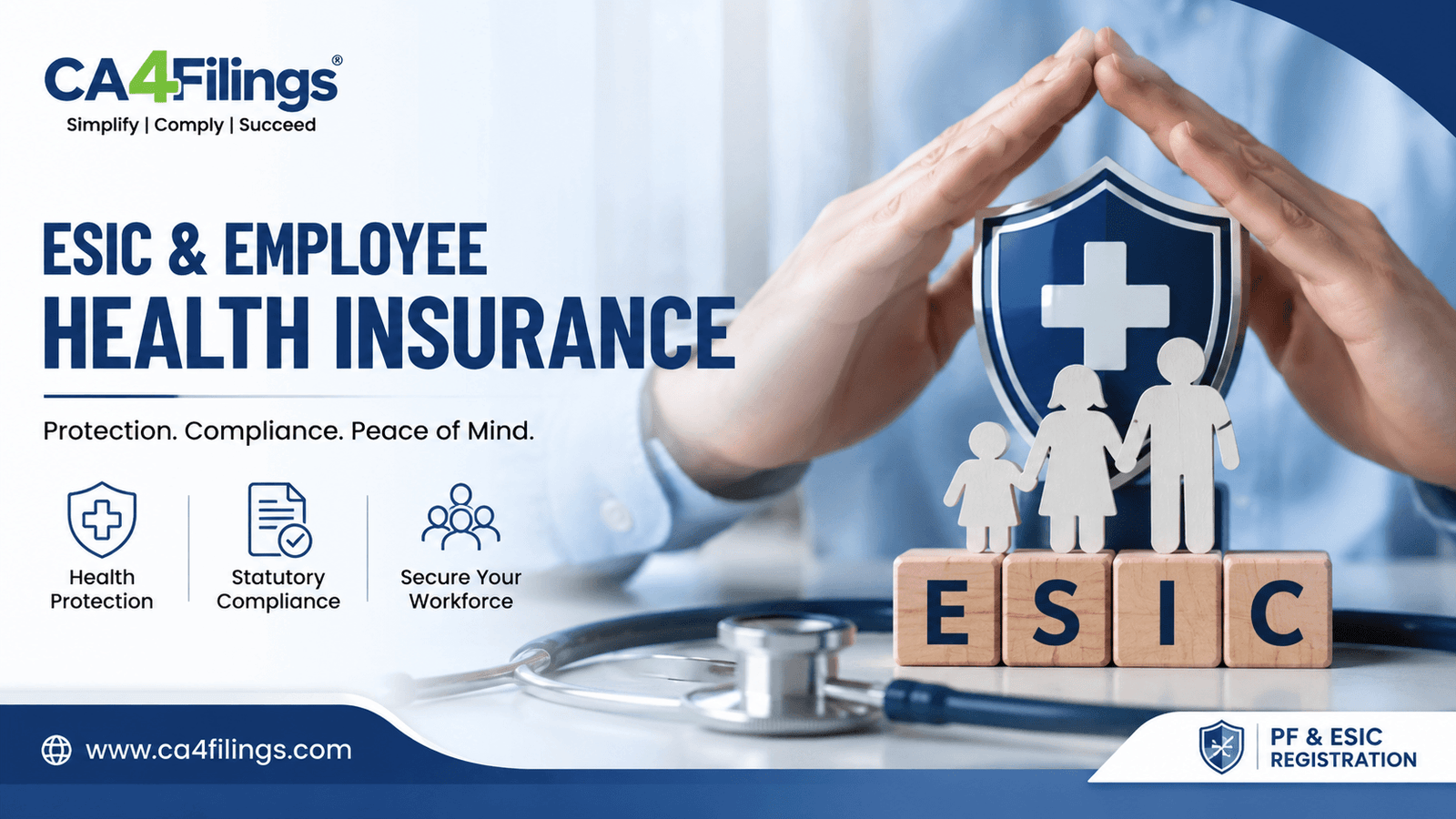
In today’s competitive business environment, employee welfare is no longer optional—it is a key part of building a productive workforce. One of the most important social security schemes in India is ESIC. When discussing Exploring the Connection Between ESIC and Employee Health Insurance, employers and employees often wonder how ESIC compares to traditional health insurance and why it matters for businesses.
For organisations hiring eligible employees, compliance with PF & ESIC Registration is not just a legal requirement but also an important step toward employee protection and business credibility.
At CA4Filings, we regularly guide businesses on labour law compliance, and one common question we receive is how ESIC actually connects with employee health insurance. Let’s understand it in simple terms.
Exploring the Connection Between ESIC and Employee Health Insurance: Understanding the Basics
The Employees’ State Insurance Corporation (ESIC) is a government-run social security and health insurance scheme designed primarily for workers in the organised sector.
The scheme provides medical, cash, maternity, disability, and dependent benefits to eligible employees.
When Exploring the Connection Between ESIC and Employee Health Insurance, it is important to understand that ESIC itself functions as a form of employee health insurance, but with broader social security benefits attached.
Unlike private insurance policies that mainly cover hospitalisation expenses, ESIC covers multiple areas of employee welfare.
What is ESIC and How Does it Work?
ESIC operates under the Employees’ State Insurance Act, 1948.
Eligible employers and employees contribute a fixed percentage of wages toward the scheme.
Contribution Structure
Currently, the contribution rates are:
- Employer Contribution: 3.25%
- Employee Contribution: 0.75%
These contributions fund healthcare and social security benefits offered through ESIC hospitals and dispensaries.
Who Needs ESIC Registration?
Generally, ESIC registration applies to:
- Factories
- Shops and establishments
- Restaurants
- Hotels
- Educational institutions
- Certain service-sector businesses
Applicability depends on employee count and wage thresholds as prescribed under the law.
Exploring the Connection Between ESIC and Employee Health Insurance Through Employee Benefits
When Exploring the Connection Between ESIC and Employee Health Insurance, the biggest factor is understanding employee benefits.
ESIC offers a comprehensive safety net that extends beyond regular insurance coverage.
Medical Benefits
Employees and their families can access:
- Outpatient treatment
- Specialist consultations
- Diagnostic services
- Hospitalisation
- Medicines
- Specialist care
For many lower and middle-income workers, this provides substantial financial relief.
Sickness Benefits
If an employee is unable to work due to illness, ESIC provides wage compensation during certified sickness periods.
Traditional health insurance policies usually do not provide this wage replacement feature.
Maternity Benefits
Eligible insured women receive:
- Paid maternity leave benefits
- Medical treatment during pregnancy
- Confinement-related medical care
This makes ESIC a powerful employee welfare mechanism.
Disability and Dependent Benefits
In cases involving workplace injury or occupational disease, ESIC offers:
- Temporary disability compensation
- Permanent disability compensation
- Dependent support in case of employee death
These benefits demonstrate why Exploring the Connection Between ESIC and Employee Health Insurance goes beyond merely discussing hospital bills.
ESIC vs Private Employee Health Insurance
Business owners frequently ask whether ESIC and private health insurance are the same thing.
The answer is no.
Here’s a practical comparison.
| Feature | ESIC | Private Employee Health Insurance |
|---|---|---|
| Regulated By | Government | Insurance Companies |
| Coverage Basis | Statutory Scheme | Policy Terms |
| Family Benefits | Yes | Depends on Policy |
| Wage Compensation | Yes | Usually No |
| Maternity Benefits | Yes | Depends on Plan |
| Employer Compliance Requirement | Mandatory | Optional |
Real-World Example
Suppose a manufacturing company hires 25 employees within ESIC eligibility limits.
One employee undergoes surgery and requires recovery time.
With ESIC, the employee may receive:
- Medical treatment
- Hospital support
- Cash sickness benefit
A private health insurance policy may only cover treatment costs, depending on policy conditions.
This practical difference is central to Exploring the Connection Between ESIC and Employee Health Insurance.
Why Employers Should Understand the ESIC–Insurance Relationship
Many employers assume ESIC is simply another compliance formality.
That approach can create problems.
When Exploring the Connection Between ESIC and Employee Health Insurance, employers should recognise its role in workforce stability.
Improved Employee Confidence
Employees feel more secure when healthcare protection is available.
This often leads to:
- Better morale
- Reduced absenteeism
- Higher retention
Reduced Financial Stress for Employees
Unexpected medical emergencies can severely impact workers.
ESIC reduces that burden by offering structured healthcare support.
Compliance Protection for Employers
Failure to register or contribute under ESIC can lead to:
- Penalties
- Interest liabilities
- Legal consequences
- Inspection-related issues
Proactive compliance protects business operations.
Exploring the Connection Between ESIC and Employee Health Insurance for Small Businesses
Small and growing businesses sometimes delay ESIC registration because they believe it is complicated.
In reality, the process becomes manageable with proper professional support.
Step-by-Step ESIC Registration Process
Step 1: Determine Applicability
Check:
- Employee strength
- Salary eligibility
- Nature of business activity
Step 2: Gather Required Documents
Common documents include:
- PAN card
- GST certificate
- Address proof
- Employee details
- Bank information
Step 3: Employer Registration
Register through the ESIC portal.
Step 4: Employee Enrollment
Generate employee insurance numbers and complete onboarding.
Step 5: Regular Contribution Filing
Ensure monthly compliance and record maintenance.
At CA4Filings, we help businesses handle these steps smoothly and avoid unnecessary compliance delays.
Common Misconceptions About ESIC and Employee Health Insurance
When Exploring the Connection Between ESIC and Employee Health Insurance, several myths create confusion.
Myth 1: ESIC is Only Hospital Insurance
Incorrect.
ESIC includes healthcare, maternity, disability, sickness, and dependent benefits.
Myth 2: Small Businesses Don’t Need ESIC
Wrong.
Applicability depends on legal thresholds, not business size alone.
Myth 3: Private Insurance Eliminates ESIC Requirement
Not necessarily.
If ESIC applicability conditions are met, employers generally must comply regardless of separate private insurance arrangements.
FAQs on Exploring the Connection Between ESIC and Employee Health Insurance
Is ESIC considered employee health insurance?
Yes. ESIC functions as a government-backed employee health insurance and social security scheme offering medical and financial benefits.
Can employers provide private insurance along with ESIC?
Yes. Some organisations provide additional private insurance benefits alongside mandatory ESIC coverage.
Who pays for ESIC contributions?
Both employers and employees contribute prescribed percentages of wages under the scheme.
Does ESIC cover employee family members?
Yes. ESIC generally extends medical benefits to eligible family members.
Is ESIC mandatory for eligible employers?
Yes. Businesses falling under applicability criteria must comply with ESIC provisions.
Exploring the Connection Between ESIC and Employee Health Insurance
When Exploring the Connection Between ESIC and Employee Health Insurance, one thing becomes clear—ESIC is much more than a standard insurance arrangement. It is a structured social security framework that supports employees through medical care, wage protection, maternity support, and disability benefits.
For employers, understanding this connection is essential for legal compliance, workforce welfare, and operational stability.
At CA4Filings, we help businesses simplify ESIC compliance, employee registration, and ongoing labour law requirements. If you want expert guidance on ESIC applicability, registration, or compliance management, connect with CA4Filings today and ensure your business stays compliant while protecting your workforce effectively.
Latest Updates
ca4filings.com Services

















-registration.png)