How to Maintain Compliance After Partnership Firm Registration
How to Maintain Compliance After Partnership Firm Registration with expert guidance on tax, legal filings, accounting, and business compliance.
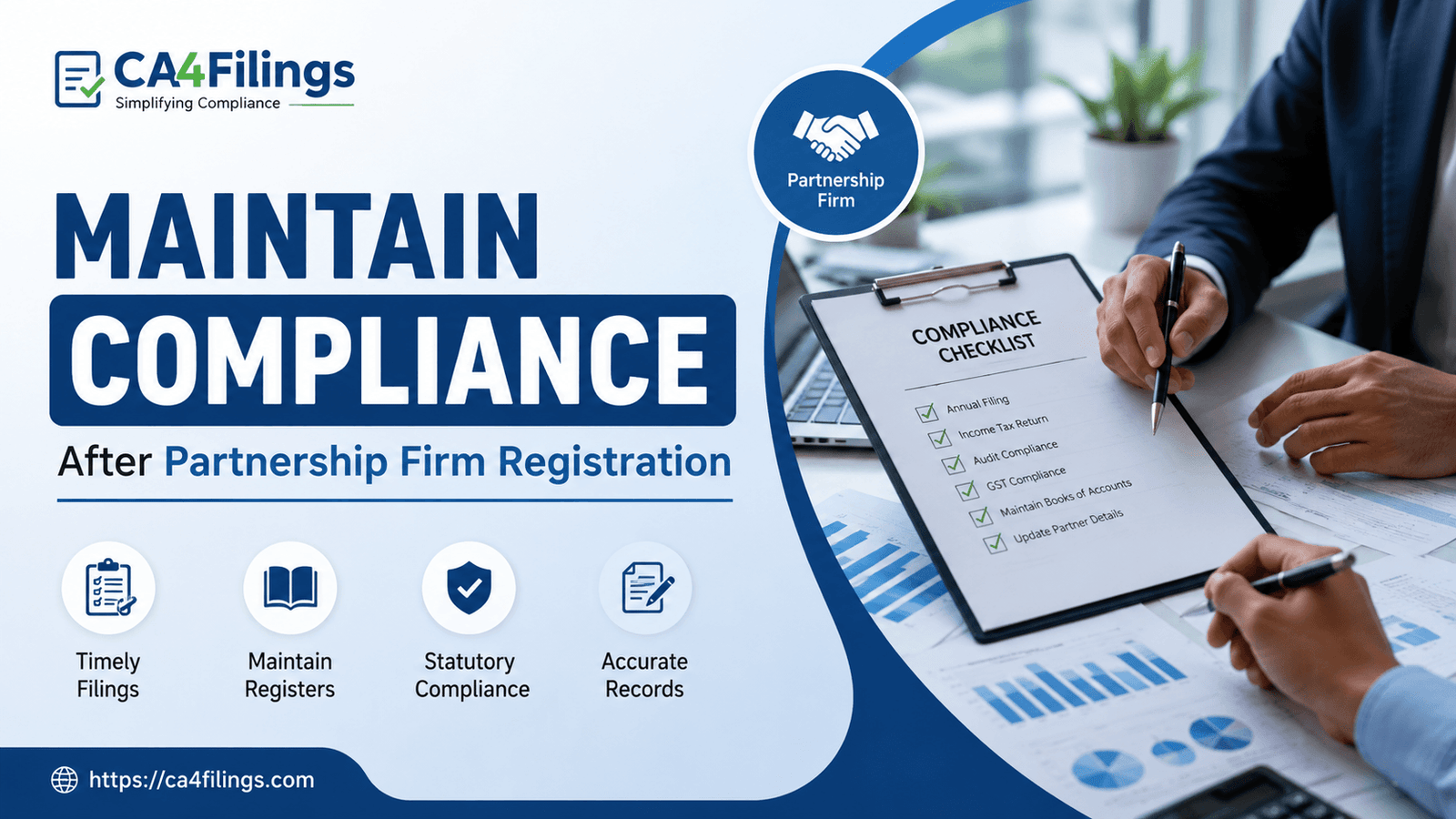
Running a partnership firm in India comes with several legal and financial responsibilities. Many business owners focus heavily on registration but often overlook post-registration compliance requirements. Understanding How to Maintain Compliance After Partnership Firm Registration is essential to avoid penalties, legal disputes, and operational issues in the future.
At CA4Filings, we regularly assist businesses that complete their Partnership Firm Registration but later struggle with taxation, bookkeeping, and statutory compliance. Proper compliance management not only keeps your business legally secure but also improves credibility with banks, vendors, and clients.
In this guide, we will explain How to Maintain Compliance After Partnership Firm Registration in a practical and easy-to-understand manner.
Why Compliance is Important for a Partnership Firm
Many entrepreneurs believe that partnership firms have fewer compliance requirements compared to companies or LLPs. While compliance is comparatively simpler, it is still extremely important.
Failure to maintain compliance can lead to:
- Heavy penalties from the Income Tax Department
- Disqualification from government tenders
- Banking and loan difficulties
- Legal disputes among partners
- Business credibility issues
Understanding How to Maintain Compliance After Partnership Firm Registration helps firms maintain transparency and smooth business operations.
Maintain Proper Partnership Deed Records
The partnership deed is the foundation of the business. It defines:
- Profit-sharing ratio
- Roles and responsibilities
- Capital contribution
- Salary or remuneration to partners
- Rules for dispute resolution
Keep the Partnership Deed Updated
Whenever there is:
- Admission of a new partner
- Retirement of a partner
- Change in profit-sharing ratio
- Change in business activity
The partnership deed should be amended immediately.
Many firms ignore this step, which later creates legal complications during tax assessments or disputes.
Obtain and Maintain PAN and TAN
One of the first steps in How to Maintain Compliance After Partnership Firm Registration is obtaining PAN and TAN.
PAN for Partnership Firm
A partnership firm must have its own PAN card for:
- Filing income tax returns
- Opening bank accounts
- Conducting financial transactions
TAN Requirement
If the firm deducts TDS on:
- Salaries
- Professional fees
- Contractor payments
- Rent
Then obtaining TAN is mandatory.
Maintain Proper Books of Accounts
Proper bookkeeping is one of the most important aspects of How to Maintain Compliance After Partnership Firm Registration.
Essential Financial Records
Maintain records such as:
- Cash book
- Ledger
- Purchase register
- Sales register
- Bank statements
- Expense vouchers
- GST invoices
Why Accurate Accounting Matters
Proper accounting helps in:
- Easy tax filing
- Financial planning
- Loan approvals
- Avoiding tax notices
- Understanding business profitability
At CA4Filings, we strongly advise businesses to update books monthly rather than waiting until year-end.
File Income Tax Returns on Time
Every partnership firm must file an Income Tax Return (ITR) annually, even if there is no profit.
Applicable Tax Rate
Currently, partnership firms are taxed at a flat rate under the Income Tax Act.
Important Due Dates
Generally:
- Firms requiring audit must file returns by the audit due date
- Non-audit firms have separate filing deadlines
Late filing can result in:
- Penalties
- Interest on taxes
- Loss of carry-forward benefits
Timely filing is a major part of How to Maintain Compliance After Partnership Firm Registration.
GST Compliance for Partnership Firms
If the firm's turnover exceeds the prescribed GST threshold, GST registration becomes mandatory.
GST Compliance Includes
- Filing GST returns
- Issuing GST invoices
- Maintaining GST records
- Reconciling input tax credit
- Paying GST on time
Common Mistakes Businesses Make
Many firms:
- File incorrect returns
- Miss filing deadlines
- Claim wrong input tax credit
These mistakes often lead to notices and penalties.
Understanding GST obligations is critical when learning How to Maintain Compliance After Partnership Firm Registration.
TDS Compliance Requirements
Partnership firms making specified payments must deduct TDS.
Payments Where TDS May Apply
- Contractor payments
- Professional fees
- Rent
- Salary
- Commission
TDS Responsibilities
The firm must:
- Deduct TDS correctly
- Deposit TDS within due dates
- File TDS returns quarterly
- Issue TDS certificates
Non-compliance can result in interest and penalties from the Income Tax Department.
Conduct Tax Audit if Applicable
Certain partnership firms are required to undergo tax audit under the Income Tax Act.
When Tax Audit Applies
Tax audit applicability depends on:
- Turnover limits
- Nature of business
- Presumptive taxation provisions
Benefits of Tax Audit
Although many businesses view audits negatively, audits actually help:
- Improve financial discipline
- Detect accounting errors
- Build lender confidence
- Reduce tax risks
Tax audit compliance is an important part of How to Maintain Compliance After Partnership Firm Registration.
Renew Licenses and Registrations
Depending on the business activity, additional licenses may require renewal.
Common Business Licenses
- Shop and Establishment License
- FSSAI License
- Trade License
- MSME Registration
- Professional Tax Registration
Missing renewal deadlines can result in penalties or cancellation of licenses.
Maintain Partner Communication and Transparency
One often ignored aspect of How to Maintain Compliance After Partnership Firm Registration is internal management.
Conduct Regular Partner Meetings
Even though it may not always be legally mandatory, regular meetings help in:
- Reviewing business performance
- Discussing tax liabilities
- Managing disputes early
- Maintaining transparency
Keep Written Records
Document major decisions through:
- Meeting minutes
- Written resolutions
- Updated agreements
This protects the firm during disagreements or legal scrutiny.
Separate Personal and Business Finances
Many partnership firms in India make the mistake of mixing personal and business expenses.
Best Practices
- Use separate bank accounts
- Avoid personal withdrawals without records
- Maintain expense proofs
- Track partner drawings properly
This improves accounting accuracy and reduces tax complications.
Stay Updated with Regulatory Changes
Tax laws and compliance rules frequently change in India.
For example:
- GST filing formats change regularly
- Income tax provisions are updated annually
- TDS rates may vary
- Compliance portals evolve frequently
Business owners who stay informed can avoid unnecessary penalties.
At CA4Filings, we continuously guide clients regarding the latest compliance changes so they can focus on growing their business.
Common Compliance Mistakes Partnership Firms Should Avoid
Understanding mistakes is equally important while learning How to Maintain Compliance After Partnership Firm Registration.
Major Mistakes Include
- Ignoring bookkeeping
- Delaying tax return filing
- Missing GST deadlines
- Not updating partnership deed
- Improper expense documentation
- Mixing personal and business finances
- Ignoring professional compliance advice
Avoiding these errors can save businesses significant financial and legal trouble.
FAQs
Is filing Income Tax Return mandatory for a partnership firm?
Yes, every partnership firm must file an Income Tax Return annually, regardless of profit or loss.
Does a partnership firm require GST registration?
GST registration becomes mandatory if turnover exceeds the prescribed threshold or if the business falls under mandatory registration categories.
What happens if a partnership firm fails to maintain compliance?
Non-compliance can lead to penalties, interest, notices, legal disputes, and cancellation of registrations.
Can a partnership deed be changed after registration?
Yes, partners can amend the partnership deed whenever necessary through mutual agreement.
Is audit mandatory for all partnership firms?
No, audit applicability depends on turnover and taxation provisions under the Income Tax Act.
Understanding How to Maintain Compliance After Partnership Firm Registration is crucial for the long-term success and stability of any business. Registration is only the beginning — maintaining proper accounting, filing taxes on time, complying with GST and TDS regulations, and keeping business records updated are equally important.
A well-compliant partnership firm enjoys better credibility, smoother operations, and fewer legal complications. Many businesses face penalties simply because they ignore routine compliance responsibilities.
At CA4Filings, we help partnership firms manage complete post-registration compliance with expert guidance, timely filing support, accounting assistance, and practical business advice. Whether you are starting a new firm or managing an existing one, our team ensures your business remains fully compliant and growth-ready.
Latest Updates
ca4filings.com Services




























-registration.png)