Types of NGOs: Choosing the Right Structure for Your Organization
Types of NGOs: Choosing the Right Structure for Your Organization – understand Trust, Society, and Section 8 Company easily.
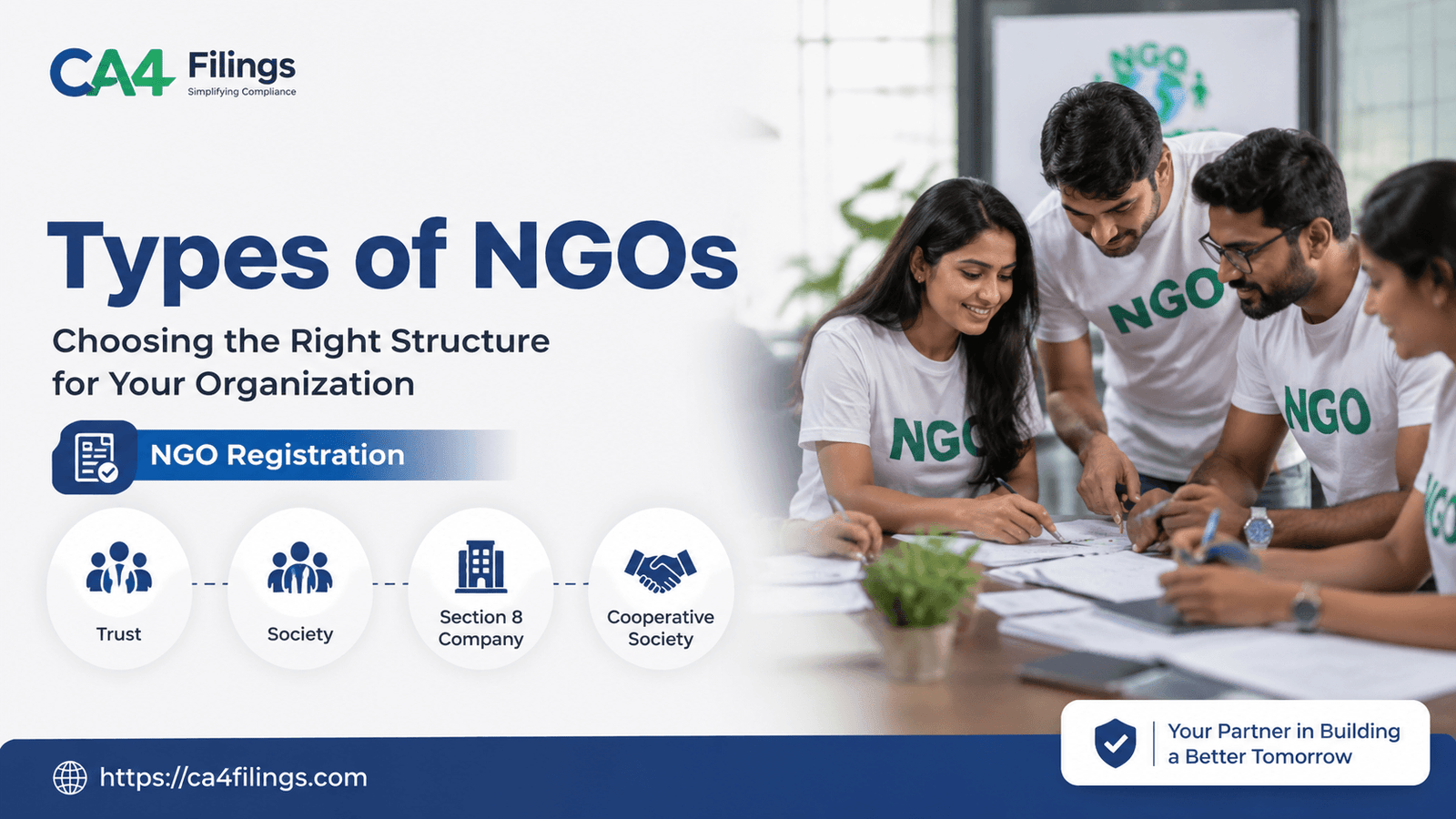
Starting an NGO is a meaningful step toward creating social impact, whether your goal is to support education, healthcare, women empowerment, environmental protection, or rural development. However, before beginning your journey, one of the most important decisions is understanding the Types of NGOs: Choosing the Right Structure for Your Organization.
At CA4Filings, we often meet social entrepreneurs who are passionate about their cause but confused about which legal structure suits their NGO. The right structure not only affects registration and compliance but also determines funding opportunities, governance, credibility, and long-term sustainability.
If you are planning to start a non-profit organization, understanding the Types of NGOs: Choosing the Right Structure for Your Organization is the first step toward building a legally compliant and professionally managed NGO. Many organizations also begin their journey with proper NGO Registration to ensure smooth operations and donor confidence from day one.
In India, NGOs are generally registered under three legal structures:
- Trust
- Society
- Section 8 Company
Each has its own advantages, legal requirements, and suitability depending on the nature of activities.
Understanding the Types of NGOs: Choosing the Right Structure for Your Organization
When discussing the Types of NGOs: Choosing the Right Structure for Your Organization, it is important to understand that there is no “one-size-fits-all” model. The ideal structure depends on:
- Your mission and objectives
- Number of founders
- Funding requirements
- Operational scale
- Governance expectations
- Future expansion plans
Let us understand each NGO structure in detail.
Trust Registration in India
A Trust is one of the oldest and simplest forms of NGO structures in India. It is generally formed for charitable or religious purposes.
Key Features of a Trust
- Governed by the Indian Trusts Act, 1882
- Managed by Trustees
- Easy to establish
- Suitable for family-run charitable activities
- Commonly used for schools, hospitals, and relief programs
Minimum Requirements
- Minimum 2 trustees
- Trust deed
- Registered office address
- PAN and identity proof of trustees
Advantages of a Trust
- Simple registration process
- Lower compliance burden
- Suitable for small NGOs
- Quick decision-making process
Limitations of a Trust
- Less transparent compared to Section 8 Companies
- Limited democratic participation
- Difficult to modify objectives later
Practical Example
Suppose a family wants to establish a charitable hospital in memory of a relative. In such cases, a Trust structure is often preferred because management remains with selected trustees.
When evaluating the Types of NGOs: Choosing the Right Structure for Your Organization, a Trust is ideal for organizations seeking operational simplicity.
Society Registration in India
A Society is formed when a group of individuals come together to work toward a common charitable objective.
Key Features of a Society
- Governed by the Societies Registration Act, 1860
- Requires democratic management
- Suitable for cultural, educational, literary, and welfare activities
- More flexible than Trusts
Minimum Requirements
- Minimum 7 members
- Memorandum of Association (MOA)
- Rules and regulations
- Registered office proof
Advantages of a Society
- Democratic structure
- Better public credibility
- Suitable for membership-based organizations
- Easier expansion across states
Limitations of a Society
- More regulatory compliance
- Internal disputes among members may arise
- Annual filing requirements
Practical Example
An NGO formed by teachers to promote rural education across multiple districts may prefer a Society structure due to member participation and broader governance.
While discussing the Types of NGOs: Choosing the Right Structure for Your Organization, a Society is often recommended for organizations involving multiple stakeholders.
Section 8 Company Registration
A Section 8 Company is considered the most professional and credible NGO structure in India.
Key Features of a Section 8 Company
- Governed by the Companies Act, 2013
- Established for charitable objectives
- Profits are reinvested for social causes
- Managed by directors
Minimum Requirements
- Minimum 2 directors
- Digital Signature Certificate (DSC)
- Director Identification Number (DIN)
- MOA and AOA
- Central Government license
Advantages of a Section 8 Company
- High credibility among donors and corporates
- Better funding opportunities
- Strong governance structure
- Preferred for CSR funding
- Transparent operations
Limitations of a Section 8 Company
- Higher compliance requirements
- More documentation
- Professional management needed
Practical Example
An organization planning to receive large CSR contributions from corporates usually opts for a Section 8 Company due to higher transparency and governance standards.
In the context of Types of NGOs: Choosing the Right Structure for Your Organization, a Section 8 Company is ideal for NGOs targeting national-level operations and institutional funding.
Comparison Between Trust, Society, and Section 8 Company
Trust
- Easy registration
- Lower compliance
- Suitable for small charitable work
- Limited transparency
Society
- Democratic structure
- Moderate compliance
- Suitable for associations and community groups
- Better operational flexibility
Section 8 Company
- Highest credibility
- Strong governance
- Preferred for CSR and international funding
- Higher compliance obligations
Understanding these distinctions is essential when exploring the Types of NGOs: Choosing the Right Structure for Your Organization.
Factors to Consider Before Choosing an NGO Structure
Nature of Activities
If your NGO activities are local and small-scale, a Trust may work well. For larger public initiatives, a Society or Section 8 Company is better.
Funding Plans
Organizations seeking CSR funding or international grants usually benefit from a Section 8 Company structure.
Management Style
- Trust: Controlled by trustees
- Society: Managed democratically
- Section 8 Company: Professionally governed
Compliance Capacity
Choose a structure based on your ability to manage annual filings and legal compliances.
Long-Term Vision
Your future growth plans play a major role in selecting the right structure under the Types of NGOs: Choosing the Right Structure for Your Organization.
Tax Benefits Available for NGOs
Regardless of the structure chosen, NGOs can apply for:
- 12A Registration for income tax exemption
- 80G Registration for donor tax benefits
- CSR eligibility
- FCRA Registration for foreign funding
Proper compliance significantly improves donor trust and financial sustainability.
Common Mistakes NGOs Make While Choosing a Structure
Ignoring Future Funding Needs
Many NGOs register as Trusts initially but later face challenges receiving CSR funding.
Choosing Based Only on Cost
Low registration cost should not be the only deciding factor.
Lack of Compliance Awareness
Every NGO structure comes with legal responsibilities that must be followed regularly.
Not Seeking Professional Guidance
Improper structuring can create operational and tax complications later.
At CA4Filings, we advise founders to carefully assess the Types of NGOs: Choosing the Right Structure for Your Organization before registration to avoid future restructuring issues.
FAQs on Types of NGOs: Choosing the Right Structure for Your Organization
Which NGO structure is best in India?
There is no single “best” structure. It depends on your objectives, funding goals, and operational scale.
Is Section 8 Company better than a Trust?
A Section 8 Company offers higher credibility and transparency, especially for CSR funding, but compliance requirements are also higher.
Can a Trust receive foreign donations?
Yes, but it must obtain FCRA Registration before accepting foreign contributions.
How many members are required to start a Society?
A minimum of 7 members is required for Society registration in India.
Which NGO structure has the least compliance?
Trusts generally have lower compliance requirements compared to Societies and Section 8 Companies.
Choosing the right NGO structure is a critical decision that affects your organization’s credibility, compliance, funding opportunities, and long-term success. Understanding the Types of NGOs: Choosing the Right Structure for Your Organization helps founders make informed choices aligned with their social mission and future goals.
Whether you are planning a local charitable initiative or a large-scale non-profit organization, selecting the appropriate legal structure from the available Types of NGOs: Choosing the Right Structure for Your Organization can save significant time, effort, and compliance challenges in the future.
At CA4Filings, we help aspiring NGOs with registration, tax exemptions, compliance management, and legal advisory services. Our expert team ensures that your NGO starts on the right legal foundation so you can focus on creating meaningful social impact.
If you are planning to establish an NGO in India, connect with CA4Filings today for professional guidance and hassle-free registration support.
Latest Updates
ca4filings.com Services




















-registration.png)