Understanding the Legal Framework Behind NGO Darpan Registration
Master the legal nuances of India's non-profit sector. Read our guide on Understanding the Legal Framework Behind NGO Darpan Registration.
Running a non-profit organization in India is a deeply noble pursuit. Whether you are building an educational trust, starting a health camp, or pushing for environmental sustainability, your primary focus is naturally on creating a real social impact. However, as an experienced Chartered Accountant who works closely with the development sector, I often tell my clients that a passionate heart needs a legally robust spine.
In India, the transition from a passionate group of volunteers to a legally recognized, credible entity involves navigating complex statutory pathways. One of the most vital milestones in this compliance journey is obtaining your Unique ID from the NITI Aayog's central database. To ensure your non-profit functions seamlessly, you must start by Understanding the Legal Framework Behind NGO Darpan Registration. Without mastering this backdrop, your organization risks falling behind on essential compliances, missing out on crucial growth opportunities, and struggling to secure the funds necessary to scale your vision.
To help you seamlessly navigate these compliance structures and clear up any regulatory confusion, our expert team provides dedicated assistance with NGO Darpan Registration to keep your non-profit transparent, compliant, and ready for institutional funding.
What is NGO Darpan?
Managed by NITI Aayog in collaboration with the National Informatics Centre (NIC), NGO Darpan is an online platform that acts as a central repository for voluntary organizations in India. Originally launched to bridge the gap between the government and the social sector, it has evolved into a mandatory tool for compliance.
Think of it as an official NGO showcase or a digital NGO directory. It provides your non-profit organization with a unique digital identity (the Darpan Unique ID). This ID acts as a validation shield, certifying that your entity is recognized by the central planning think-tank of India.
The Core Pillars: Understanding the Legal Framework Behind NGO Darpan Registration
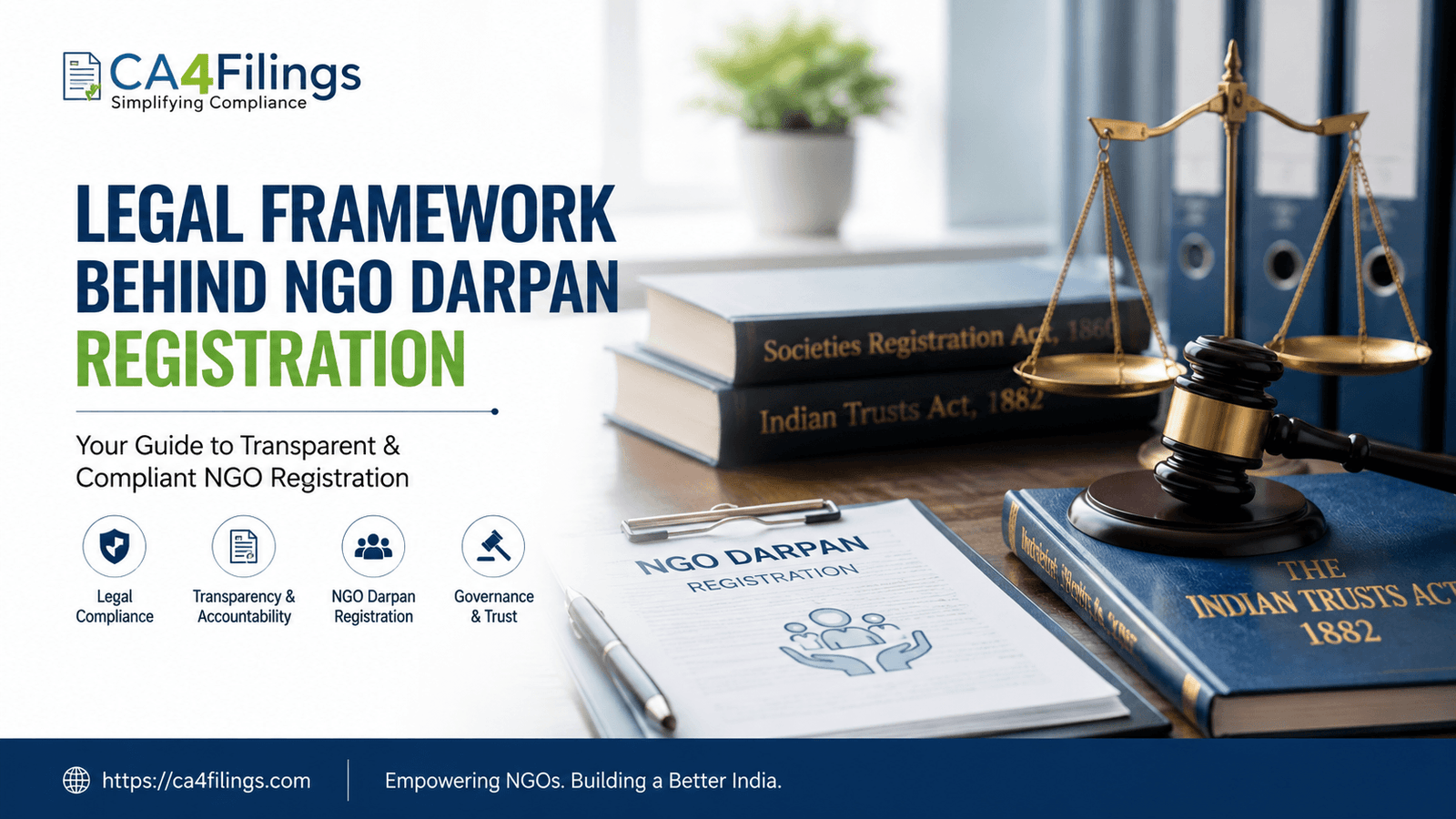
When we talk about Understanding the Legal Framework Behind NGO Darpan Registration, we are looking at how separate pieces of Indian legislation converge on a single portal. The registration process itself does not grant legal status; rather, it validates an existing legal status under Indian laws.
The legal framework relies heavily on three primary statutes:
The Indian Trusts Act, 1882 (or state-specific Trust Acts): If your NGO operates as a Public Charitable Trust.
The Societies Registration Act, 1860: If your organization functions as a member-driven society.
The Companies Act, 2013 (Section 8): If you have incorporated your non-profit as a limited company with charitable objectives.
The Darpan portal pulls these legal entities into a unified network to enforce structured legal compliance across different ministries.
Driving Forces Behind the Legal Mandates
Why has the government made this registration so critical? It boils down to two fundamental principles: transparency and accountability. Let’s break down the exact legal requirements and rules that tie your NGO to the Darpan portal:
1. The Gateway to Government Grants
If your non-profit plans to apply for government grants, subsidies, or central ministries' development schemes, a Darpan Unique ID is non-negotiable. Over 60 central government departments access this NGO portal to verify an organization’s operational and financial history before releasing any grant funding.
2. The PMLA Amendment Connection
Under the Prevention of Money Laundering (Maintenance of Records) Amendment Rules, all banking and financial institutions are mandated to capture the Darpan Unique ID for non-profit organizations when opening or operating bank accounts. This integration helps monitor the financial ecosystem and prevents the misuse of funds.
3. Pre-requisite for FCRA and Tax Benefits
If you want to expand your social impact through international funding, the Ministry of Home Affairs requires a valid Darpan ID before you can apply for or renew your Foreign Contribution Regulation Act (FCRA) license. Furthermore, regulatory bodies track your Darpan status during routine checks for income tax exemptions.
Who is Eligible to Register?
Before initiating the registration process, your entity must meet specific statutory benchmarks. The portal is strictly reserved for formal, non-governmental structures.
| Eligible Entity Type | Governing Legislation | Core Operational Requirement |
|---|---|---|
| Charitable Trust | Indian Trusts Act, 1882 / State Acts | Valid, registered Trust Deed |
| Societies | Societies Registration Act, 1860 | Certified Rules & Regulations / Bye-laws |
| Section 8 Company | Companies Act, 2013 | Certificate of Incorporation & MOA/AOA |
CA Advice: Unregistered groups, informal clubs, or private family trusts created without public charitable intent are strictly ineligible to join the portal.
Step-by-Step Registration Process
While the registration on the government portal does not attract any official processing fees, entering incorrect details can lead to long delays or profile rejection.
Step 1: Account Creation & PAN Verification
Visit the official portal and select the sign-up option. Enter the exact legal name of your NGO alongside its Permanent Account Number (PAN). The portal cross-verifies this information directly with the Income Tax department database.
Step 2: Providing Office Bearer Details
You must provide the legal identity profiles of at least three key governing body members (such as the President, Secretary, and Treasurer). Submitting their Aadhaar and PAN details is mandatory to establish absolute accountability.
Step 3: Document Uploads
Upload clean, legible PDF copies of your foundational documents:
The NGO Registration Certificate
Trust Deed, Bye-laws, or Memorandum of Association (MOA)
Trust/Society/Company PAN Card
Step 4: Verification and ID Generation
Once the application is submitted, NITI Aayog officials evaluate the credentials. If your documentation satisfies all statutory checks, a Unique Darpan ID is generated within 7 to 15 working days.
Common Compliance Pitfalls to Avoid
As a CA, I see many enthusiastic founders make simple errors that bottleneck their progress. When completing your registration, always look out for:
Name Mismatches: The name entered on the portal must match your PAN card and registration certificate down to the last punctuation mark.
Stale Contact Data: Ensure the mobile numbers and emails used are active, as all crucial OTPs and government communication flow through them.
Omission of Key Members: Failing to provide Aadhaar or PAN details for the required minimum of three office bearers will trigger an automatic system rejection.
Frequently Asked Questions (FAQs)
Q1. Is NGO Darpan registration mandatory for all NGOs in India?
Legally, it is not compulsory just to exist. However, it becomes entirely mandatory if your NGO wants to apply for government grants, obtain an FCRA registration, or satisfy the KYC compliance requirements of Indian banks.
Q2. How long is the Darpan Unique ID valid?
The registration is permanent. However, you are legally required to keep the profile updated. Any change in your governing body members, registered office address, or core field of operations must be immediately updated on the portal.
Q3. Can an NGO register on Darpan before getting 12A or 80G tax exemptions?
Yes. You can register on the Darpan portal as soon as your trust, society, or Section 8 company receives its registration certificate and PAN card. You can add your 12A and 80G exemption details to your profile later once they are approved by the Income Tax Department.
Q4. Are there any government fees for this registration?
No. NITI Aayog does not levy any official government fees for creating a profile or generating a Unique ID on the platform.
Structuring for the Future with CA4Filings
Gaining a complete Understanding the Legal Framework Behind NGO Darpan Registration ensures your non-profit scales on a foundation of absolute transparency and uncompromised compliance. It turns your organization from a local initiative into an institution ready for significant grant funding, public trust, and long-term partnerships.
Regulatory paperwork shouldn't distract you from your core mission of driving social change. At CA4Filings, we take the entire compliance burden off your shoulders. From checking your foundational documents to smoothly managing your registration, our legal experts ensure your non-profit stays fully compliant with all regulatory standards.
Let’s streamline your administrative compliance so you can focus on making a difference. Reach out to CA4Filings today, and let's get your unique digital identity set up correctly!
Latest Updates
ca4filings.com Services

















-registration.png)