NGO Darpan: A Tool for Building Trust with Stakeholders
Discover how "NGO Darpan: A Tool for Building Trust with Stakeholders" enhances transparency, unlocks government grants, and secures vital CSR funding.
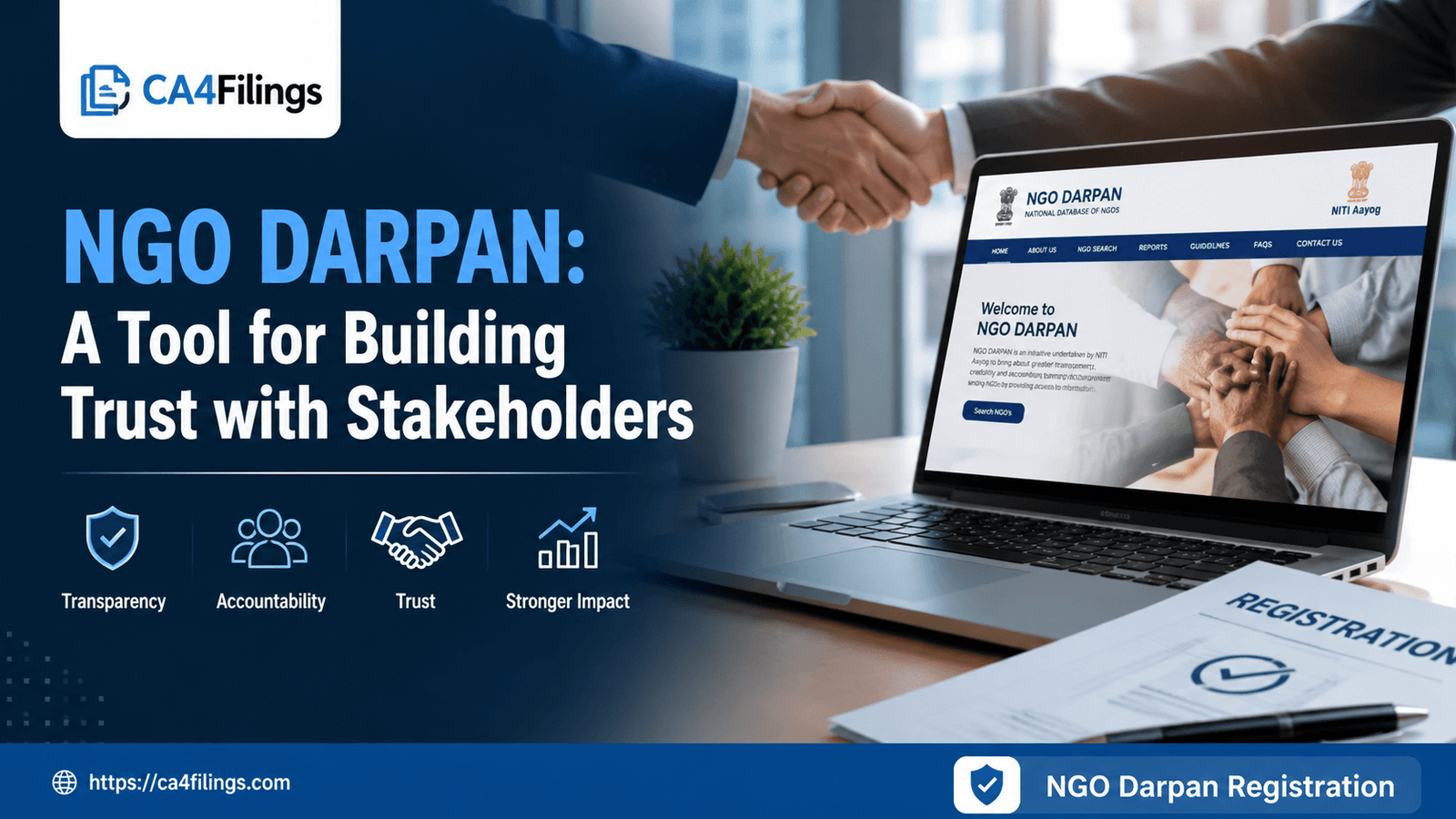
Running a non-governmental organization (NGO) in India is a deeply rewarding journey, but it comes with a unique set of administrative and emotional challenges. Whether you are distributing mid-day meals, building schools, or driving healthcare initiatives, one harsh truth remains: without money, there is no ministry. To keep your social engine running, you constantly need capital. However, before a corporate house signs a Corporate Social Responsibility (CSR) check or a government ministry sanctions a development grant, they will ask one fundamental question: "Can we trust you" This is exactly where NITI Aayog's centralized platform steps into the picture. Today, NGO Darpan: A Tool for Building Trust with Stakeholders serves as the definitive bridge between grassroots execution and institutional faith.
At CA4Filings, we regularly consult with passionate founders who believe that their pure intentions are enough to secure funding. Unfortunately, in the modern regulatory landscape, intent must be backed by institutional transparency. If your voluntary organization wants to elevate its operations, scale its social impact, and legally secure institutional funds, you must formalize your compliance framework. Obtaining your NGO Darpan Registration is the absolute first step toward shedding the "unverified" label and gaining direct access to central ministries, public funding schemes, and corporate partnerships.
Understanding the Core Framework of NGO Darpan
Originally conceptualized to eliminate the communication gap between the voluntary sector and government departments, the NGO Darpan portal—maintained directly by NITI Aayog—has evolved into India's ultimate directory for legitimate non-profits. When a Trust, Society, or Section 8 Company registers on this platform, it is awarded a unique, digitized Darpan ID.
Think of it as a corporate identity number for the social sector. This portal does not replace your basic legal incorporation; rather, it acts as an overlay that publicizes your operational existence. By maintaining a public, searchable ledger of your board members, past projects, and financial health, the system drastically improves your transparency and credibility, making it immensely easier for external entities to verify your track record in seconds.
Why NGO Darpan: A Tool for Building Trust with Stakeholders is Essential
Corporate donors and government offices do not have the time to personally visit your project sites to verify your work. Instead, they rely on digital footprints and institutional clearances. Implementing NGO Darpan: A Tool for Building Trust with Stakeholders into your core compliance roadmap directly addresses their skepticism.
1. Eliminating Anonymity in the Social Sector
Historically, the non-profit ecosystem suffered from a lack of centralized data. Malicious entities would set up dummy trusts, collect local donations, and vanish. The Darpan portal systematically eradicates this issue. Because the platform requires PAN and Aadhaar authentication for at least three key board functionaries, it ensures absolute accountability. Stakeholders know exactly who is running the show, eliminating the fear of fraud.
2. Streamlining Stakeholder Engagement
True stakeholder engagement goes beyond sending annual PDF newsletters to your donors. Institutional donors, venture philanthropists, and government bureaucrats want a standardized way to evaluate your organization. When you point them to a verified, active NITI Aayog profile, you dramatically lower their due diligence friction. It shows them that you are not afraid of regulatory scrutiny.
3. The Gateway to Institutional Capital
If your NGO is planning to expand, you will eventually need to apply for a Foreign Contribution Regulation Act (FCRA) license or file a CSR-1 form with the Ministry of Corporate Affairs. A valid Darpan Unique ID is a mandatory prerequisite for these applications. In short, without it, your financial growth hits a hard ceiling.
When CA4Filings handles compliance for non-profits, we emphasize that NGO Darpan: A Tool for Building Trust with Stakeholders serves as a core marketing asset, not just a dry government certificate. The strategic advantages include:
Enhanced NGO Visibility: Your organization is listed on a national dashboard accessible to every central ministry and state department looking for execution partners.
A Foundation for Credibility Building: Passing NITI Aayog’s stringent backend verification signals to the market that your foundational documents are authentic.
Seamless Data Flow: Registered entities receive direct, automated notifications regarding newly launched government welfare schemes, subsidies, and grant applications.
Step-by-Step Process for Onboarding Your NGO
While the portal does not charge an official government fee for processing, the application demands precision. A minor typo or an mismatched name can lead to an outright rejection. Here is the operational framework we follow at CA4Filings to secure approval:
Step 1: Pre-Requisite Documentation Review
Before clicking "Sign Up," ensure your legal entity possesses a PAN card issued explicitly under its registered name. You cannot use personal PAN details of your trustees. Gather the Trust Deed, Society Rules, or Articles of Association (AoA), along with verified Aadhaar cards for your principal office bearers (President, Secretary, and Treasurer).
Step 2: Account Creation and Profile Setup
Navigate to the official portal (ngodarpan.gov.in) and initiate account creation using your organizational PAN. You must assign a dedicated mobile number and email ID that will act as the primary node for all future OTP verifications and ministry communications.
Step 3: Entering Key Functionaries and Independent Witness
Input the legal names, contact numbers, and identification cards of your executive committee. Furthermore, the portal now requests details of at least one independent witness who is not directly related to the core management team to further establish internal control and balance.
Step 4: Outlining Sectors and Social Impact Measurement
You must specify your geographical areas of operations (States and Districts) and select your core working sectors (e.g., Education, Environment, Women Empowerment). Be prepared to outline your past achievements, as clear social impact measurement parameters help ministries assess your execution capability.
Step 5: Final Evaluation and ID Generation
Once submitted, the NITI Aayog backend evaluates your data against central databases. If everything aligns perfectly, your profile goes live, and your official Darpan Unique ID is generated.
Best Practices for Maintaining Long-Term Stakeholder Trust
Merely getting your ID is not the end of the road. To truly leverage NGO Darpan: A Tool for Building Trust with Stakeholders, you must commit to continuous compliance.
Annual Profile Updates
Every financial year, ensure you update your reporting parameters on the dashboard. If your board changes, update the member list immediately. Outdated data on a public government site looks incredibly unprofessional to prospective corporate donors.
Audited Financial Transparency
Once your NGO crosses three years of active operations, uploading your audited balance sheets, income statements, and annual organization impact narratives directly onto public platforms validates your fiduciary financial health.
Frequently Asked Questions
Is NGO Darpan registration mandatory for all non-profits in India?
It is not mandatory for basic day-to-day operations if you rely solely on local, private donations. However, if you plan to apply for central government grants, execute ministry-led welfare schemes, or apply for an FCRA license, it is absolutely compulsory.
Can a newly registered NGO apply on the Darpan portal?
Yes, absolutely! Newly formed entities can register immediately after obtaining their organizational PAN and basic incorporation documents (Trust Deed or Section 8 Certificate). You do not need to wait for three years to create your profile.
What are the main reasons why Darpan applications get rejected?
The primary reasons include low-quality or blurry PDF uploads of the registration certificates, name discrepancies between the NGO’s PAN card and its incorporation deed, or mismatched Aadhaar details of the board members.
Let CA4Filings Build Your Institutional Credibility
In a crowded social sector landscape, standing out requires an unwavering commitment to compliance, transparency, and public open-book operations. Utilizing NGO Darpan: A Tool for Building Trust with Stakeholders signals to the entire philanthropic ecosystem that your organization operates with the highest standards of professional accountability. It transforms your non-profit from a localized group into a nationally recognized entity capable of managing large-scale capital.
Don't let administrative friction or complicated document verifications slow down your core mission of changing lives. Let our team of experienced compliance professionals handle the entire registration journey for you cleanly and securely.
Latest Updates
ca4filings.com Services


















-registration.png)