Startup Registration in the Web3 Era: DAOs vs. Traditional Corporate Entities
Explore startup registration in the Web3 era, comparing DAOs and traditional companies, legal structures, compliance requirements, and taxation in India.
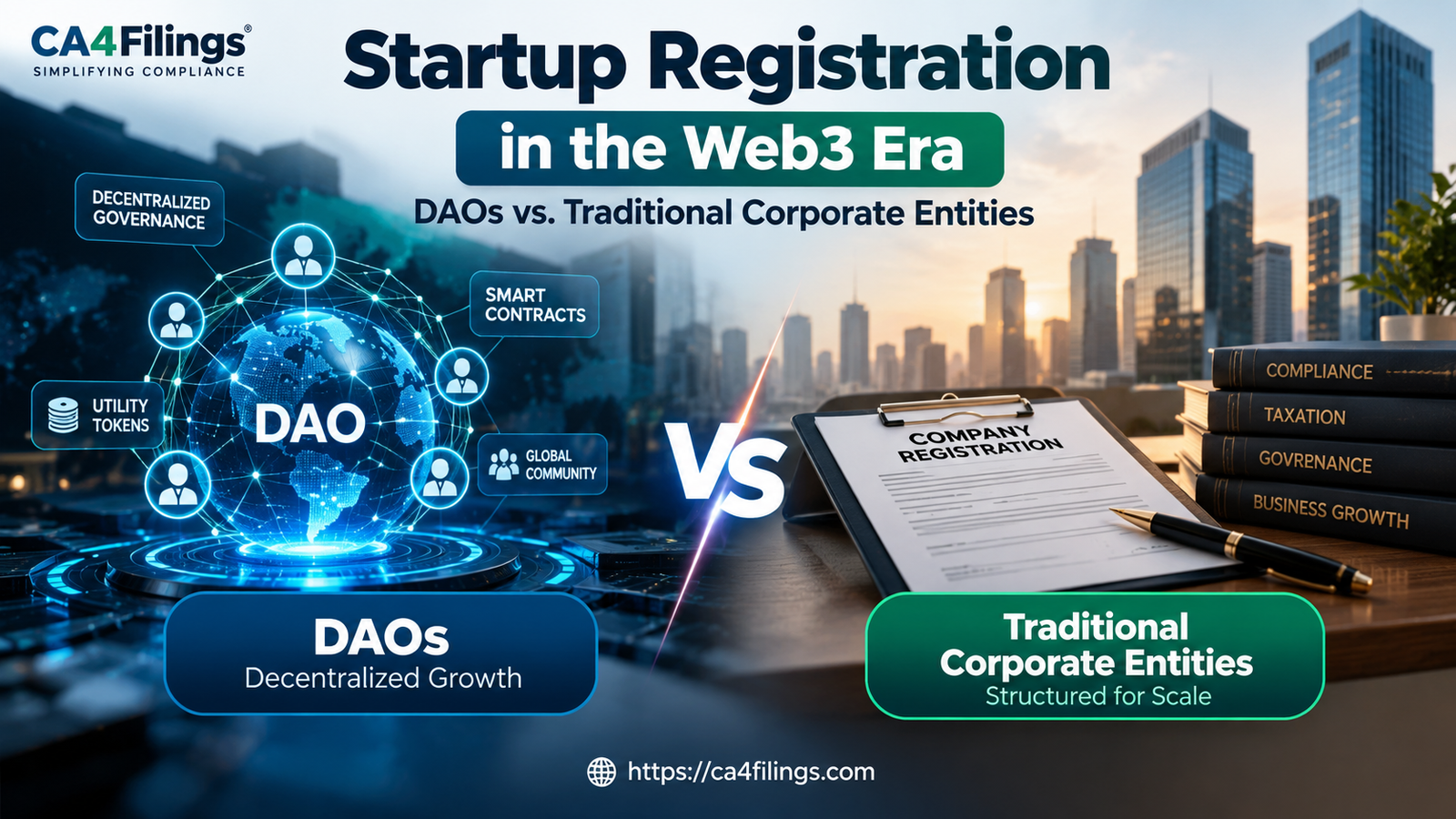
The way entrepreneurs build businesses is changing rapidly. With blockchain technology, cryptocurrencies, and decentralized platforms becoming more common, founders are exploring new ways to launch and manage their ventures. This shift has made startup registration an important consideration for both traditional businesses and Web3-based projects.
In India, entrepreneurs generally choose established legal structures such as private limited companies, LLPs, and partnerships. However, Web3 founders may also consider a decentralized autonomous organization (DAO), where community members participate in decision-making through blockchain-based rules and smart contracts.
At CA4Filings, we help entrepreneurs understand the legal and financial implications of different business structures. If you are planning a conventional venture, our Company Registration services can help you understand the process of establishing a compliant business in India. For Web3 founders, the decision requires additional thought because decentralization does not automatically eliminate legal, tax, or regulatory responsibilities.
Let's explore how DAOs compare with traditional corporate entities and what Indian founders should consider before choosing a structure.
What Is Startup Registration in the Web3 Era?
Startup registration refers to the process of establishing a legally recognised business entity, completing applicable registrations, and meeting regulatory requirements.
In the Web3 ecosystem, this process can be more complex because a project may involve blockchain protocols, digital assets, international contributors, token-based fundraising, and decentralised governance.
For example, imagine a startup developing a decentralised finance application. Its founders may want to issue tokens, accept contributions from users worldwide, and allow community members to vote on product updates.
While the technology supports decentralised operations, the founders must still evaluate questions such as:
Who legally owns the intellectual property?
Who is responsible for contractual obligations?
How will income, expenses, and digital assets be recorded?
What tax and regulatory requirements apply?
Who will be accountable if the project causes financial losses?
Answering these questions early makes startup registration more practical and helps prevent legal disputes later.
What Is a Decentralized Autonomous Organization (DAO)?
A decentralized autonomous organization is a blockchain-based organisation that uses smart contracts and community voting to coordinate certain activities.
Instead of relying entirely on a conventional management hierarchy, a DAO may allow token holders or designated members to propose changes, vote on decisions, and influence how its treasury is used.
Key Features of a DAO
Decentralised governance: Decision-making may be distributed among community members.
Smart contract automation: Certain rules and transactions execute automatically when specified conditions are met.
Transparent transactions: Public blockchains can provide an auditable record of transactions.
Global participation: Contributors may participate from different jurisdictions.
Community ownership: Governance tokens or membership arrangements may give participants specified rights.
However, a DAO is not automatically a separate legal person simply because it operates through blockchain technology. Its legal status depends on the applicable jurisdiction, legal arrangements, and relevant facts.
For Indian founders, this distinction is particularly important. A DAO operating without a clearly identified legal entity may face challenges when entering contracts, hiring employees, opening bank accounts, or protecting its intellectual property.
Traditional Corporate Entities: A Practical Overview
Traditional corporate entities offer established legal frameworks for conducting business. In India, the most common options for entrepreneurs include private limited companies and limited liability partnerships.
1. Private Limited Company
A private limited company is often suitable for startups planning to raise investment, build products, hire employees, or expand commercially.
Its advantages include:
A separate legal identity.
Limited liability for shareholders, subject to applicable law.
A defined ownership and management framework.
Greater familiarity among many institutional investors.
An established structure for issuing shares and documenting ownership.
A private limited company can also develop blockchain products or provide Web3 services. Using blockchain technology does not require a business to abandon conventional incorporation.
2. Limited Liability Partnership (LLP)
An LLP may suit founders running a professional services business, a blockchain consultancy, or a smaller technology venture with a partnership-oriented management model.
Its key benefits include limited liability, operational flexibility, and a defined legal framework under Indian law.
However, an LLP may not be the preferred choice for every venture, particularly where the founders intend to raise conventional equity investment from venture capital funds.
3. Partnership or Sole Proprietorship
These structures may suit smaller businesses or individual consultants. However, they may offer less protection against personal liability than an appropriately structured limited liability entity.
The right choice depends on the business model, investment plans, ownership arrangements, and legal risks.
DAO vs. Traditional Company: Which Is Better?
Choosing between a DAO and a conventional company requires looking beyond technology. The important question is how the organisation will operate, raise money, manage liability, and comply with applicable laws.
| Factor | DAO | Traditional Company |
|---|---|---|
| Governance | Often community-driven | Directors and shareholders under a defined framework |
| Legal identity | May be uncertain without a recognised legal structure | Established under applicable company law |
| Liability | Depends on legal arrangements and circumstances | Generally limited for shareholders, subject to law |
| Fundraising | May involve token-based or community funding | May involve equity, debt, or other permitted instruments |
| Compliance | Can involve complex cross-border questions | Established filing and compliance procedures |
| Banking | May be challenging without a suitable legal entity | Generally more straightforward, subject to bank policies |
| Accountability | Can be distributed across participants | Responsibilities can be assigned to identifiable officeholders |
For example, a blockchain gaming project may use DAO-style voting to let its community influence game development. At the same time, a registered company could employ developers, own intellectual property, sign vendor agreements, and manage commercial operations.
This hybrid arrangement can combine community participation with a clearer legal and operational framework. However, its effectiveness depends on the actual contracts, governance rights, tax treatment, and regulatory requirements.
Legal and Compliance Considerations for Indian Web3 Startups
Startup registration is only the first step. Web3 founders should assess their ongoing obligations before launching a platform or offering digital assets to the public.
1. Smart Contract Legalities
Smart contracts automate transactions, but they do not automatically resolve every legal issue. Their enforceability depends on the applicable law, contractual terms, consent, and surrounding circumstances.
Founders should consider:
Documenting the rights and obligations of participants.
Reviewing the legal implications of automated payments.
Establishing procedures for coding errors and security incidents.
Defining dispute resolution and liability arrangements.
A smart contract audit can help identify technical vulnerabilities, but it does not replace legal review.
2. Utility Token Issuance
Utility tokens may provide access to a platform, application, or specified digital service. However, their legal treatment depends on their actual features and how they are marketed and used.
Before proceeding with utility token issuance, founders should assess applicable Indian laws, investor protection considerations, tax implications, and cross-border restrictions.
A token labelled as a utility token is not automatically exempt from financial or other regulatory requirements.
3. Digital Asset Corporate Structure
A digital asset corporate structure should clarify which entity owns the software, holds treasury assets, enters into agreements, and manages business operations.
Founders should also establish appropriate wallet controls, transaction approval procedures, accounting policies, and records of token holdings.
Separating personal holdings from business assets is a sensible starting point for financial transparency and risk management.
4. Blockchain Compliance and Taxation
Blockchain compliance may involve company law, tax reporting, anti-money-laundering requirements, data protection, and other rules depending on the activities undertaken.
In India, virtual digital assets are subject to specific income-tax provisions, including Section 115BBH where applicable. Certain transfers also attract tax deducted at source under Section 194S, subject to the relevant conditions and exceptions.
The tax treatment of a transaction depends on its nature and the applicable provisions. Founders should not assume that decentralised operations or overseas participants automatically remove Indian tax obligations.
Step-by-Step Guide to Startup Registration for Web3 Founders
At CA4Filings, we recommend the following practical approach before launching a Web3 venture.
Step 1: Define Your Business Model
Identify whether you are building a blockchain software company, a decentralised protocol, a token-based platform, or a community-governed project.
Your business model will influence the appropriate legal structure.
Step 2: Select the Legal Entity
Compare a private limited company, LLP, and any legally available DAO-related arrangement. Consider liability, investment requirements, governance, and ownership.
Step 3: Complete Incorporation Formalities
Where a company is appropriate, complete the applicable name reservation, incorporation documentation, director identification, registered office, and other formalities through the prescribed process.
Step 4: Establish Governance and Contracts
Prepare founder agreements, intellectual property assignments, contributor agreements, and governance policies. Clearly document the relationship between any incorporated entity and the DAO.
Step 5: Set Up Accounting and Tax Processes
Maintain reliable records of fiat transactions, digital asset holdings, expenses, and applicable taxable events. Seek professional advice on GST and other indirect tax obligations where relevant.
Step 6: Review Compliance Before Launch
Assess token-related restrictions, applicable reporting requirements, cybersecurity risks, data protection obligations, and the rules governing your intended services.
Completing these steps before accepting funds or launching a token can reduce avoidable legal and financial complications.
Latest Updates
ca4filings.com Services