How Can I Register a Company for an Event Planning or Hospitality Business?
Learn how can i register a company for an event planning or hospitality business in India, including legal structures, licences, GST and compliance.
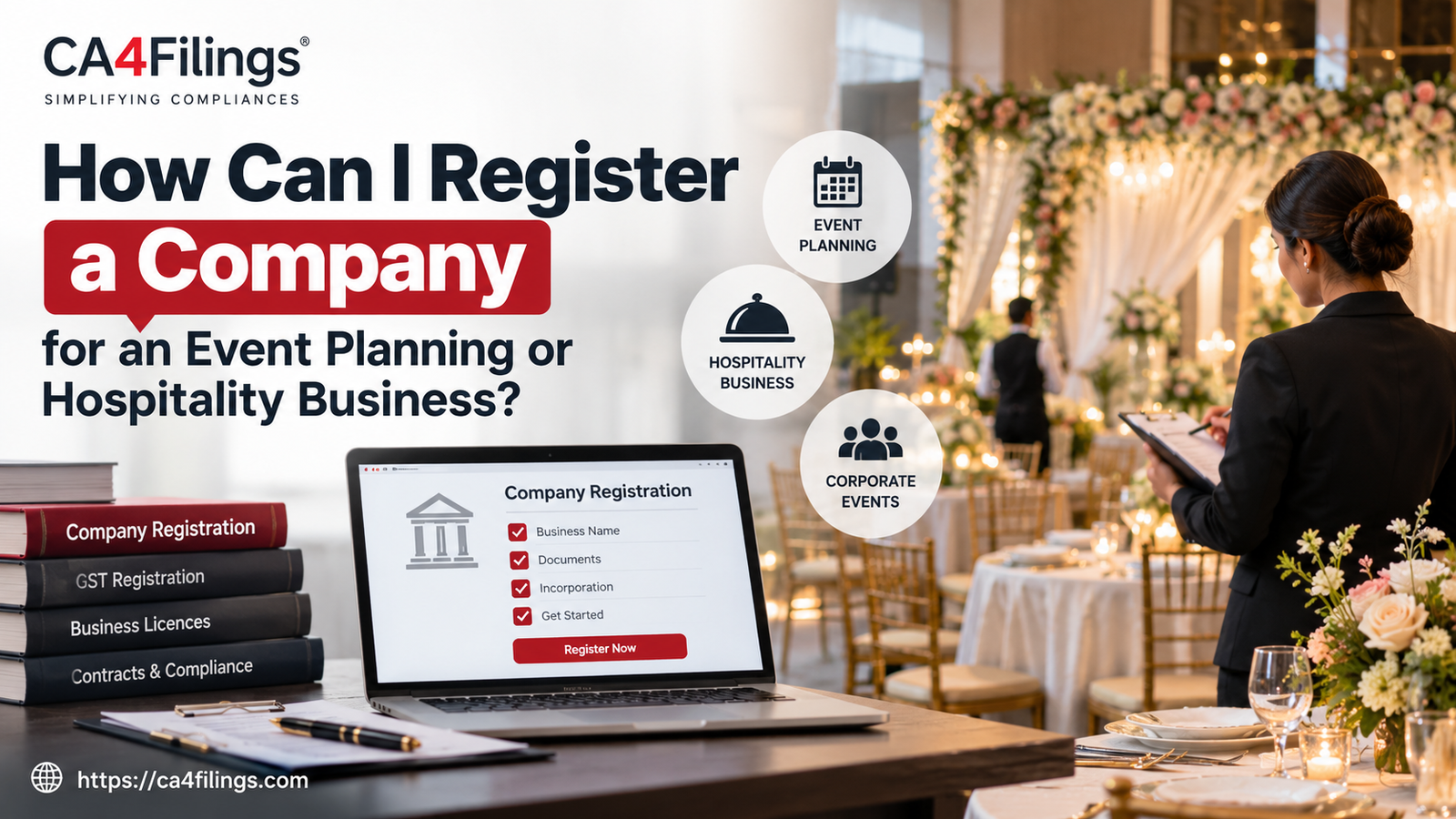
If you are planning to start an event management, wedding planning, catering, or hospitality business, one of your first questions will be: how can i register a company in India? Whether you want to organise corporate conferences, manage destination weddings, provide catering services, or operate a hospitality venture, choosing the right business structure is essential for long-term success.
At CA4Filings, we understand that starting a business involves more than finding clients and arranging memorable events. You also need to consider legal registration, taxation, licences, contracts, and financial management. Getting these things right from the beginning can help you avoid unnecessary complications as your business grows. Our Company Registration services can help entrepreneurs establish their businesses with the appropriate legal structure and documentation.
Let us explore the registration process, important licences, and practical considerations for starting an event planning or hospitality business in India.
How Can I Register a Company for an Event Planning Business in India?
The registration process depends on your business goals, number of owners, expected turnover, and expansion plans. For example, a freelance wedding planner may initially operate as a sole proprietor, while an entrepreneur planning to manage large corporate events across multiple cities may prefer a private limited company.
Before starting the registration process, consider these business structures.
1. Sole Proprietorship
A sole proprietorship is suitable for individuals starting small event planning, decoration, or independent hospitality services.
Key features include:
Simple setup with relatively low initial costs.
Complete control over business decisions.
Business income is generally taxed as the proprietor's personal income.
The owner has unlimited personal liability for business obligations.
You may need supporting registrations, such as GST registration, Shops and Establishments registration, or local trade permissions, depending on your activities and applicable rules.
2. Partnership Firm or LLP
If you intend to run the business with another person, you can consider a partnership firm or a Limited Liability Partnership (LLP).
A partnership firm allows two or more individuals to share responsibilities and profits. However, partners generally face personal liability for the firm's obligations.
An LLP offers a separate legal identity and limited liability, making it useful for event planners, catering professionals, and hospitality consultants working together.
3. Private Limited Company
A private limited company is often suitable for entrepreneurs who want to build a scalable event management or hospitality brand.
Its benefits include:
A separate legal identity.
Limited liability for shareholders, subject to applicable law.
Better suitability for bringing in investors.
Greater flexibility when expanding operations or entering corporate service agreements.
A private limited company also involves annual filings, accounting requirements, and other statutory compliances. Therefore, consider your budget and long-term objectives before selecting this structure.
Step-by-Step Guide: How Can I Register a Company?
Once you have selected the appropriate business structure, follow these steps to establish your business legally.
Step 1: Choose a Suitable Business Name
Select a unique, professional name that reflects your services. If you are starting a wedding planning company, for example, your name should communicate creativity, reliability, and professionalism.
For a company or LLP, check name availability through the Ministry of Corporate Affairs (MCA) and ensure that the proposed name complies with applicable naming rules. Also check relevant trademark records to reduce the risk of brand conflicts.
Step 2: Arrange the Required Documents
For a private limited company, the usual documents include:
PAN and identity proof of directors and shareholders.
Address proof of directors and shareholders.
Recent photographs, where required.
Registered office address proof.
Utility bill for the registered office.
No-objection certificate from the property owner, where applicable.
Foreign nationals or non-resident participants may need additional documents and authentication.
Step 3: Apply for Incorporation
Company incorporation is generally completed through the MCA's online system using the applicable incorporation forms, including the SPICe+ process.
The process typically involves obtaining digital signatures, completing director identification formalities, submitting incorporation details, and providing the required declarations.
Once the application is approved, the company receives a Certificate of Incorporation and a Corporate Identity Number (CIN). PAN and TAN are generally issued through the integrated incorporation process.
Step 4: Open a Business Bank Account
After incorporation, arrange a bank account in the company's name. Banks generally request incorporation documents, PAN, constitutional documents, and KYC information.
Keep personal and business transactions separate. This makes bookkeeping easier and helps you monitor event-wise expenses, customer advances, vendor payments, and profitability.
Step 5: Complete Tax and Local Registrations
Depending on your business activities and location, you may need GST registration, Shops and Establishments registration, municipal permissions, or other industry-specific approvals.
For instance, an event management company supplying taxable services may need to evaluate GST registration requirements based on its turnover, location, and applicable exceptions.
What Licences Does an Event Planning or Hospitality Business Need?
Registering a company does not automatically authorise every business activity. Additional permissions depend on what you provide, where your events take place, and whether you serve food or alcoholic beverages.
1. GST Registration
GST registration may be required when your business meets the applicable statutory threshold or falls within a compulsory registration category. Thresholds and exceptions vary according to the circumstances.
Event planners should also understand invoicing, input tax credit eligibility, advance payments, and the tax treatment of bundled services.
2. FSSAI Registration or Licence
If your business prepares, stores, distributes, or serves food as a food business operator, you may need registration or a licence from the Food Safety and Standards Authority of India (FSSAI), depending on the nature and scale of operations.
For example, a wedding planner arranging catering through an independent caterer should clarify which party is responsible for the applicable food safety permissions.
3. Liquor Liability Permits and Alcohol Permissions
If your events involve alcohol, verify the applicable state excise laws and event-specific permissions. Depending on the location and arrangement, a temporary liquor licence or other authorisation may be necessary.
Liquor liability permits and related insurance considerations should be assessed carefully, particularly when your business directly serves or arranges alcoholic beverages. Requirements differ across states, so do not assume that a permission issued in one state applies elsewhere.
4. Fire Safety and Local Permissions
Large venues, temporary structures, exhibitions, and public gatherings may require fire safety clearances, police permissions, sound permissions, or other local approvals.
Check the requirements with the relevant authorities and venue management before confirming an event.
Contracts and Insurance: Protecting Your Business
Understanding how can i register a company is only one part of establishing a sustainable event planning business. Proper contracts and insurance are equally important for managing commercial risks.
1. Venue Service Agreements
Your venue service agreements should clearly specify the booking amount, payment milestones, cancellation terms, event timings, permitted activities, damage liability, and responsibilities for obtaining approvals.
For example, if a venue becomes unavailable because of an unexpected closure, your agreement should explain how refunds, rescheduling, and related costs will be handled.
2. Vendor Contracts
Always use written vendor contracts with decorators, caterers, photographers, entertainers, transport providers, and equipment suppliers.
Your contracts should cover:
Scope of work and agreed deliverables.
Pricing, taxes, and payment schedules.
Setup and dismantling timelines.
Replacement arrangements if a vendor fails to deliver.
Cancellation, refunds, and dispute resolution.
Written agreements reduce misunderstandings and make accountability easier.
3. Event Cancellation Insurance
Event cancellation insurance may help protect against specified financial losses arising from covered cancellations or disruptions. Public liability and other suitable insurance policies may also be worth considering.
Review policy exclusions, deductibles, coverage limits, and claim conditions before purchasing a policy. Not every cancellation or business loss will be covered.
Common Mistakes to Avoid During Company Registration
Entrepreneurs often focus on securing bookings while overlooking essential compliance requirements.
Avoid these common mistakes:
Choosing a business structure without considering liability and future expansion.
Using a name without checking availability or trademark conflicts.
Mixing personal and business finances.
Ignoring GST, income tax, and annual filing obligations.
Assuming company incorporation covers all industry-specific licences.
Accepting large customer advances without written cancellation terms.
Signing vendor agreements without defining responsibilities and refund conditions.
A little preparation at the beginning can prevent costly disputes and compliance problems later.
Latest Updates
ca4filings.com Services