Understanding the Penalties for Non-Compliance with MSME Registration Requirements
Learn MSME registration non-compliance penalties, avoid fines, disputes, and legal risks, and keep your business protected with ease.
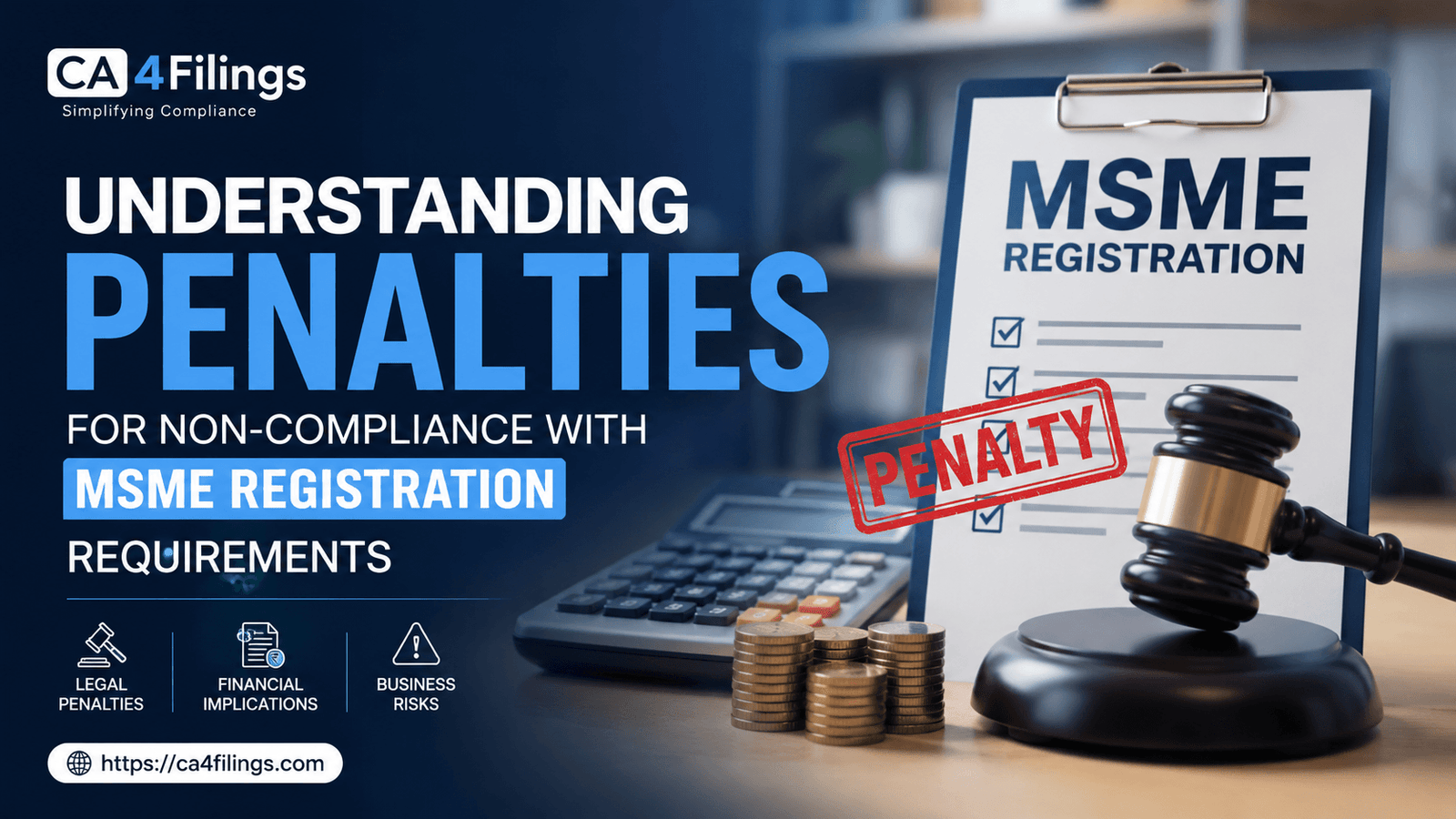
Running a business in India is an exhilarating journey, but it comes with a fair share of regulatory responsibilities. Over the last few years, the Government of India has heavily pushed for the formalization of smaller businesses, primarily through the Micro, Small, and Medium Enterprises (MSME) framework, now known as Udyam Registration. As Chartered Accountants at CA4Filings, we often get asked by enthusiastic entrepreneurs: "Is it mandatory to register, and what happens if we don’t" If you are looking for clarity, you are in the right place. Today, we are diving deep into the critical topic of Understanding the Penalties for Non-Compliance with MSME Registration Requirements so you can protect your enterprise from unexpected legal and financial hurdles.
Before we unpack the finer details of compliance, let’s address the foundation. While getting your business registered under the Udyam portal offers an incredible basket of benefits—including collateral-free bank loans, massive subsidies on patent registrations, and protection against delayed payments—many business owners treat it as optional or delay the process. However, delaying or misrepresenting facts during your MSME Registration can attract strict statutory consequences. Navigating these rules isn't just about avoiding fines; it is about building a credible, sustainable brand that vendors and banks can trust.
Let’s break down everything you need to know about compliance, Section 22 of the MSMED Act, and how a few simple steps can keep your business perfectly safe.
Understanding the Penalties for Non-Compliance with MSME Registration Requirements: The Core Statutory Provisions
The primary law governing small scale industries in India is the Micro, Small and Medium Enterprises Development (MSMED) Act, 2006. While registration on the Udyam portal is technically voluntary for many general benefits, the Act imposes absolute transparency and accuracy once you opt-in or engage with other registered MSMEs.
When it comes to Understanding the Penalties for Non-Compliance with MSME Registration Requirements, Section 27 of the MSMED Act is the most critical clause you need to know.
According to Section 27, any business owner who intentionally misallocates data, suppresses material facts, or provides false financial information regarding their plant, machinery, or turnover during or after registration faces strict statutory fines:
First Offence: A fine that can extend up to ₹1,000.
Subsequent Offences: For second and continuous non-compliances or repeated false declarations, the fine can scale from a minimum of ₹1,000 up to ₹10,000.
While these flat numeric penalties might seem relatively small on paper, the secondary, operational, and financial penalties resulting from non-compliance can completely cripple a growing company's cash flow.
The Hidden Costs: Beyond the Official Section 27 Fines
As CAs, we always tell our clients that the official government penalty is only the tip of the iceberg. The true damage of non-compliance happens in your day-to-day business operations, banking relationships, and corporate reputation.
1. Retroactive Loss of Delayed Payment Protection
Under Section 15 of the MSMED Act, buyers are legally mandated to clear an MSME's dues within 45 days (if there is a written agreement) or 15 days (if there is no written agreement). If they fail, they must pay compound interest at three times the bank rate notified by the RBI.
However, if your registration details are non-compliant, outdated, or declared incorrectly, you lose your legal standing before the MSME Samadhan Council. If a buyer defaults on your payment, you cannot easily claim that 3x interest, leaving your working capital permanently blocked.
2. Disallowance of Expenses Under Section 43B(h) of the Income Tax Act
This is the biggest game-changer introduced recently. Under Section 43B(h), large buyers cannot claim an income tax deduction for purchases made from a registered MSME unless they clear the payment within the 45-day/15-day window.
If you provide an invalid or non-compliant Udyam certificate to your corporate buyers, they cannot safely compute their tax liabilities. Many large corporations are now actively auditing their vendors. If your business fails this compliance check, large companies will simply stop buying from you to avoid their own tax complications.
3. Banking Complications and Subsidy Reversals
Many business owners enjoy a 1% to 2% concession on overdrafts or term loan interest rates based on their MSME status. If an audit reveals that your turnover or investment numbers were misreported—meaning you are non-compliant with the registration parameters—banks hold the right to reverse your lower interest rate retroactively and charge penal interest rates.
Practical Steps to Ensure 100% MSME Compliance
Avoiding penalties doesn't require complex legal gymnastics. It simply requires operational discipline. Here is a step-by-step compliance checklist we recommend at CA4Filings:
Align with ITR and GSTIN Data: The Udyam portal is now fully integrated with the Income Tax (PAN) and GST networks. The portal automatically pulls your investment in plant & machinery and your annual turnover. Never try to manually manipulate these numbers during renewals.
Annual Upgradation of Udyam Details: If your business transitions from Micro to Small, or Small to Medium due to a surge in turnover, ensure your portal profile updates automatically or file an amendment. Failing to update changes can be viewed as suppressing material facts.
Mention Udyam Registration on Invoices: To leverage the delayed payment laws perfectly, print your correct Udyam Registration Number on all tax invoices, purchase orders, and official letterheads.
Real-World Example: The Danger of "Creative Bookkeeping"
Consider the case of a manufacturing unit in Pune that deliberately under-reported its investment in manufacturing equipment to remain classified as a "Small" enterprise rather than a "Medium" one, hoping to retain exclusive local government tenders.
During a routine tax audit, the discrepancy was caught because their depreciation schedules in their Income Tax Returns didn't match their Udyam declarations. Not only did they face scrutiny under Section 27 of the MSMED Act, but they were also disqualified from the government tender, blacklisted for future bids, and their bank recalled their concessional credit lines. It was a costly lesson that could have been completely avoided with accurate, honest filing.
Frequently Asked Questions (FAQs)
Q1. Is MSME/Udyam registration mandatory for every small business in India?
Technically, registration is voluntary. However, if you want to claim government subsidies, apply for priority sector bank loans, or enforce the 45-day payment protection rule against your buyers, registration becomes practically essential. Furthermore, large corporate clients will demand it from you to satisfy their own Section 43B(h) tax compliance.
Q2. What is the penalty for uploading fake documents on the Udyam Portal?
The Udyam portal operates on a self-declaration basis linked to your PAN and GST. If you intentionally falsify records or enter incorrect data to game the system, Section 27 of the MSMED Act applies a fine up to ₹1,000 for the first offence and up to ₹10,000 for subsequent offences, alongside potential exposure to fraud charges under the Indian Penal Code if financial losses are caused to lenders.
Q3. Can my MSME registration be cancelled by the government for non-compliance?
Yes. If an authorized investigating officer finds that an enterprise has misrepresented its classification category or provided fraudulent data, the competent authority holds the right to suspend or cancel the Udyam Registration certificate after giving the business a fair opportunity to be heard.
Q4. How does the 45-day payment rule protect me if my buyer goes bankrupt?
If your registration is fully compliant and valid, you can file an official case with the Micro and Small Enterprise Facilitation Council (MSEFC). The Council's directive acts as a legal decree. Even during insolvency proceedings, MSME dues are given significant weight, and buyers are highly hesitant to delay these payments due to the mandatory 3x penal interest rule.
Let CA4Filings Safeguard Your Business Growth
Understanding the Penalties for Non-Compliance with MSME Registration Requirements is not about fearing the law; it is about respecting the guardrails that allow your business to scale safely. In the modern Indian economic landscape, transparency is rewarded, and non-compliance is penalized heavily through lost opportunities, canceled contracts, and tarnished banking relationships.
Don't let minor technical errors or missing updates put your hard-earned business at risk. At CA4Filings, we take the regulatory weight off your shoulders. Our team of expert Chartered Accountants ensures that your business documentation, tax returns, and corporate declarations sync perfectly with government portals, keeping you 100% compliant, always.
Latest Updates
ca4filings.com Services

























-registration.png)