Step-by-Step Process for MSME Registration in India
Learn the complete Step-by-Step Process for MSME Registration in India. Secure your Udyam certificate and unlock massive government benefits today.
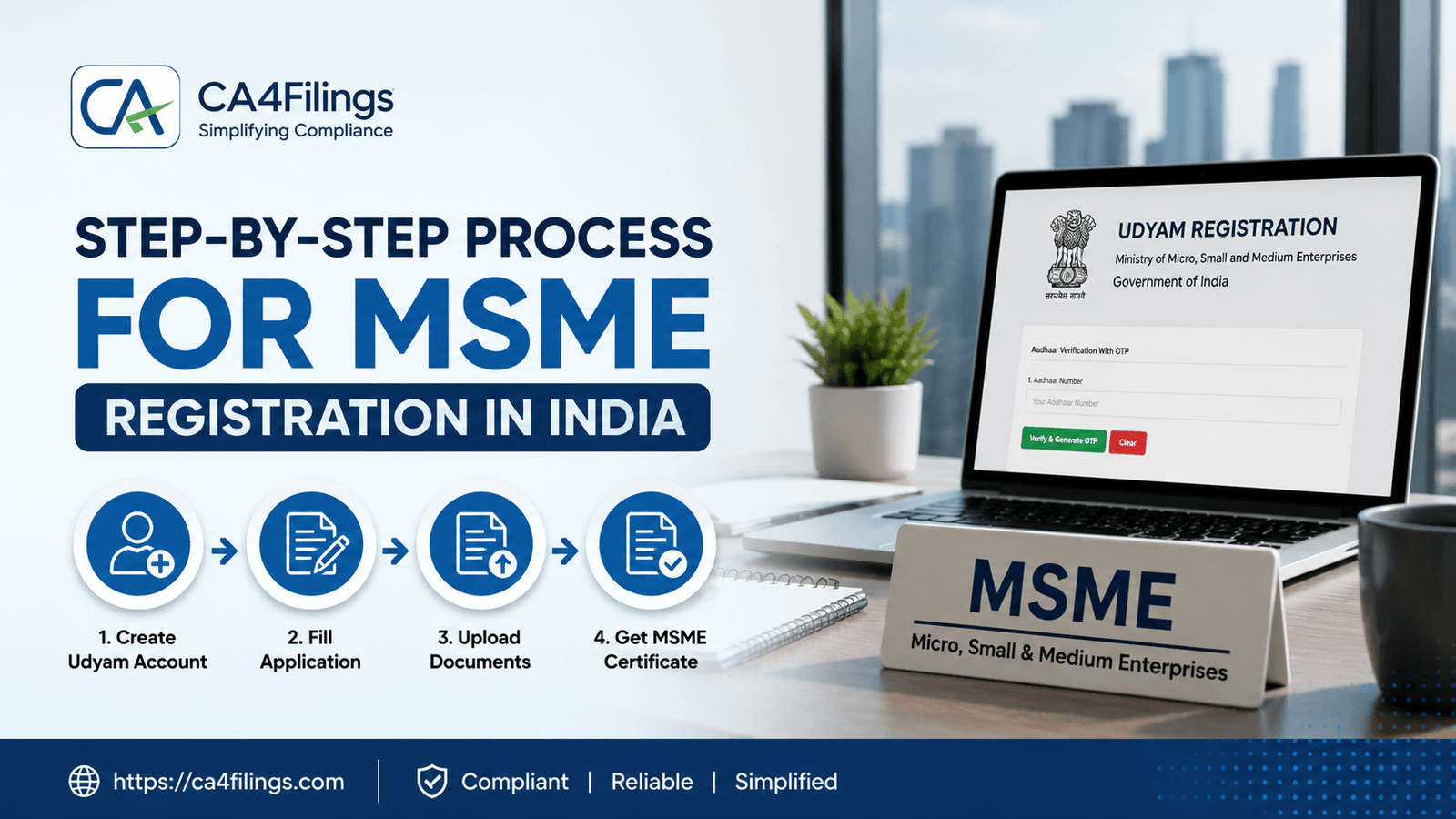
Running a business in India is an exhilarating journey, but it also comes with its fair share of regulatory compliance and financial hurdles. As Chartered Accountants, we frequently meet passionate entrepreneurs who miss out on incredible government schemes simply because they lack formal certification. If you want to scale your business, secure cheaper credit, and protect your enterprise against delayed payments, understanding the Step-by-Step Process for MSME Registration in India is the most critical first move you can make. At CA4Filings, we believe that formalizing your business shouldn't be a tedious chore, which is why we have crafted this comprehensive guide to simplify the pathway for you.
The Micro, Small, and Medium Enterprises (MSME) sector serves as the absolute backbone of the Indian economic ecosystem, driving employment and manufacturing across the nation. To support these entities, the Government of India introduced the Udyam platform, which completely overhauled and streamlined the traditional system. Obtaining an online MSME Registration through this portal transforms your enterprise into a recognized legal entity, opening doors to an array of financial incentives and strategic advantages. Let us dive deep into the eligibility criteria, required documentation, and the actual procedural steps involved in getting your business registered.
Understanding MSME Classification and Eligibility Criteria
Before initiating the Step-by-Step Process for MSME Registration in India, it is vital to know exactly where your business fits within the updated government framework. The classification criteria were thoroughly revised to combine both investment in plant & machinery/equipment and annual turnover, completely eliminating the previous distinction between manufacturing and service sectors.
1. Micro Enterprises
An enterprise falls under the micro category if its total investment in plant, machinery, or equipment does not exceed ₹1 Crore, and its cumulative annual turnover does not exceed ₹5 Crore. This is an ideal bracket for proprietary startups, boutique agencies, and small manufacturing units.
2. Small Enterprises
For a small enterprise registration, the criteria shift upwards. Your business qualifies as a small enterprise if the total investment in plant and machinery does not cross ₹10 Crore, and the total annual turnover remains within the strict threshold of ₹50 Crore.
3. Medium Enterprises
If your enterprise is scaling rapidly, you might qualify for a medium enterprise registration. The revised limit for a medium-sized company dictates that the investment in plant and machinery must not exceed ₹50 Crore, and the total yearly turnover must remain under ₹250 Crore.
Expert CA Tip from CA4Filings: While calculating your annual turnover for eligibility, the export turnover of goods or services is completely excluded. This means if you are a heavy exporter, your international sales won't push you out of your beneficial MSME bracket!
Key MSME Benefits and Incentives in India
Why should you spend your time going through the MSME registration process in India? The answer lies in the phenomenal array of MSME benefits designed specifically to lower your operational costs and boost business sustainability.
Collateral-Free Bank Loans: Under the CGTMSE scheme, the government offers credit guarantees to financial institutions, allowing MSMEs to secure business loans without pledging personal or business properties as collateral.
Protection Against Delayed Payments: This is perhaps the biggest relief for small businesses. According to the MSMED Act, if you supply goods or services to a buyer, they must clear your payment within 45 days. Delayed payments attract compound interest at three times the bank rate notified by the RBI.
Substantial Electricity Bill Concessions: Many states provide direct rebates on power bills to businesses holding a valid Udyam certificate, drastically cutting down fixed manufacturing overheads.
Patent and Trademark Subsidies: To promote innovation, registered MSMEs receive up to a 50% subsidy on patent and trademark registration fees, making intellectual property protection highly affordable.
Exemption on Direct Tax and ISO Certification: Registered businesses can leverage various MSME incentives in India, such as a full reimbursement of expenses incurred during ISO certification audits and specific tax exemptions under central schemes.
Essential MSME Registration Requirements
The modern Indian MSME registration process is completely paperless, digital, and zero-cost on the official government portal. To ensure that your application proceeds without any unnecessary rejections, you must gather the fundamental MSME registration requirements beforehand:
Aadhaar Card: The Aadhaar number must belong to the proprietor (in case of a proprietorship), the managing partner (for a partnership firm), or the authorized director/promoter (for a Private Limited Company or LLP).
PAN Card: A Permanent Account Number is mandatory. For partnerships and companies, the entity's specific PAN is required, whereas a sole proprietor can use their personal PAN.
GSTIN (GST Number): Under the latest guidelines, having a GSTIN is linked directly to the Udyam portal for turnover verification, though specific exemptions apply to very small micro-units that do not hit the mandatory GST thresholds.
Bank Account Details: You will need the active account number and IFSC code of the business bank account to facilitate any direct benefit transfers or subsidy disbursements.
Business Address Proof: A basic utility bill, lease agreement, or property document indicating the primary place of business operation.
The Step-by-Step Process for MSME Registration in India
Now that you are well-versed with the prerequisites and benefits, let us walk through the exact step-by-step MSME registration guide to help you obtain your certificate seamlessly.
Step 1: Visit the Official Government Portal
Open your browser and navigate exclusively to the official Udyam Registration portal (udyamregistration.gov.in). Beware of fraudulent, look-alike private websites that charge exorbitant fees. The official government portal is absolutely free of cost.
Step 2: Enter Aadhaar and Validate with OTP
On the homepage, select the option for "New Entrepreneurs who are not yet registered as MSME". Enter the entrepreneur’s Aadhaar number and the exact name as printed on the Aadhaar card. Click on "Validate and Generate OTP". You will receive a 6-digit code on your mobile number linked with Aadhaar; enter it to proceed.
Step 3: PAN Verification and Entity Type Selection
Next, select your organizational type (e.g., Sole Proprietorship, Partnership, Private Limited Company) and input the PAN card details. Click "PAN Validate". The portal will communicate directly with the Income Tax databases to verify your credentials automatically.
Step 4: Fill in the Business Detail Form
Once your PAN is validated, a comprehensive application form will appear. You will need to accurately fill out:
The official name of your enterprise and the operational units.
The exact location and postal address of all your plants or offices.
Your active mobile number and professional email address.
The date of commencement of your business operations.
Step 5: Provide Bank Account and NIC Codes
Input your bank account number along with the specific IFSC code. Following this, you must select the appropriate National Industrial Classification (NIC) code for your business activities. You can search by entering keywords related to your business (e.g., "software development", "garment manufacturing") to pick the correct 2-digit, 4-digit, and 5-digit NIC codes.
Step 6: Enter Investment and Turnover Statistics
Specify the exact figures for investment made in plant and machinery alongside your total annual turnover. If you have filed your previous Income Tax Returns (ITR), these statistics are automatically fetched from the tax portal, leaving zero room for human discrepancies.
Step 7: Final Submission and Udyam Certificate Download
Review the entire digital form carefully to prevent typo errors. Select the checkboxes acknowledging your alignment with the declarations, and click on "Submit and Get Final OTP". Enter the final verification code received on your phone. Upon successful authentication, your unique Udyam Registration Number will be generated on screen. Within a couple of working days, your printable Udyam Certificate will be available for download from the same portal.
Common Pitfalls to Avoid During Registration
Even though the Step-by-Step Process for MSME Registration in India appears straightforward, small mistakes can lead to complex rectifications later. First, ensure your mobile number is updated and linked with your Aadhaar card; otherwise, you won't receive the mandatory validation OTPs. Second, avoid selecting incorrect NIC codes, as financial institutions look closely at these codes when processing your MSME incentives applications. Lastly, never misrepresent your investment values, as the system auto-reconciles data with the Income Tax and GST portals at the end of each financial year.
Frequently Asked Questions (FAQs)
Q1: Is there any government fee for the Step-by-Step Process for MSME Registration in India?
Ans: No, the government does not charge any processing or registration fees on the official Udyam portal. It is entirely free. If you hire professional experts like CA4Filings, you only pay nominal professional service fees for handling the verification and documentation seamlessly on your behalf.
Q2: Does the Udyam MSME certificate have a specific validity period?
Ans: Once issued, the Udyam registration certificate is valid for the lifetime of the business entity. There is no requirement for annual renewal, provided your investment and turnover remain within the prescribed MSME thresholds.
Q3: Can a single business owner obtain multiple MSME registrations?
Ans: No, an individual or a single business entity cannot hold multiple Udyam numbers. You can, however, add multiple separate manufacturing units, branches, or distinct business lines under the umbrella of a single MSME registration number.
Q4: Is it compulsory for traders to apply for MSME registration?
Ans: Yes, wholesale and retail traders are permitted to register on the Udyam portal. However, their benefits are primarily limited to securing priority sector lending from banks, and they may not qualify for specific manufacturing-centric subsidies.
Empower Your Business Journey Today
Taking your business to the next level requires a blend of hard work and strategic legal alignment. Completing the Step-by-Step Process for MSME Registration in India is undeniably one of the fastest, most effective ways to shield your business from financial shocks and accelerate growth through government-backed MSME benefits and incentives. Why leave money and valuable corporate protection on the table?
Let CA4Filings Handle Your MSME Journey Seamlessly
While the online portal is accessible, navigating proper NIC classification, investment entry alignment, and cross-verifying tax data demands expert precision to avoid compliance bottlenecks. At CA4Filings, our experienced team of Chartered Accountants takes the entire administrative burden off your shoulders, ensuring your Udyam certification is 100% accurate and compliant. Reach out to CA4Filings today, and let us fuel your business expansion!
Latest Updates
ca4filings.com Services






















-registration.png)