Impact of MSME Registration on Business Growth
Discover how securing your Udyam certificate alters your trajectory. Explore the direct Impact of MSME Registration on Business Growth with CA4Filings.
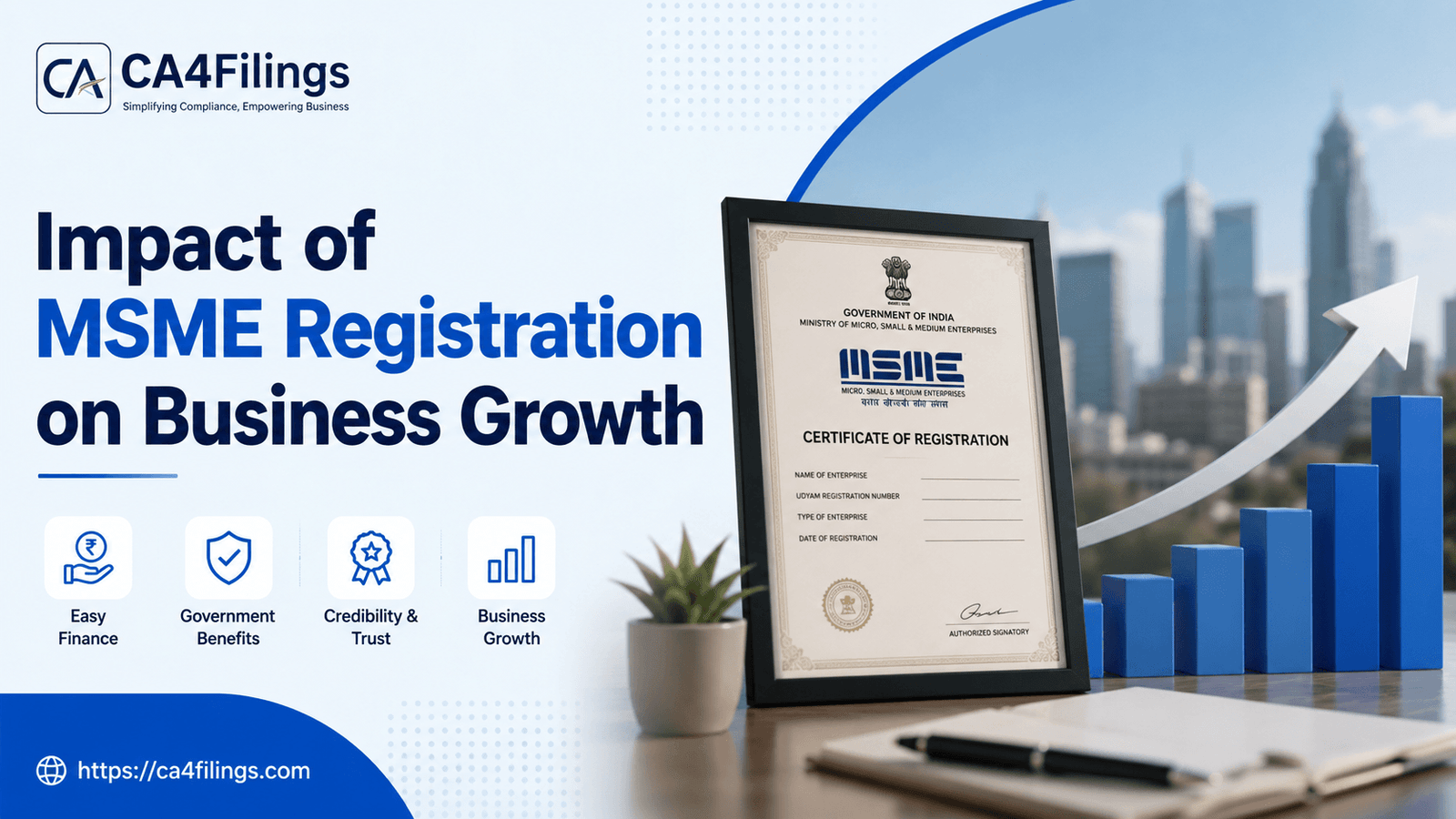
Starting a business in India is an exhilarating journey, fueled by long hours, late nights, and a vision to build something substantial. However, as many promoters quickly realize, passion alone isn’t enough to scale. In a competitive market like India, small and medium enterprises often face significant roadblocks, particularly regarding working capital management, collateral-free credit availability, and delayed payments from corporate clients.
If you are looking for a reliable way to overcome these hurdles, understanding the Impact of MSME Registration on Business Growth can completely change the trajectory of your enterprise. At CA4Filings, we regularly meet brilliant entrepreneurs who are running profitable operations but missing out on massive government-backed advantages simply because they haven’t officialized their status. By obtaining your online MSME Registration, you formally unlock a suite of legal protections and fiscal incentives explicitly engineered to fuel long-term expansion. Let's delve into how this single compliance step shifts your business into a high-growth phase.
Understanding MSME Registration and the Indian Landscape
Before exploring the macroeconomic benefits, it is crucial to establish a baseline by understanding MSME registration criteria under current Indian laws. The Ministry of Micro, Small and Medium Enterprises categorizes entities based on twin metrics: investment in plant and machinery/equipment, and annual turnover.
Micro Enterprises: Investment up to ₹1 Crore; Turnover up to ₹5 Crores.
Small Enterprises: Investment up to ₹10 Crores; Turnover up to ₹5 Crores to ₹50 Crores.
Medium Enterprises: Investment up to ₹50 Crores; Turnover up to ₹50 Crores to ₹250 Crores.
The registration process is entirely digital, handled through the government's official Udyam portal. It generates a permanent identification number and an e-certificate. While the registration itself is free and requires minimal documentation like your Aadhaar and PAN, the long-term impact of MSME registration on business operations is profound. It transitions your firm from the unorganized sector into a recognized, structured economic unit.
The Direct Impact of MSME Registration on Business Growth
When we evaluate the financial and operational health of growing firms, the benefits of MSME registration act as an immediate catalyst. Here is a comprehensive breakdown of how formal registration transforms your day-to-day operations and strategic scalability.
1. Unlocking Collateral-Free Bank Loans
The primary bottleneck restricting business growth for young companies is capital. Traditional bank loans often demand substantial property or fixed assets as security—assets that small scale promoters prefer to reinvest into operations.
Under the Credit Guarantee Fund Trust for Micro and Small Enterprises (CGTMSE) scheme, the Government of India provides guarantees to financial institutions, allowing them to extend collateral-free credit facility options to registered units. This drastically lowers the entry barrier for funding, ensuring your cash flow remains optimized for inventory purchase, talent acquisition, and market expansion.
2. Safeguarding Cash Flow Against Delayed Payments
One of the most powerful advantages of MSME Act provisions is the legal shield it provides against chronic payment delays. Large corporate buyers often stretch credit cycles, choking the liquidity of small vendors.
The MSME Development (MSMED) Act mandates that buyers must clear invoices within 45 days of accepting goods or services (or within the agreed period, whichever is shorter). If a buyer defaults, they are legally liable to pay compound interest to the supplier at three times the bank rate notified by the Reserve Bank of India. Access to the Micro and Small Enterprises Facilitation Council (MSEFC) gives you an affordable arbitration mechanism to recover stuck dues without long, expensive court battles.
3. Substantial Reductions in Operating Overhead Costs
To boost profitability and preserve vital runway, reducing non-essential expenses is vital. Registered entities enjoy multiple operational discounts that directly support long-term sustainability:
Electricity Bill Concessions: Many state governments offer reduced power tariffs for registered manufacturing units upon submitting their certificate.
Patent and Trademark Subsidies: Protecting intellectual property is expensive. The government offers up to a 50% subsidy on patent and trademark registration fees for verified MSMEs, enabling cost-effective innovation.
ISO Certification Reimbursement: Upgrading quality standards to compete internationally is easier when you can claim refunds on the expenses incurred during ISO certification processes.
4. Direct Entry into Lucrative Public Procurement Tenders
The Government of India runs a Public Procurement Policy which dictates that Central Ministries, Departments, and Public Sector Undertakings (PSUs) must source a minimum of 25% of their annual total purchases from micro and small enterprises.
Furthermore, registered units enjoy special waivers on Earnest Money Deposits (EMD) and security deposits when participating in government tenders. This opens up massive B2G (Business-to-Government) marketplaces that would otherwise be dominated exclusively by massive conglomerates, acting as a powerful engine for predictable revenue generation.
Comparing the Growth Curve: Registered vs. Unregistered Enterprises
| Growth Factor | Without Registration | With MSME Registration |
|---|---|---|
| Bank Loan Interest Rates | High retail rates (Often 12% - 16%) | Concessional business rates (Typically 1% - 1.5% lower) |
| Tender Eligibility | Requires heavy initial security deposits (EMD) | EMD waived; preferential procurement quotas applied |
| Payment Security | Vulnerable to prolonged buyer delays | Legal right to interest on dues pending past 45 days |
| Market Credibility | Seen as a casual, informal setup | Verified corporate identity via official Udyam portal |
Strategic Guidance from CA4Filings
At CA4Filings, we tell our clients that regulatory compliance should never be viewed as a checklist of hurdles; instead, it is a strategic tool. The collective impact of MSME registration on business ecosystems allows a proprietor to think less about short-term survival and more about structural scaling.
When you eliminate cash flow volatility through legal payment protections and lower your cost of capital through subsidized credit lines, you automatically enhance your operational margins. Those optimized margins can be aggressively deployed back into Research & Development, automation, and geographic expansion—the true building blocks of market leadership.
Frequently Asked Questions (FAQs)
Q1. Is MSME registration mandatory for all new businesses in India?
No, registration on the Udyam portal is completely voluntary. However, bypassing it means giving up critical legal protections against delayed corporate payments, tender advantages, and significant banking concessions that your competitors are likely utilizing.
Q2. Can a service-based business apply for an MSME certificate?
Yes, absolutely. The revised definitions implemented by the Ministry of MSME completely merged the classification criteria for manufacturing and service sectors. Both sectors are evaluated on identical investment and turnover parameters.
Q3. How long is the Udyam registration certificate valid?
The certificate issued upon registration is permanent. It does not carry an expiration date. However, you must update your financial numbers, investment figures, and turnover statistics annually on the portal after filing your Income Tax Returns (ITR) to maintain an accurate classification.
Q4. Does this registration provide benefits regarding direct taxation?
While the certificate doesn't automatically grant a blanket direct tax exemption, it makes your business eligible for several targeted government incentive schemes, low-interest working capital loans, and structural subsidies that indirectly lower your net tax burden by boosting allowable operational deductions.
Accelerate Your Journey with CA4Filings
Navigating government portals, choosing the right corporate classification, and aligning your documentation can feel overwhelming when you are busy managing daily customer deliverables. That is exactly where our team steps in to smooth out the wrinkles.
At CA4Filings, we handle the entire end-to-end documentation, classification review, and portal filing for your enterprise. Our team of experienced financial consultants ensures your application is processed flawlessly, preventing unexpected rejections or misclassifications that could delay your access to vital banking benefits. Don't let administrative inertia hold back your company's true potential. Reach out to CA4Filings today, and let's formalize your business structure to unlock sustainable marketplace growth.
Latest Updates
ca4filings.com Services
























-registration.png)