How to Appeal Against GST Cancellation Decisions
Learn how to appeal against GST cancellation decisions with our step-by-step CA guide. Protect your business and restore your GSTIN smoothly.
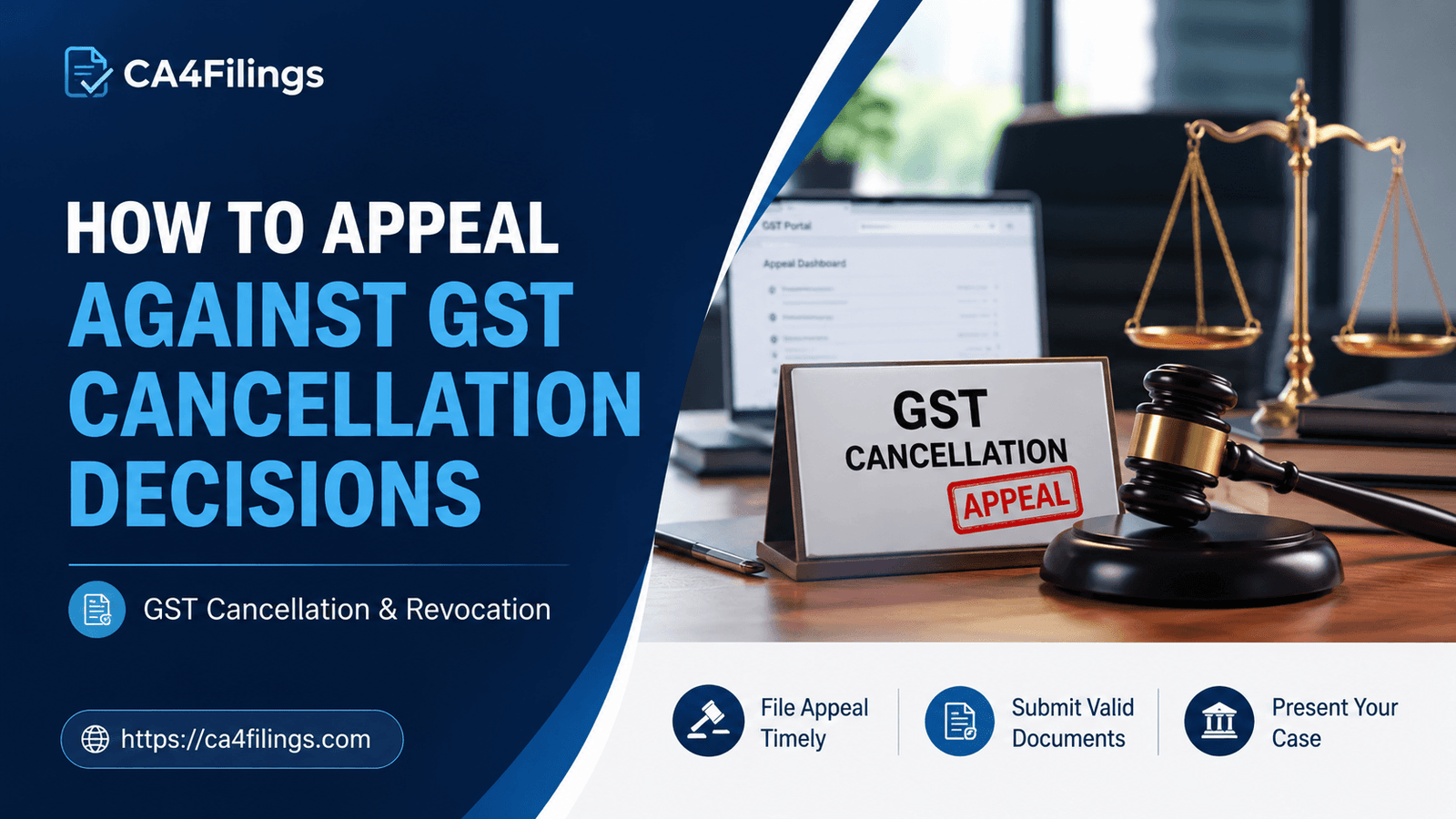
Imagine waking up on a busy Monday morning, logging into the GST portal to generate an e-way bill or file a return, and seeing a bold, red warning message: “Your GST Registration has been cancelled.” For any business owner in India, this is nothing short of a nightmare. It brings your entire operations to a grinding halt—you cannot issue tax invoices, you cannot pass on Input Tax Credit (ITC) to your clients, and your hard-earned business reputation takes an immediate hit.
If you are currently facing this situation, take a deep breath. A cancellation order is not the absolute end of the road. The law provides a robust mechanism to fight back, and today, we will walk you through exactly how to appeal against GST cancellation decisions so you can get your business back on track.
When a tax officer cancels your registration, you generally have two remedies: filing for a revocation of cancellation or filing an official appeal. If the deadline to apply for revocation has already passed, or if your revocation application was rejected by the officer, learning the right appeal process for tax authority decisions becomes your primary shield. At CA4Filings, we specialize in handling complex tax disputes, and we often manage cases under our GST Cancellation & Revocation services to help businesses navigate these turbulent waters smoothly.
Why Did the Tax Officer Cancel Your GSTIN?
Before understanding how to challenge GST cancellation decision notices, we must look at the root cause. Under Section 29(2) of the CGST Act, a proper officer can cancel a GST registration from a retrospective or prospective date under specific circumstances:
Non-Filing of Returns: Regular taxpayers who fail to file returns for a continuous period of six months (or three consecutive tax periods for composition dealers).
Voluntary Registration Non-Commencement: A person who took voluntary registration but did not commence business within six months.
Fraud or Misstatement: The registration was obtained by means of fraud, willful misstatement, or suppression of facts.
Violation of Anti-Profiteering Rules: Conducting business in violation of the rules prescribed under the GST Act (like claiming wrongful ITC).
In almost all cases, the tax authority will first issue a Show Cause Notice (SCN) via form GST REG-17. If you fail to reply to this notice within the stipulated time, or if your reply fails to convince the officer, they will pass a formal GST cancellation decision appealable order under form GST REG-19.
Understanding the Appeal Process for GST Cancellation
When a taxpayer receives a cancellation order in Form GST REG-19, they have the legal right to approach the First Appellate Authority. This process is governed by Section 107 of the CGST Act.
An appeal is essentially a formal request to a higher-ranking tax official to review and overturn the decision made by the lower-ranking proper officer who cancelled your registration. This mechanism is crucial for appealing decisions by tax authority figures when there has been an oversight, a technical glitch, or a disproportionate penalty levied on an honest taxpayer.
Step-by-Step Guide on How to Appeal Against GST Cancellation Decisions
Filing an appeal requires strict adherence to legal provisions and procedural steps. A minor technical error can lead to the rejection of your appeal. Here are the precise appeal steps for GST cancellation decision processes:
Step 1: Analyze the Cancellation Order
Log into the GST portal and download the cancellation order (Form GST REG-19). Carefully read the grounds on which the officer has cancelled your registration. Note the date of the order, as your statutory clock starts ticking from this day.
Step 2: Prepare the Statement of Facts and Grounds of Appeal
This is the most critical document. You need to draft a clear narrative explaining the "Statement of Facts" (what happened) and the "Grounds of Appeal" (why the cancellation order is legally or factually flawed). For example, if your returns weren't filed due to severe illness or an accounting team transition, document it with proof.
Step 3: Electronic Filing on the GST Portal
Log in to the GST Portal and navigate to Services > User Services > My Applications. Select the application type as Appeal to Appellate Authority and click on new application. Fill out the electronic form GST APL-01. Upload your drafted Grounds of Appeal, the SCN, the cancellation order, and all supporting evidence in PDF format.
Step 4: Submission of Hard Copies
After submitting Form GST APL-01 online, a provisional Acknowledgement Number is generated. Law requires you to submit a physical copy of the appeal application, along with all certified copies of the impugned order and supporting documents, to the Appellate Authority office within 7 days. Once verified, a final Acknowledgment (Form GST APL-02) is issued.
Step 5: Attend the Personal Hearing
The Appellate Authority will issue a notice fixing a date for a personal hearing. You or your authorized representative (like a CA from CA4Filings) must appear to argue the case, present legal precedents, and clarify any doubts the authority might raise.
Requirements for Appealing GST Cancellation Decision
To ensure your appeal is admitted and not dismissed at the threshold, you must fulfill the basic statutory requirements for appealing GST cancellation decision orders:
The Limitation Period (Time Limit): The appeal must be filed within 3 months from the date on which the cancellation order was communicated to you. The Appellate Authority can condone a delay of an additional 1 month if you can show a sufficient, genuine cause for the delay.
Payment of Admitted Dues: You cannot appeal if you owe admitted tax liabilities. You must pay 100% of the tax, interest, fine, and penalty arising from the order that you admit to owing.
Pre-Deposit Requirement: To challenge the disputed part of an order, you must pre-deposit an amount equal to 10% of the disputed tax amount. However, in pure registration cancellation cases where no specific tax demand is raised, the pre-deposit is usually minimal or restricted to outstanding late fees and interest on pending returns.
Clearance of Pending Returns: While not an explicit pre-requisite to file the appeal, the Appellate Authority will almost always direct you to file all pending returns and clear all outstanding tax liabilities before they order the restoration of your GST registration.
Practical Insights: A Real-World Example
Let's look at a case handled by our team. A manufacturing client in Delhi had their GST registration cancelled retrospectively because their landlord forgot to renew the commercial rent agreement, and a sudden physical verification by the tax department marked the business premises as "non-existent."
The client missed the deadline for a revocation application. We stepped in to manage their GST registration cancellation appeal. We compiled electricity bills, current bank statements, board resolutions, and a newly executed lease deed to prove continuous business operations at that location. During the personal hearing, we established that the business was genuine and actively paying taxes. The Appellate Authority accepted our grounds, reversed the cancellation decision, and restored the client's GSTIN, saving them from massive business disruption.
Frequently Asked Questions (FAQs)
Q1. Can I apply for a new GST registration if my old one is cancelled?
No, it is highly discouraged. If you apply for a new GSTIN while an older registration is cancelled by an officer for non-compliance, the tax portal or the reviewing officer will likely reject your new application. Your best course of action is learning how to appeal against GST cancellation decisions and restoring your original GSTIN.
Q2. What happens to my Input Tax Credit (ITC) during the cancellation period?
When your registration is cancelled, your GSTIN becomes inactive. You cannot claim ITC on purchases made during this period, nor can your buyers claim ITC on sales made by you. Once you successfully win the appeal and your GSTIN is restored retroactively, you can file the pending returns and regularize the ITC flow.
Q3. What is the difference between Revocation and an Appeal?
Revocation is an administrative remedy filed directly to the same officer who cancelled your registration, usually within 90 days of the order. An appeal is a quasi-judicial remedy filed before a higher authority (Appellate Authority) when the revocation route is closed or rejected.
Q4. Can I file a GST appeal online without physical submission?
While the initial filing of Form GST APL-01 is completely online on the GST portal, the law mandates submitting the physical, certified copy of the cancellation order and the appeal memo to the appellate office within 7 days to get your final acknowledgment.
Let CA4Filings Handle Your GST Appeal
Filing a GST cancellation decision appeal involves navigating intricate legal jargon, preparing rigorous documentation, and tracking tight statutory deadlines. One wrong move or poorly worded ground of appeal can lead to a permanent rejection, forcing you to shut down or restructure your business entirely.
Don't leave your business's survival to chance. At CA4Filings, our team of experienced Chartered Accountants handles the entire appeal process for tax authority decisions on your behalf—from drafting airtight grounds of appeal to representing you face-to-face before the Appellate Authority. Let us take care of the legal complexities while you focus on running your business. Reach out to CA4Filings today, and let’s get your GST registration restored!
Latest Updates
ca4filings.com Services


























-registration.png)