Understanding the Role of the Registrar of Companies (ROC) in LLP Registration
Understanding the Role of the Registrar of Companies (ROC) in LLP Registration: Learn ROC functions, compliance, approval process, and legal responsibilities.
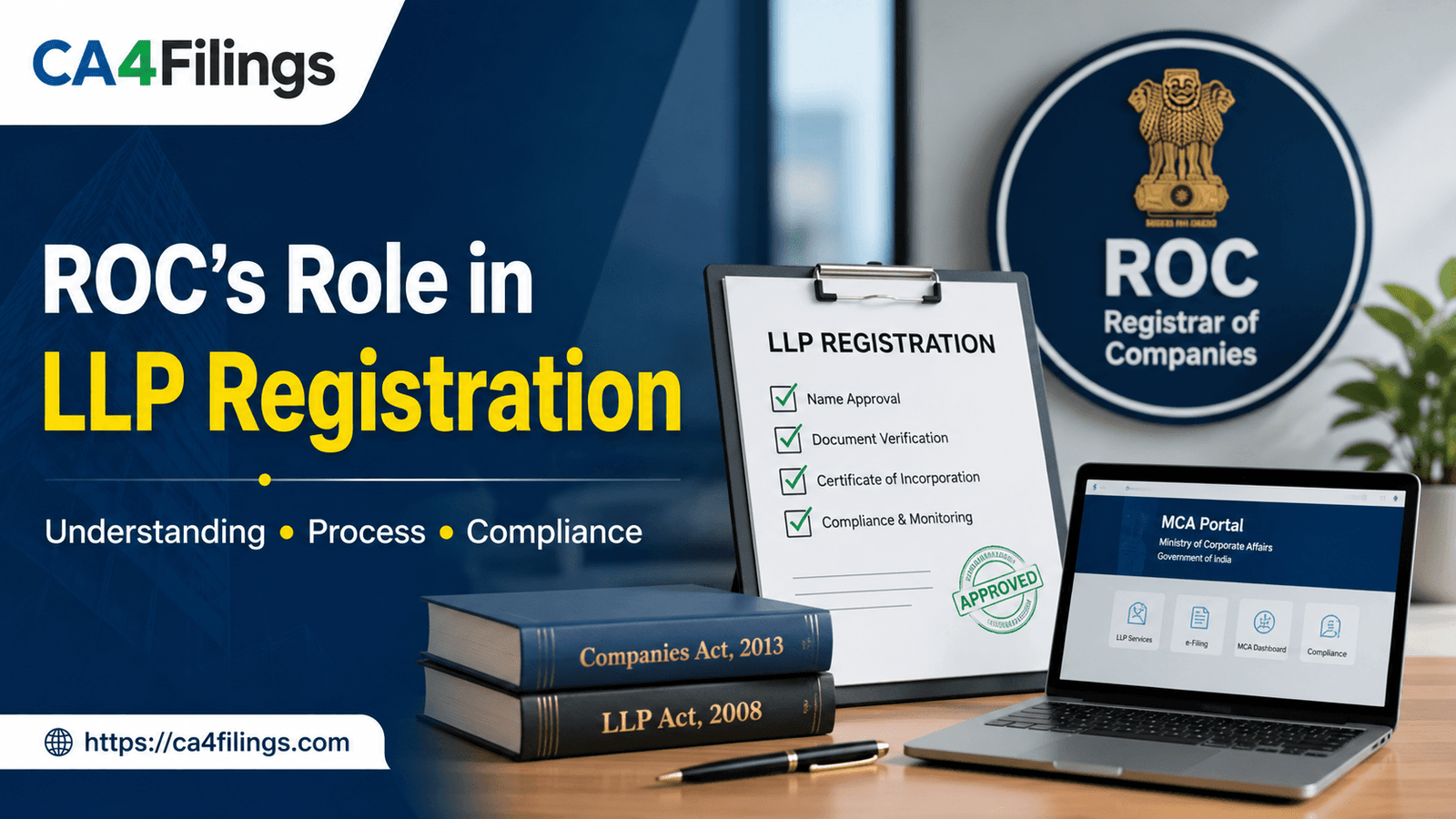
When entrepreneurs in India plan to start a business with limited liability and flexible management, a Limited Liability Partnership (LLP) often becomes the preferred choice. However, many business owners are unaware of the authority that supervises and regulates the entire registration process — the Registrar of Companies (ROC). Understanding the Role of the Registrar of Companies (ROC) in LLP Registration is essential for anyone planning to establish an LLP smoothly and legally.
At CA4Filings, we regularly assist startups, professionals, and small business owners in completing their LLP Registration without unnecessary delays. One common challenge applicants face is misunderstanding how the ROC functions during the registration and compliance stages.
In this article, we will explain Understanding the Role of the Registrar of Companies (ROC) in LLP Registration in a simple and practical way so that business owners can confidently complete the process.
What is the Registrar of Companies (ROC)?
The Registrar of Companies (ROC) is an office operating under the Ministry of Corporate Affairs (MCA), Government of India. The ROC is responsible for administering and regulating companies and LLPs registered under the Companies Act and the Limited Liability Partnership Act, 2008.
Each state or region in India has its designated ROC office. For example, businesses registered in Delhi NCR may fall under the ROC Delhi jurisdiction.
The ROC plays a central role in ensuring that LLPs comply with legal and regulatory requirements from registration to annual filings.
Understanding the Role of the Registrar of Companies (ROC) in LLP Registration
Understanding the Role of the Registrar of Companies (ROC) in LLP Registration becomes important because the ROC acts as the approving authority for the entire LLP incorporation process.
The ROC performs several responsibilities, including:
- Verifying incorporation documents
- Approving LLP names
- Issuing the Certificate of Incorporation
- Monitoring compliance filings
- Maintaining public records of LLPs
- Taking action against non-compliant entities
Without ROC approval, no LLP can be legally established in India.
Key Functions of ROC in LLP Registration
Name Approval Process
One of the primary responsibilities while Understanding the Role of the Registrar of Companies (ROC) in LLP Registration is the approval of the proposed LLP name.
The ROC checks whether:
- The proposed name is unique
- It does not resemble an existing company or LLP
- It does not violate trademark laws
- It follows MCA naming guidelines
For example, if someone applies for “Infosys Consultancy LLP,” the ROC may reject the application due to similarity with an existing registered brand.
Verification of Incorporation Documents
The ROC carefully examines all documents submitted during LLP incorporation.
These generally include:
- PAN and Aadhaar of partners
- Address proof
- Registered office proof
- Subscriber sheet
- LLP agreement details
- Digital Signature Certificates (DSC)
Any mismatch or incorrect documentation can lead to rejection or resubmission.
Issuance of Certificate of Incorporation
After successful verification, the ROC issues the Certificate of Incorporation (COI). This document officially confirms the legal existence of the LLP.
The COI contains:
- LLP Identification Number (LLPIN)
- Date of incorporation
- Name of LLP
This is one of the most important stages in Understanding the Role of the Registrar of Companies (ROC) in LLP Registration.
Importance of ROC in Maintaining Legal Compliance
Many business owners believe the ROC’s role ends after registration. In reality, the ROC continuously monitors LLP compliance throughout its existence.
Annual Filing Monitoring
Every LLP must file:
- Form 11 (Annual Return)
- Form 8 (Statement of Accounts & Solvency)
- Income Tax Returns
The ROC tracks these filings and imposes penalties for delays.
Record Maintenance
The ROC maintains a public database containing details of registered LLPs. This helps:
- Investors verify business authenticity
- Vendors conduct due diligence
- Financial institutions assess credibility
Regulatory Oversight
If an LLP fails to comply with regulations, the ROC has the authority to:
- Levy penalties
- Issue notices
- Strike off inactive LLPs
- Initiate legal proceedings
Therefore, Understanding the Role of the Registrar of Companies (ROC) in LLP Registration is not only about incorporation but also about ongoing compliance management.
Step-by-Step LLP Registration Process Involving ROC
Step 1: Obtain DSC and DPIN
Partners must obtain:
- Digital Signature Certificate (DSC)
- Designated Partner Identification Number (DPIN)
These are mandatory for filing forms electronically with the ROC.
Step 2: Name Reservation
An application is filed through the RUN-LLP service on the MCA portal for name approval.
The ROC reviews and either:
- Approves the name
- Requests clarification
- Rejects the application
Step 3: Filing Incorporation Forms
The FiLLiP form is submitted along with required documents.
The ROC examines the application carefully.
Step 4: Approval and Incorporation
Once satisfied, the ROC issues the Certificate of Incorporation.
Step 5: LLP Agreement Filing
The LLP Agreement must be filed within 30 days of incorporation through Form 3.
This step is also monitored by the ROC.
Common Reasons for ROC Rejection in LLP Registration
While Understanding the Role of the Registrar of Companies (ROC) in LLP Registration, it is equally important to know why applications get rejected.
Incorrect Documentation
Minor errors like:
- Name mismatch
- Incorrect address proof
- Missing signatures
can delay approval.
Non-Unique LLP Name
The ROC strictly checks name similarity with existing entities and trademarks.
Improper Business Objectives
If the business activity mentioned is unclear or legally restricted, the ROC may seek clarification.
Errors in Form Filing
Technical or data entry mistakes in MCA forms often result in resubmission notices.
At CA4Filings, we help businesses avoid such issues through proper documentation review before submission.
Practical Tips for Smooth ROC Approval
Choose a Unique Name
Before applying, conduct a thorough MCA and trademark search.
Keep Documents Updated
Ensure:
- PAN details match Aadhaar
- Address proofs are recent
- Utility bills are valid
Draft a Clear LLP Agreement
A professionally drafted LLP Agreement reduces future disputes and compliance issues.
Respond Quickly to ROC Notices
If the ROC raises queries, timely response is crucial to avoid rejection.
Why ROC Compliance Matters for Business Growth
Understanding the Role of the Registrar of Companies (ROC) in LLP Registration also helps businesses build long-term credibility.
ROC-compliant LLPs find it easier to:
- Open bank accounts
- Raise funding
- Secure loans
- Participate in government tenders
- Build trust with clients
Non-compliance, on the other hand, may result in heavy penalties and legal complications.
FAQs on Understanding the Role of the Registrar of Companies (ROC) in LLP Registration
Is ROC approval mandatory for LLP registration?
Yes, an LLP becomes legally valid only after approval and incorporation by the ROC.
Can ROC reject an LLP name application?
Yes, the ROC can reject names that are identical, misleading, or violate trademark guidelines.
What happens if LLP annual filings are not completed?
The ROC imposes additional fees and penalties for delayed filings. Continuous non-compliance may even lead to strike-off action.
Does every state have a separate ROC office?
Yes, ROC offices are assigned jurisdiction-wise across different states and regions in India.
Can an LLP operate before ROC incorporation approval?
No, business operations should begin only after receiving the Certificate of Incorporation from the ROC.
Understanding the Role of the Registrar of Companies (ROC) in LLP Registration is crucial for every entrepreneur planning to establish a legally compliant business in India. The ROC is not merely a registration authority — it acts as the regulatory backbone that ensures transparency, accountability, and lawful functioning of LLPs.
From approving names and verifying documents to monitoring annual compliance, the ROC plays a vital role at every stage of the LLP lifecycle. Ignoring ROC requirements can lead to delays, penalties, and unnecessary legal complications.
At CA4Filings, we simplify the entire LLP registration and compliance process for startups, professionals, and growing businesses across India. Our experienced team ensures accurate documentation, smooth ROC approvals, and timely compliance support so you can focus on growing your business with confidence.
If you are planning to start your LLP, connect with CA4Filings today for expert guidance and hassle-free registration support.
Latest Updates
ca4filings.com Services



























-registration.png)