LLP Compliance Checklist: Staying on the Right Side of the Law
LLP Compliance Checklist: Staying on the Right Side of the Law – Learn mandatory LLP compliances, due dates, filings, and penalties.
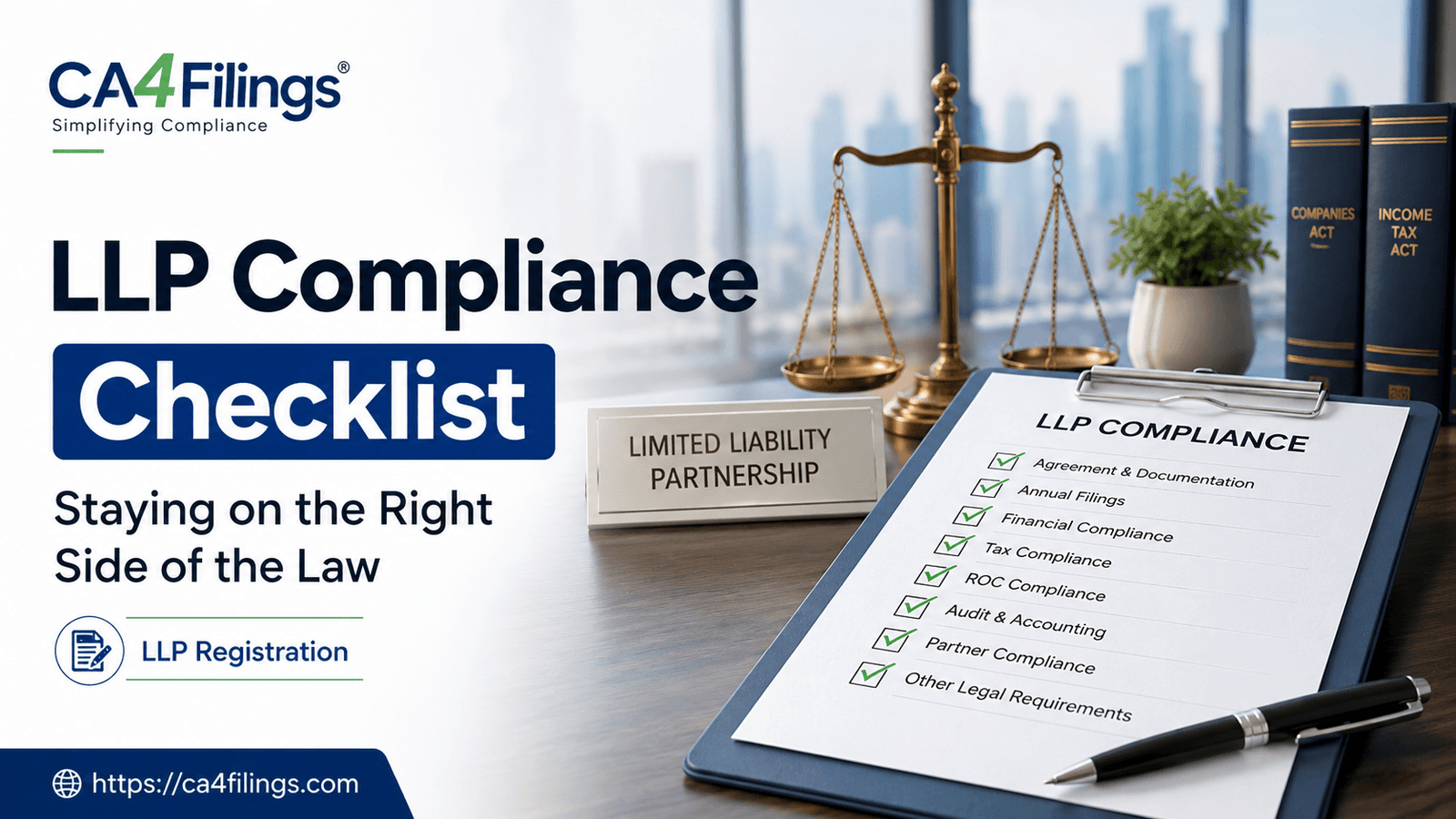
Running a Limited Liability Partnership (LLP) offers flexibility, limited liability protection, and fewer compliance burdens compared to private limited companies. However, many business owners mistakenly believe that LLPs are entirely free from legal obligations. In reality, following an LLP Compliance Checklist: Staying on the Right Side of the Law is essential to avoid penalties, maintain credibility, and ensure smooth business operations.
At CA4Filings, we often meet entrepreneurs who successfully complete their LLP Registration but later struggle with annual filings, accounting requirements, and MCA compliance deadlines. Missing even a single compliance can result in heavy penalties and unnecessary legal complications.
In this article, we will walk you through a practical LLP Compliance Checklist: Staying on the Right Side of the Law so your business remains fully compliant and legally secure.
Understanding the Importance of LLP Compliance
An LLP is governed by the LLP Act, 2008 and regulated by the Ministry of Corporate Affairs (MCA). Every LLP, whether active or inactive, must fulfill certain annual and event-based compliances.
Ignoring the LLP Compliance Checklist: Staying on the Right Side of the Law can lead to:
- Heavy late filing penalties
- Disqualification of designated partners
- Legal notices from MCA
- Difficulty in obtaining loans or investments
- Closure-related complications
Proper compliance also improves your business reputation with banks, investors, and clients.
LLP Compliance Checklist: Staying on the Right Side of the Law
Maintain Proper Books of Accounts
Every LLP must maintain accurate financial records relating to:
- Income and expenses
- Assets and liabilities
- Sales and purchases
- Cash flow and bank transactions
Books of accounts should be maintained at the registered office for at least 8 years.
File Annual Return – Form 11
One of the most important parts of the LLP Compliance Checklist: Staying on the Right Side of the Law is filing Form 11.
Key Details:
- Due Date: 30th May every year
- Filed with MCA
- Contains details of partners and LLP structure
Even if your LLP has not conducted any business activity, Form 11 filing is mandatory.
File Statement of Accounts and Solvency – Form 8
Form 8 is another critical annual compliance.
Due Date:
- 30th October every year
This form includes:
- Financial statements
- Solvency declaration
- Profit and loss details
Failure to file Form 8 can attract significant penalties on a daily basis.
Income Tax Return Filing
Every LLP must file its Income Tax Return annually, irrespective of profit or loss.
Due Dates:
- 31st July (if audit not applicable)
- 31st October (if audit applicable)
Timely filing helps avoid:
- Interest penalties
- Notices from Income Tax Department
- Loss of carry-forward benefits
Audit Requirement for LLPs
A common question business owners ask is whether LLP audit is mandatory.
Audit Becomes Mandatory If:
- Annual turnover exceeds ₹40 lakh, or
- Contribution exceeds ₹25 lakh
Once audit applicability is triggered, the LLP must appoint a Chartered Accountant for conducting the audit.
Following the LLP Compliance Checklist: Staying on the Right Side of the Law ensures businesses are aware of audit thresholds before penalties arise.
Event-Based LLP Compliances
Apart from annual filings, LLPs must also comply with event-based requirements.
Change in Partners
Whenever a partner joins or exits the LLP:
- Form 4 must be filed
- Due within 30 days
Change in Registered Office
If the LLP shifts its office address:
- Form 15 must be filed with MCA
Amendment in LLP Agreement
Any change in:
- Profit-sharing ratio
- Business activity
- Partner responsibilities
requires filing Form 3.
Ignoring such updates can create legal disputes among partners later.
Importance of PAN, TAN, and GST Compliance
An LLP must also comply with taxation-related registrations and filings.
PAN and TAN
After incorporation:
- PAN is mandatory for tax filing
- TAN is required if TDS applies
GST Registration
GST registration becomes mandatory if:
- Turnover crosses prescribed limits
- Interstate sales are involved
- Business falls under compulsory registration categories
Monthly or quarterly GST returns must be filed regularly.
Penalties for Non-Compliance
One of the biggest reasons to follow an LLP Compliance Checklist: Staying on the Right Side of the Law is to avoid unnecessary penalties.
Common Penalties Include:
- ₹100 per day for delayed MCA filings
- Additional interest on unpaid taxes
- Legal notices and prosecution
- Difficulty in business closure
Unlike some other laws, MCA late filing penalties often have no maximum cap. Delays can become extremely expensive over time.
Practical Compliance Tips for LLP Owners
At CA4Filings, we recommend LLP owners follow these practical steps:
Maintain a Compliance Calendar
Keep track of:
- MCA due dates
- GST return dates
- Income tax deadlines
Hire a Professional CA
A professional ensures:
- Timely filings
- Proper bookkeeping
- Accurate financial reporting
Separate Business and Personal Transactions
Always maintain:
- Dedicated business bank account
- Proper invoices
- Expense records
Review LLP Agreement Periodically
As businesses grow, operational structures change. Updating the LLP agreement avoids future conflicts.
Benefits of Staying Compliant
Following an LLP Compliance Checklist: Staying on the Right Side of the Law is not just about avoiding penalties. It also offers long-term business advantages.
Better Credibility
Compliant businesses gain trust from:
- Clients
- Investors
- Banks
Easier Loan Approvals
Financial institutions prefer businesses with:
- Updated filings
- Clean compliance records
Smooth Business Expansion
Future funding, partnerships, and government registrations become easier when compliance records are strong.
Stress-Free Operations
Business owners can focus on growth instead of worrying about notices and penalties.
Common Mistakes LLP Owners Should Avoid
Ignoring Nil Filings
Many LLP owners think inactive LLPs need not file returns. This is incorrect.
Delaying Accounting Work
Last-minute bookkeeping often leads to:
- Errors
- Missed deductions
- Incorrect filings
Missing MCA Notices
Ignoring MCA communication can escalate compliance issues quickly.
Not Updating Changes
Changes in partners, address, or agreement should always be filed promptly.
Avoiding these mistakes is a key part of LLP Compliance Checklist: Staying on the Right Side of the Law.
FAQs
Is annual filing mandatory for inactive LLPs?
Yes. Even inactive LLPs must file Form 11 and Form 8 annually.
What is the penalty for late filing of LLP forms?
Generally, MCA imposes a penalty of ₹100 per day until the filing is completed.
Does every LLP require a tax audit?
No. Audit is mandatory only if turnover exceeds ₹40 lakh or contribution exceeds ₹25 lakh.
Can an LLP operate without GST registration?
Yes, if turnover is below the prescribed threshold and business activities do not require compulsory GST registration.
Why is maintaining books of accounts important?
Proper accounting helps in tax filing, audits, financial management, and legal compliance.
Maintaining compliance is one of the most important responsibilities of every LLP owner. A well-managed LLP Compliance Checklist: Staying on the Right Side of the Law helps businesses avoid penalties, build credibility, and operate smoothly without legal hurdles.
From annual MCA filings to tax returns and event-based compliances, every requirement must be handled carefully and on time. Many businesses face avoidable financial losses simply because they ignore basic compliance obligations.
At CA4Filings, we help businesses stay fully compliant with expert guidance, timely reminders, accurate filings, and end-to-end professional support. Whether you are starting a new LLP or managing an existing one, our experienced team ensures your compliance journey remains simple, hassle-free, and legally secure.
Latest Updates
ca4filings.com Services
























-registration.png)