Mistakes to Avoid While Filing Your Income Tax Return (ITR)
Learn the critical Mistakes to Avoid While Filing Your Income Tax Return (ITR) to stay compliant and avoid tax notices. Expert insights from CA4Filings.
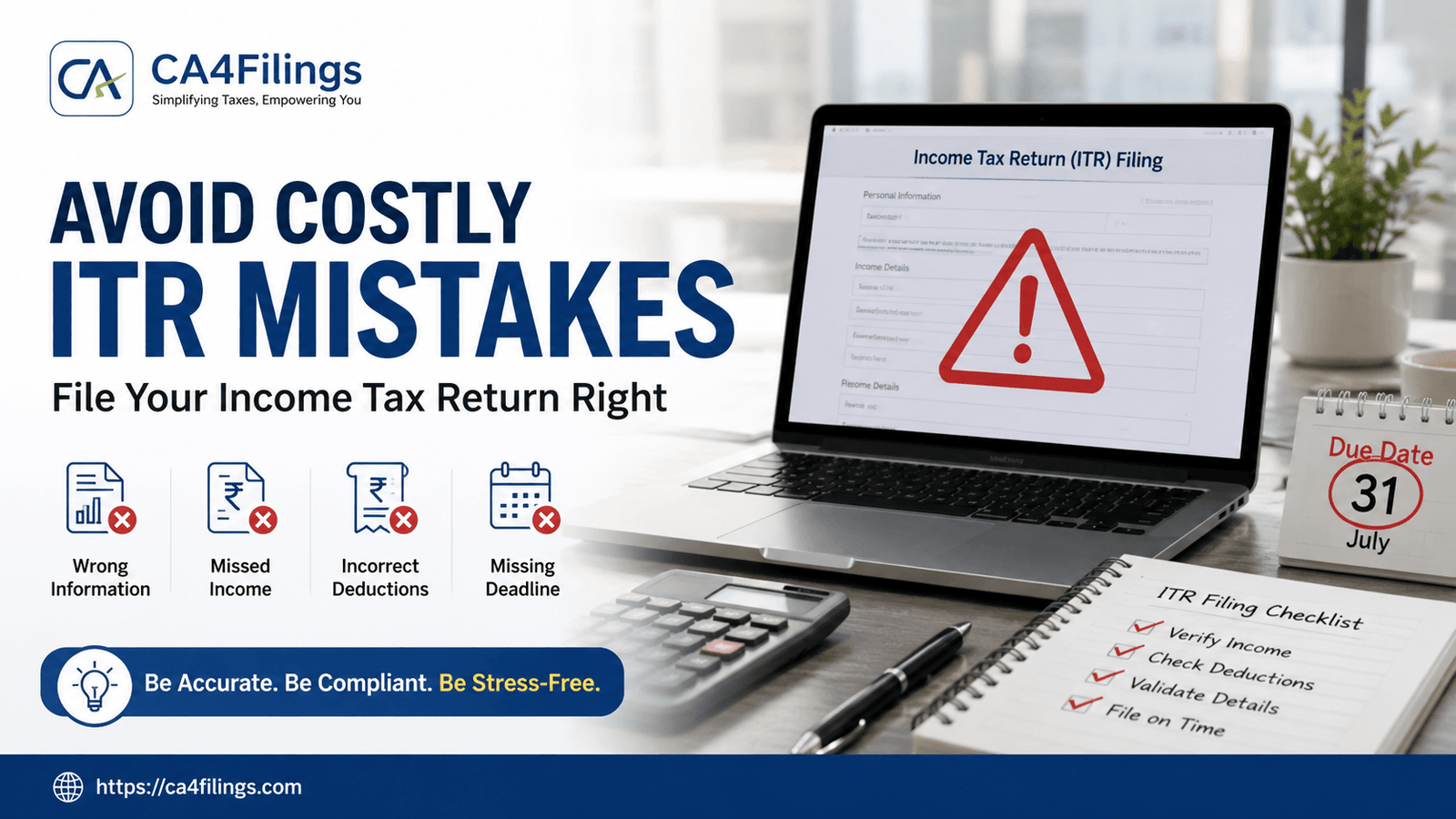
It is tax season again in India, and the annual rush to file taxes is in full swing. For many taxpayers—whether you are a salaried professional, a freelancer, or a small business owner—the process can feel overwhelming. In the hurry to meet the deadline, it is incredibly easy to make minor oversights that could lead to delayed refunds, penalties, or worse, an income tax notice. Understanding the critical Mistakes to Avoid While Filing Your Income Tax Return (ITR) is essential for a smooth and stress-free compliance experience. At CA4Filings, we regularly see taxpayers facing unnecessary hurdles simply because they rushed through their forms.
Filing your taxes does not have to be a daunting task if you know what pitfalls to look out for. If you want to ensure your submissions are entirely accurate, taking advantage of a professional Income Tax Return Filing service can save you significant time and eliminate costly errors. Let us break down the most common traps taxpayers fall into and how you can steer clear of them this year.
Choosing the Wrong ITR Form
One of the most foundational Mistakes to Avoid While Filing Your Income Tax Return (ITR) is selecting the incorrect ITR form. The Income Tax Department has rolled out different forms (from ITR-1 to ITR-7) tailored to different sources of income and taxpayer categories.
ITR-1 (Sahaj): For resident individuals having income from salary, one house property, and interest income, with total income up to ₹50 Lakhs.
ITR-2: For individuals and HUFs who have capital gains, foreign income, or multiple house properties, but do not have business profits.
ITR-3: For individuals and HUFs having income from a proprietary business or profession.
ITR-4 (Sugam): For individuals, HUFs, and firms opting for the presumptive taxation scheme under Section 44AD, 44ADA, or 44AE.
If a salaried individual who also traded in equity shares files an ITR-1 instead of an ITR-2, the tax department will treat the return as defective. You will receive a notice under Section 139(9) asking you to rectify the error within 15 days, which unnecessarily complicates your tax assessment.
Mismatch Between ITR and Form 26AS / AIS / TIS
Gone are the days when you could manually calculate your income and hope the tax department would take your word for it. Today, the tax department tracks almost every financial footprint you leave through Form 26AS, the Annual Information Statement (AIS), and the Taxpayer Information Summary (TIS).
Failing to reconcile your reported figures with these documents is among the most frequent Mistakes to Avoid While Filing Your Income Tax Return (ITR).
What You Must Cross-Check
Before hitting the submit button, ensure that the following details perfectly align with your AIS and Form 26AS:
Tax Deducted at Source (TDS): Check that the TDS deducted by your employer, bank, or clients is fully reflected.
High-Value Transactions: Significant credit card spend, mutual fund investments, or property purchases must match department records.
Advance Tax & Self-Assessment Tax: Verify that the BSR code and challan numbers match exactly.
If there is a mismatch—for instance, if your bank deducted TDS on a fixed deposit but you forgot to declare that interest income—an automated data-mismatch notice is almost guaranteed.
Ignoring Income from Other Sources
Many taxpayers mistakenly believe that they only need to report their primary source of livelihood, such as a monthly salary or core business revenue. However, omitting secondary streams is an expensive blunder. This makes ignoring miscellaneous earnings one of the vital Mistakes to Avoid While Filing Your Income Tax Return (ITR).
Commonly Forgotten Income Streams
Savings Bank Interest: Your bank account interest is taxable under "Income from Other Sources," though you can claim a deduction up to ₹10,000 under Section 80TTA (or ₹50,000 under 80TTB for senior citizens).
Fixed Deposit (FD) Interest: Even if the bank has deducted TDS, you must report the gross interest income in your return.
Gifts and Dividends: Dividend income from shares or mutual funds is now entirely taxable in the hands of the investor and must be disclosed.
Not Disclosing Multiple Bank Accounts
The Income Tax Department requires you to report details of all active bank accounts held in India at any time during the financial year. You only have the option to exclude dormant accounts (accounts that have not been operated for more than two years).
Taxpayers often commit one of the classic Mistakes to Avoid While Filing Your Income Tax Return (ITR) by only providing details of the single account where they wish to receive their tax refund. You must list every single active savings or current account, including their IFSC codes. This tracking helps the government monitor aggregate fund movements and prevent tax evasion.
Forgetting to Verify the ITR (e-Verification)
Imagine spending hours gathering documents, calculating figures, and submitting your return, only to find out months later that your ITR was never processed. This happens when you forget the final, critical step: e-verification.
Filing your return is only half the job done. Your ITR is treated as invalid unless it is verified within 30 days of filing. This oversight is one of the most heartbreaking Mistakes to Avoid While Filing Your Income Tax Return (ITR) because an unverified return means you legally never filed your taxes at all.
Quick Ways to e-Verify Your ITR
Aadhaar-based OTP sent to your registered mobile number.
Net Banking log-in via the income tax e-filing portal.
Bank Account EVC (Electronic Verification Code).
Sending a physically signed copy of ITR-V to the CPC, Bengaluru (though e-verification is much faster and highly recommended).
FAQs on Tax Filing Pitfalls
1. What happens if I make a mistake in my filed ITR?
If you discover an error after submission, you can rectify it by filing a Revised Return under Section 139(5). This must be done before the end of the relevant assessment year or before the assessment is completed, whichever is earlier.
2. Can I claim deductions that are not mentioned in my Form 16?
Yes. If you missed submitting investment proofs (like LIC premiums, medical insurance, or 80C investments) to your employer on time, you can still claim them while filing your ITR, provided you hold valid receipts.
3. Is it mandatory to file ITR if my income is below the basic exemption limit?
Generally, no. However, you must file a return under the seventh proviso to Section 139(1) if you meet certain criteria, such as spending over ₹2 Lakhs on foreign travel, paying electricity bills exceeding ₹1 Lakh in a year, or having gross business turnover exceeding specified limits.
File Accurately with CA4Filings
Filing your taxes is a civic duty, but doing it correctly is a financial necessity. By keeping a close eye on these critical Mistakes to Avoid While Filing Your Income Tax Return (ITR), you can protect yourself from unnecessary legal notices, penalty fees, and administrative delays.
Tax laws in India evolve continuously, and tracking every compliance update can be tough while running a business or managing a busy job. Don't leave your tax compliance to guesswork. Let our experienced professionals at CA4Filings handle your end-to-end tax preparation. Reach out to CA4Filings today, and let us make your tax compliance seamless, accurate, and completely stress-free!
Latest Updates
ca4filings.com Services






















-registration.png)