The Gig Economy Guide: Filing Taxes for Uber Drivers, Writers, and Designers via ITR 4
Maximize your tax savings with our expert guide on ITR 4. Learn how freelancers and gig workers can simplify filing, use section 44ADA, and stay compliant.
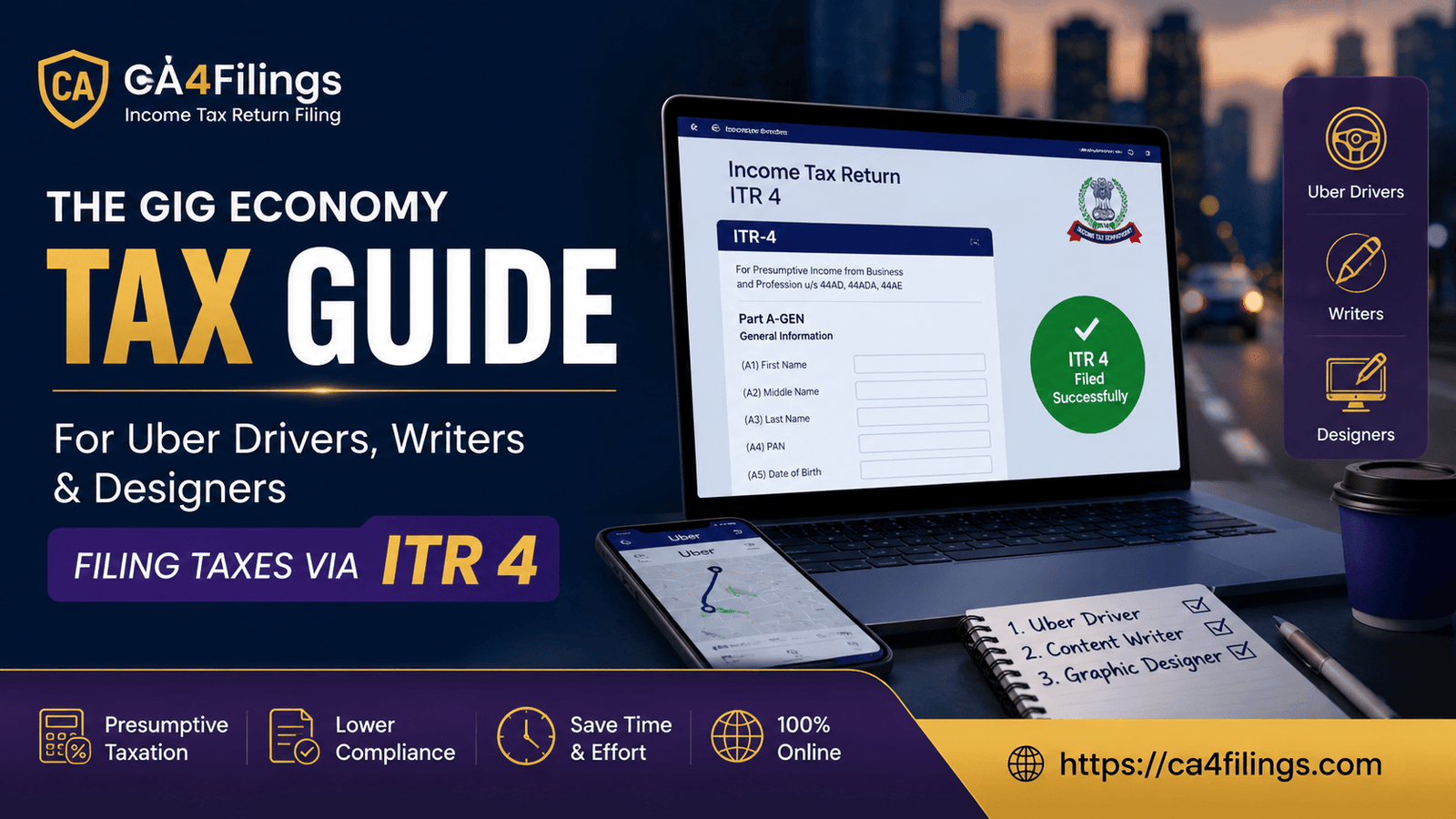
The rise of the gig economy has truly changed how we work in India. Whether you are driving for a platform like Uber, freelancing as a writer, or working as a graphic designer, you are part of a growing wave of independent professionals. However, with this freedom comes the responsibility of tax compliance. Navigating the tax landscape can feel overwhelming, but at CA4Filings, we make Income Tax Return Filing simple and stress-free. For many of you, understanding itr 4 is the first step toward staying compliant without the headache of maintaining complex books of accounts.
Why ITR 4 is a Game Changer for Gig Workers
If you are a freelancer or a self-employed professional, you might be wondering why itr 4 is the talk of the town. Form itr 4, often referred to as "Sugam," is designed specifically for individuals, HUFs, and firms (excluding LLPs) who want to opt for the presumptive taxation scheme.
The main benefit here is the reduction of compliance burdens. Instead of recording every single cup of coffee or transport expense you incur, the government allows you to declare a fixed percentage of your income as profit. This eliminates the need for detailed bookkeeping and, in many cases, helps you avoid mandatory tax audits.
Understanding the Presumptive Taxation Scheme
To use itr 4, you generally fall under two main sections of the Income Tax Act: section 44ada for professionals and Section 44AD for small businesses.
Section 44ADA: The Professional's Advantage
If you are a writer, designer, or consultant, you likely qualify as a "specified professional." Section 44ada allows you to declare 50% of your gross receipts as your net profit. The government assumes that your expenses constitute the other 50%. This is incredibly beneficial if your actual operating costs are lower than 50% of your earnings, as you only pay tax on half of what you make.
Gross Receipts Limit: You can use this scheme if your annual gross receipts do not exceed ₹50 lakh.
The Digital Payments Incentive: The government encourages digital transactions. If at least 95% of your receipts are through digital modes (like bank transfers, UPI, or cards), the threshold for itr 4 eligibility under section 44ada increases to ₹75 lakh.
Section 44AD: For Businesses
If your work doesn't fall under the "professional" category—for instance, some types of gig-based retail or general services—you might look at Section 44AD. This allows you to declare 6% (for digital receipts) or 8% (for cash receipts) of your turnover as profit. Keep in mind that there is a cash receipts limit you must monitor to stay within the eligibility criteria for these schemes.
Key Considerations: Expenses and Digital Payments
When you opt for itr 4, remember that you are essentially agreeing to the "presumptive" profit margin. You generally cannot claim additional business expenses deduction beyond what is already factored into these schemes. While this sounds restrictive, it is usually a net positive because you save significantly on accounting costs and the time spent tracking receipts.
However, be mindful of your transaction methods. Utilizing digital payment platforms is not just good for your business efficiency; it also offers a digital payments incentive by increasing the turnover threshold for your eligibility, as mentioned earlier. Staying organized with your bank statements is the best way to prove your digital receipts during any verification.
Step-by-Step: Is ITR 4 Right for You?
Choosing the right form is crucial. Follow these steps to determine if itr 4 is your best path:
Assess Your Income Source: Are you a professional (writer, designer) or a business owner?
Check Your Annual Turnover: Ensure it is within the limits (e.g., ₹50 lakh or ₹75 lakh for professionals).
Evaluate Your Profit Margins: If your actual profit is lower than the presumptive percentage (e.g., lower than 50% for section 44ada), you may prefer the regular tax regime, which requires full auditing and maintenance of books.
Confirm Eligibility: Ensure you don't have income from sources that disqualify you from using itr 4, such as capital gains or holding unlisted equity shares.
Frequently Asked Questions (FAQs)
1. Can I switch back from the presumptive scheme?
Yes, you can choose to opt out of the itr 4 presumptive scheme in future years. However, once you opt out, there may be specific conditions and restrictions on opting back in, so it is best to consult with an expert at CA4Filings before making a switch.
2. What happens if I have actual expenses higher than 50%?
If your actual business expenses exceed 50% of your receipts, you might end up paying more tax under the presumptive scheme. In this scenario, you may choose to file under the regular regime, but note that you will then be required to maintain books of accounts and potentially undergo an audit.
3. Does ITR 4 apply to Uber drivers?
Uber drivers are typically classified as self-employed business owners. Depending on the nature of their earnings, they often fall under the scope of presumptive taxation schemes, making itr 4 a common and efficient filing choice for them.
4. What is the deadline for filing ITR 4?
Generally, for individuals not subject to an audit, the deadline is July 31st of the assessment year. Always check for official extensions.
Filing your taxes doesn't have to be a source of stress. By leveraging itr 4, you can simplify your tax obligations and focus more on growing your gig work. Whether you are navigating section 44ada or managing your self-employed tax liability, having a professional team in your corner makes all the difference.
At CA4Filings, we specialize in helping gig workers stay tax-compliant. Contact us today to simplify your tax journey and ensure you are making the most of the available deductions and schemes.
Latest Updates
ca4filings.com Services




















-registration.png)