The Entrepreneur’s Blueprint to Choose Between ITR 3 and ITR 4
Confused between ITR 3 and itr 4? Get an expert breakdown from CA4Filings on choosing the right income tax form for your business and saving taxes.
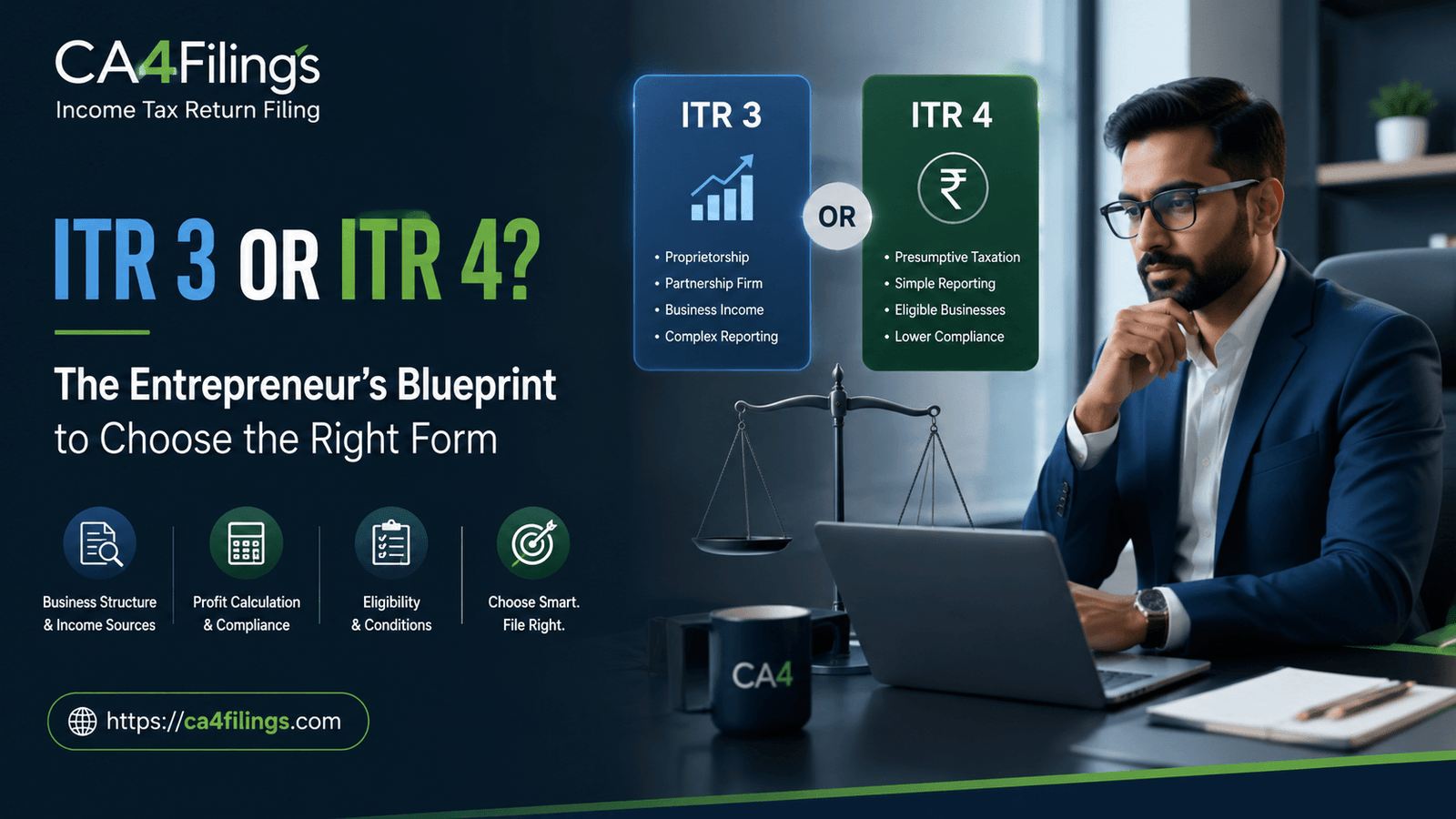
For many entrepreneurs and freelancers in India, tax season often brings the same recurring question: which form should I file? Selecting the correct return is crucial to avoid scrutiny from the Income Tax Department. At CA4Filings, we often see clients struggle with the distinction between ITR 3 and itr 4, and getting this choice right is a fundamental part of efficient Income Tax Return Filing. Whether you are a budding freelancer or a seasoned business owner, understanding these forms is your first step toward financial compliance.
Choosing between these two forms isn't just about paperwork; it's about how you manage your business income and your long-term tax strategy. Let’s break down the blueprint to help you decide.
What is ITR 4 and Who is it For?
Commonly known as the "Sugam" form, itr 4 is designed for taxpayers who opt for the presumptive tax scheme. This scheme is a massive relief for small business owners and professionals because it eliminates the complex burden of rigorous bookkeeping.
If you are a resident individual, a Hindu Undivided Family (HUF), or a partnership firm (excluding LLPs), you might be eligible for itr 4 under sections 44AD, 44ADA, or 44AE. Essentially, instead of calculating your exact profits by deducting every single business expense, the government allows you to declare a flat percentage of your turnover or receipts as your taxable income.
When to Opt for ITR 4
Simplicity: You prefer not to maintain detailed books of accounts.
Profit Margins: Your actual profit margins are equal to or higher than the presumptive rates (typically 6% or 8% for business and 50% for professionals).
Turnover Limits: Your business turnover is under ₹2 crore (or higher in specific digital transaction cases), or your professional receipts are under ₹50 lakh.
Documentation: You want to minimize your compliance costs and avoid the complexity of an audit.
When Does ITR 3 Become Necessary?
While the presumptive scheme is attractive, it isn't a one-size-fits-all solution. ITR 3 is the more comprehensive form intended for individuals and HUFs who have income from a proprietary business or profession that doesn't fall under the "simple" category.
If you don't opt for the presumptive tax scheme, you must use ITR 3. Furthermore, there are specific situations where you are legally required to move away from simpler forms and adopt ITR 3:
Complex Income Streams: If you have income from capital gains (shares, mutual funds, or property) beyond the limited exceptions allowed in other forms.
Losses: If you have incurred business losses and intend to carry them forward to set off against future profits.
Detailed Accounting: If your business is large enough that you are already maintaining a formal profit and loss account and a balance sheet maintenance system to track every expense.
Professional Tax Needs: In many cases, if you have multiple sources of complex income, such as directorship in a company or unlisted equity shares, ITR 3 is mandatory.
Key Differences for Your Business Strategy
To help you visualize the decision, here is a quick comparison:
| Feature | ITR 3 | itr 4 |
|---|---|---|
| Taxation Method | Actual profits based on books | Presumptive (fixed percentage) |
| Books of Accounts | Mandatory | Not required |
| Audit Requirement | If turnover exceeds threshold | Generally exempt |
| Best For | Growing or complex businesses | Small, stable businesses/freelancers |
The "Hidden" Risks of Choosing the Wrong Form
Choosing itr 4 simply to save on compliance costs can backfire. If your actual business expenses are significantly high, declaring a fixed 8% or 50% profit might mean you end up paying tax on "phantom income" that you didn't actually earn. Conversely, if you file ITR 3 without maintaining proper records, you invite unnecessary scrutiny. At CA4Filings, we always advise clients to perform a cost-benefit analysis before locking in their choice.
Frequently Asked Questions
1. Can I switch from ITR 3 to itr 4?
Yes, you can, but be careful. If you opt for the presumptive tax scheme and then decide to opt out, you may be barred from using the scheme again for the next five years.
2. Is professional tax related to ITR 4?
No, professional tax is a state-level levy on employment or profession, whereas ITR 4 is a central income tax form. They are entirely separate compliance requirements.
3. Do I need an audit if I file ITR 4?
Generally, no. The primary benefit of the presumptive scheme is that it waives the audit requirement, provided your income declaration meets the statutory percentage.
4. What happens if I make a mistake in my ITR choice?
Filing a defective return can lead to notices from the IT department. If you realize an error after filing, you can file a revised return, but it is always better to consult with an expert at the start.
Let CA4Filings Handle the Complexity
Choosing between ITR 3 and itr 4 is a strategic business decision that impacts your tax outflow and your future compliance requirements. Don’t let tax terminology overwhelm you—let the experts handle the heavy lifting.
At CA4Filings, we take the stress out of your tax compliance. Whether you need help with your balance sheet maintenance, advice on the presumptive tax scheme, or professional guidance on which form best suits your business income, our team is here to ensure you stay compliant and save on unnecessary tax burdens.
Latest Updates
ca4filings.com Services























-registration.png)