The Critical Differences Between Old Tax Regime and New Tax Regime in ITR 1
Confused between the Old and New Tax Regimes for your ITR 1 filing? CA4Filings breaks down the key differences to help you choose the best tax-saving path.
Every year, as the tax season approaches, salaried individuals find themselves at a crossroads when preparing their itr 1. Navigating the complexities of Indian tax laws can feel overwhelming, which is why professional assistance for Income Tax Return Filing is often the smartest move you can make to avoid errors and optimize your outflow. At CA4Filings, we often hear the same question: "Should I stick to the Old Tax Regime, or is the New Tax Regime better for me"
Choosing between these two systems isn't just about picking lower numbers; it’s about understanding how your specific income structure interacts with different tax slab rates.
Understanding the Basics of ITR 1
When you file your itr 1, you are dealing with the simplest form of return, specifically meant for resident individuals with income from salary, one house property, and other sources like interest. Since this form is streamlined, many taxpayers assume it shouldn't be complicated. However, the introduction of the concessional tax regime (the "New" regime) has added a layer of decision-making that can significantly impact your take-home pay.
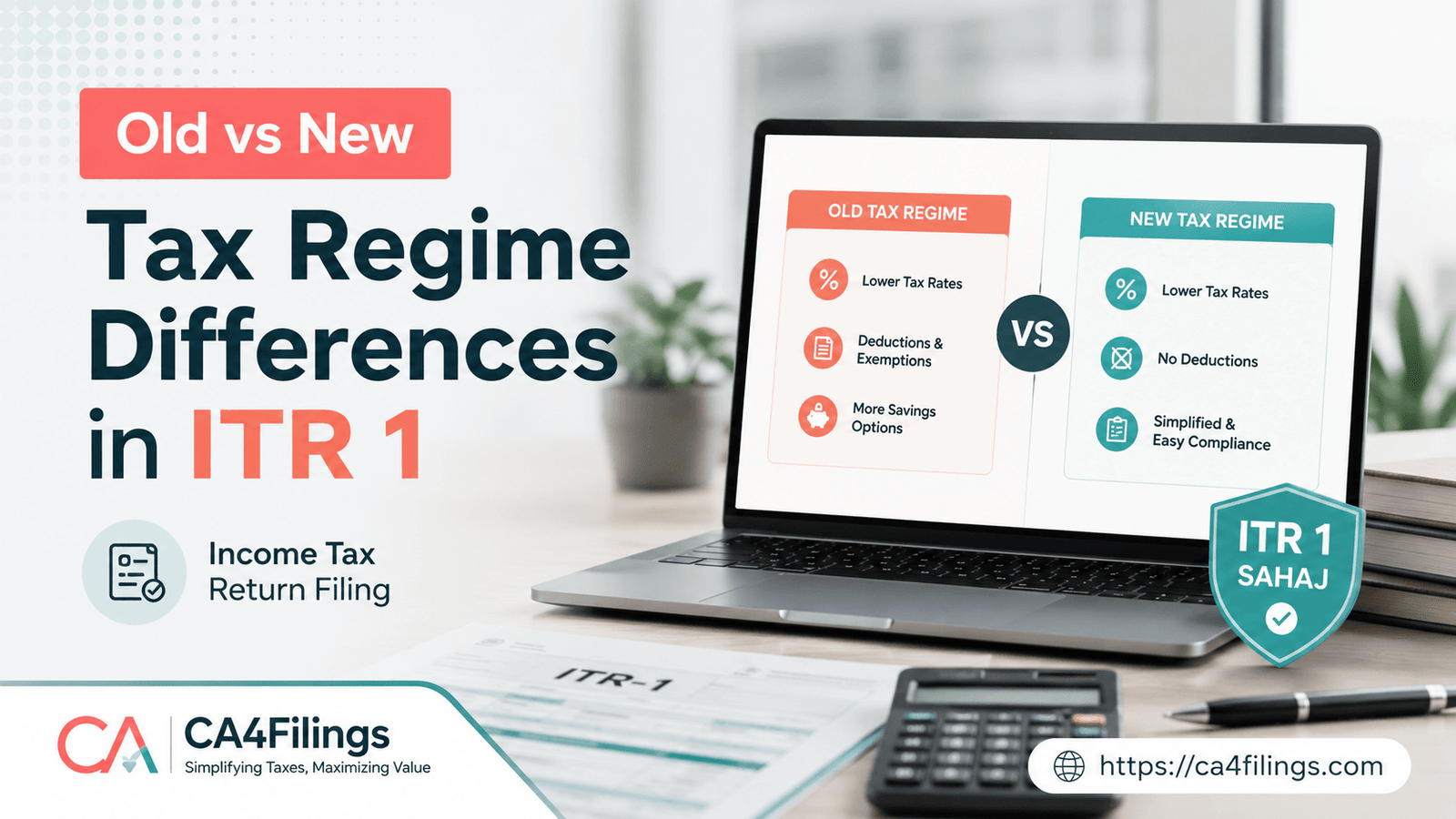
The government introduced the New Tax Regime to simplify the process by removing various exemptions. In contrast, the Old Tax Regime encourages savings by allowing you to claim deductions.
The Core Conflict: Deductions vs. Lower Rates
The fundamental shift lies in your approach to tax planning. The Old Tax Regime functions on the premise of "invest and save." You are rewarded for putting money into specific instruments. Conversely, the New Tax Regime offers lower tax slab rates in exchange for deduction sacrifices.
When you choose the New Tax Regime for your itr 1, you lose out on popular deductions such as:
Section 80C changes: You can no longer claim the ₹1.5 lakh deduction for LIC, PPF, or ELSS.
HRA and LTA: House Rent Allowance and Leave Travel Allowance exemptions are unavailable.
Section 80D: Health insurance premium deductions are excluded.
Essentially, the New Regime is a "no-frills" tax system. If you have minimal investments and prefer simplicity, it might seem attractive. However, for those with heavy home loans or high insurance premiums, the Old Regime often remains the more optimal tax choice.
Breaking Down the Standard Deduction Comparison
A critical point that taxpayers often overlook is the standard deduction comparison. In recent amendments, the government has extended the ₹50,000 standard deduction to the New Tax Regime as well. This was a game-changer.
Previously, the standard deduction was exclusive to the Old Regime. Now that it is available in both, the "gap" between the two regimes has narrowed, making the decision process even more nuanced for itr 1 filers.
Which Regime Should You Pick?
To determine your path, consider these three factors:
Investment Profile: If you are a disciplined saver who hits the ₹1.5 lakh limit under 80C and pays significant rent, the Old Regime likely keeps your tax liability lower.
Home Loan Interest: Under the Old Regime, you can claim a deduction on interest paid on a self-occupied property loan (Section 24b). This is generally not available under the New Regime.
Income Level: As your income increases, the lower slab rates of the New Regime become more powerful, potentially offsetting the loss of deductions.
A Practical Example for Your ITR 1
Let’s say you earn ₹10 lakhs annually.
Under the Old Regime: You claim ₹50,000 (standard), ₹1.5 lakh (80C), and maybe ₹25,000 (80D). Your taxable income drops significantly.
Under the New Regime: You only get the ₹50,000 standard deduction. While the tax rates on the remaining amount are lower, you are paying tax on a higher base income.
You must run a "test calculation" before submitting your itr 1. At CA4Filings, we prepare these side-by-side comparisons for our clients every day to ensure they aren't paying a rupee more than necessary.
Frequently Asked Questions
Can I switch my tax regime every year?
Yes, if you are a salaried individual without business income, you can choose the regime that suits you best each year when filing your itr 1.
Is the New Tax Regime always better for everyone?
Not necessarily. It is only better if your total eligible deductions (like HRA, 80C, 80D) are low. If you have significant investments, the Old Regime is usually better.
What happens if I miss the deadline for filing my ITR 1?
Missing the deadline attracts a penalty and the potential loss of the ability to carry forward certain losses. Always file on time.
Does the choice of regime affect the filing process?
The filing process remains the same, but you must select the appropriate flag in your itr 1 form to indicate which regime you are opting for.
Choosing between the regimes is a personalized decision. There is no one-size-fits-all solution for your itr 1. While the New Regime offers simplicity and lower headline rates, the Old Regime remains a powerful tool for those who prioritize long-term wealth creation through tax-saving investments.
Don't leave your tax liability to guesswork. At CA4Filings, we specialize in helping individuals navigate these complex choices with precision and professional integrity. Contact us today, and let our experts ensure your tax filing is perfectly optimized for your financial goals.
Latest Updates
ca4filings.com Services

























-registration.png)