The Anatomy of a Perfect Income Tax Return ITR Form Submission
Struggling with tax season? Learn the anatomy of a perfect income tax return itr form submission with our expert guide at CA4Filings for stress-free filing.
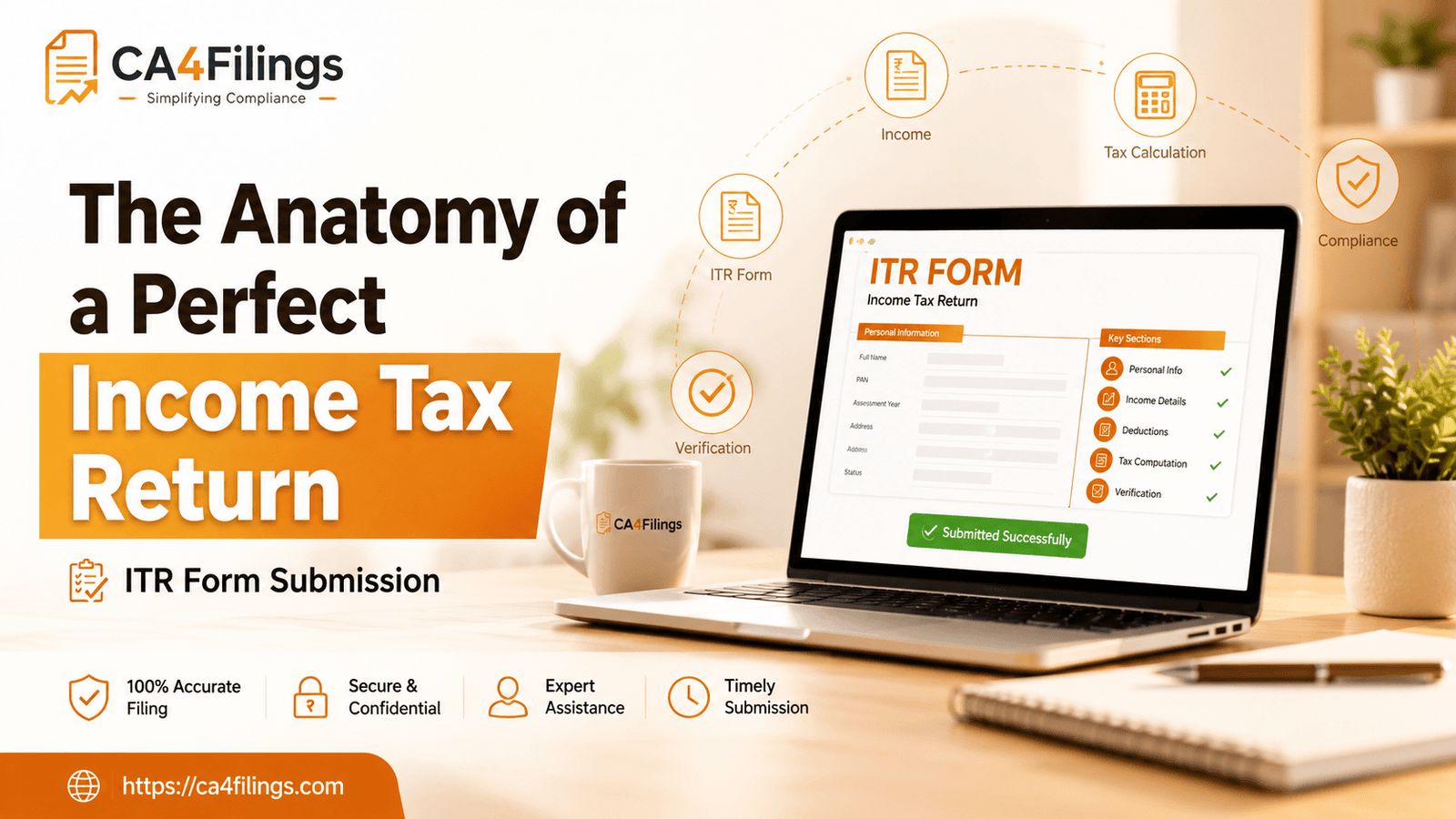
Tax season is often met with a collective sigh from taxpayers across India. Whether you are a salaried professional or a business owner, navigating the complexities of the tax portal can feel like solving a puzzle with missing pieces. At CA4Filings, we believe that understanding the anatomy of a perfect Income Tax Return Filing process is the key to avoiding notices and ensuring peace of mind. Getting your income tax return itr form right the first time is not just about compliance; it is about financial discipline and accuracy.
In this guide, we will break down the essential components of a flawless submission. By mastering these steps, you can turn a daunting annual chore into a streamlined process.
Why Accuracy Matters in Your Income Tax Return ITR Form
Many taxpayers view the filing process as a mere formality. However, the Income Tax Department’s systems are increasingly sophisticated. When you submit your income tax return itr form, the system performs an automated data validation process. If the figures in your ITR don't match the information reported by third parties (like your bank or employer), you are almost guaranteed to receive a notice.
A "perfect" submission is one that is verified against your financial statements before the 'Submit' button is clicked. It is about transparency, reconciliation, and timely action.
Step 1: Gathering and Reconciling Your Documents
Before you even log into the e-filing portal, you must have your data house in order. A common mistake we see at CA4Filings is rushing to file without reconciling documents.
Form 26AS and AIS/TIS: Always cross-verify your TDS certificates with Form 26AS and the Annual Information Statement (AIS). These documents contain the "truth" from the government's perspective.
Bank Statements: Ensure that interest income, dividends, and other miscellaneous earnings are captured correctly.
Investment Proofs: If you are claiming deductions under Chapter VI-A (like 80C, 80D), ensure you have the receipts handy.
Leveraging Pre-filled Data Effectively
The Income Tax Department now provides significant pre-filled data in the portal. While this is a massive convenience, it is also a potential pitfall. Never assume the pre-filled information is 100% complete or accurate.
Think of pre-filled data as a baseline. Your role as a taxpayer is to audit that data. Does the salary figure match your Form 16? Is the house property income reflected correctly? We always advise clients to treat the pre-filled fields as a starting point, not the final word.
Choosing the Right Tool: E-Filing Utilities vs. Manual Entry
Depending on your source of income, you might choose between the direct online filing or the offline utility.
When to use the Offline Utility
For individuals with complex income streams—such as capital gains from multiple portfolios or business income with various deductions—the offline utility is often superior. It allows you to work at your own pace without worrying about session timeouts on the browser. Once the data is entered, you can generate a JSON file to upload directly to the portal.
The Anatomy of the Final Review
Before you transmit your income tax return itr form, conduct a final "Tax Summary" check. Most modern interfaces provide a tax summary page that outlines:
Total Gross Income: Ensure it matches your consolidated income records.
Deductions Claimed: Verify that these align with your tax-saving investments.
Taxes Paid: This includes TDS, TCS, and Advance Tax. Make sure these match your tax credit statements exactly.
If the "Net Tax Payable" or "Refund" amount is different from what you calculated on your personal spreadsheet, stop. Go back and check the entries. A mismatch here is the most common reason for receiving a defective return notice.
FAQs: Expert Insights from CA4Filings
What happens if I make a mistake in my income tax return itr form?
If you realize you made an error after filing, don't panic. You can file a "Revised Return" under Section 139(5) as long as you do it within the stipulated timelines.
Is it mandatory to e-verify the return?
Yes. Your submission is not complete until it is e-verified via Aadhaar OTP, net banking, or by sending a physical ITR-V to the CPC in Bengaluru.
Can I change my ITR form type after filing?
No. You must select the correct form (ITR-1 to ITR-7) based on your income category. Filing in the wrong form type will likely lead to the return being treated as "defective."
How does CA4Filings help with the filing process?
We handle the reconciliation, data validation, and technical submission to ensure your ITR is compliant, minimizing the chances of any scrutiny from the tax authorities.
Submitting an income tax return itr form is a responsibility that defines your financial character. While the process may seem automated, the "human touch" of reviewing every entry against your actual bank statements and certificates is what differentiates a perfect filing from a problematic one.
At CA4Filings, we specialize in taking the complexity out of your taxes. Whether you are a business owner or an individual with diverse income streams, our team is here to ensure your tax journey is smooth, accurate, and stress-free.
Latest Updates
ca4filings.com Services
























-registration.png)