Step-by-Step: How to Claim Home Loan Interest Exemptions in ITR 1
Master the step-by-step process to claim home loan interest exemptions in ITR 1. Maximize your tax savings with expert advice from CA4Filings.
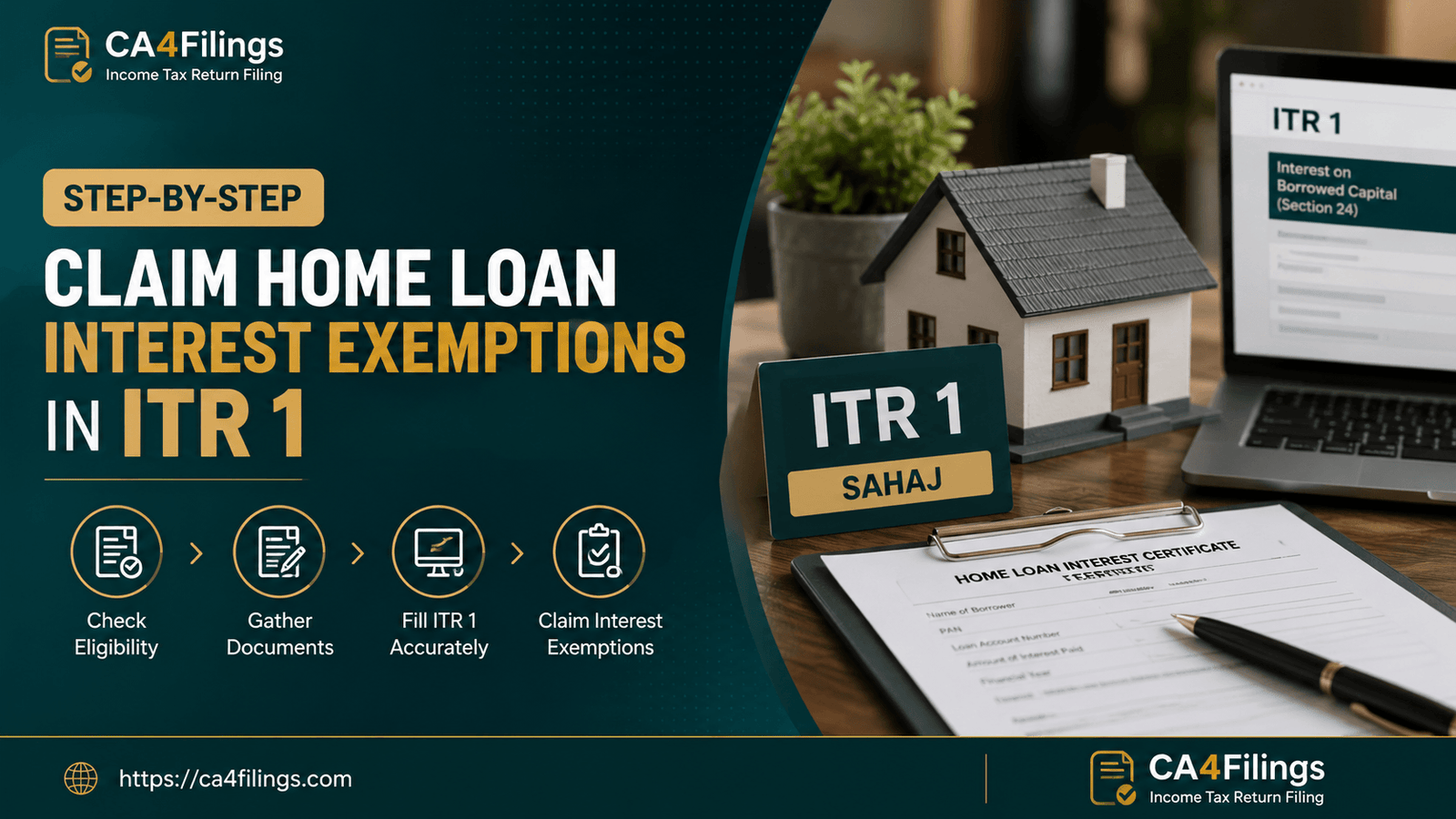
Buying a home is one of the most significant financial milestones in an individual's life. While the emotional fulfillment of owning a house is unmatched, the financial commitment in the form of Equated Monthly Installments (EMIs) can be quite heavy. Fortunately, the Income Tax Act offers substantial relief to homeowners. If you are a salaried individual looking to file your tax returns, knowing how to correctly navigate itr 1 to claim these deductions can save you thousands of rupees.
At CA4Filings, we encounter many taxpayers who miss out on these benefits simply because they find the tax forms confusing. Navigating tax portals shouldn't feel like rocket science. If you need professional assistance to ensure you are maximizing your tax refunds without compliance errors, you can seamlessly avail our expert Income Tax Return Filing services to get your returns filed accurately by certified professionals. Let’s break down exactly how you can claim your home loan interest exemptions in itr 1 step-by-step.
Can You Use ITR 1 to Claim Home Loan Interest?
Before diving into the steps, we need to address a critical compliance rule. The itr 1 form, also known as Sahaj, is meant for resident individuals who have a total income of up to ₹50 Lakhs derived from salaries, one house property, and other sources (like interest income).
You can claim home loan tax benefits in itr 1 only if the loan is against a Self-Occupied Property. If you own a let out property deductions cannot be claimed using this specific form. For a let-out or rented property, or if you own multiple house properties, you must file ITR 2 instead of itr 1.
The Two Pillars of Home Loan Tax Benefits
A standard home loan EMI consists of two components: the principal amount and the interest amount. The tax laws treat both components differently.
1. Interest Repayment under Section 24b
Under section 24b, you can claim a deduction of up to ₹2,000,000 per financial year on the interest component of your home loan, provided the property is self-occupied. If you opted for the New Tax Regime, please note that this deduction is completely blocked. You must file under the Old Tax Regime to claim interest benefits on a self-occupied home.
2. Principal Repayment 80C
The principal portion of your EMI qualifies for a deduction under Section 80C, up to a maximum limit of ₹1,500,000. This includes registration fees and stamp duty paid during the purchase. However, remember that the principal repayment 80C benefit comes with a lock-in period; if you sell the property within 5 years of taking possession, the claimed deductions will be added back to your taxable income in the year of sale.
Essential Checklist Before You File ITR 1
To file your itr 1 smoothly and avoid receiving tax notices later, keep the following documents and details ready:
Certificate of Interest: Request a certificate of interest from your lending bank or housing finance company. This document clearly splits your total annual EMIs into principal paid and interest paid.
Property Possession Date: The section 24b interest deduction is available only if the construction is complete and you have received possession.
Pre-Construction Interest Details: If you paid interest while the property was being built, this accumulated pre-construction interest can be claimed in 5 equal annual installments starting from the year construction was completed, subject to the overall ₹2 Lakh cap.
Step-by-Step Guide to Claiming Home Loan Interest in ITR 1
Once you have gathered your certificate of interest, follow this step-by-step process on the Income Tax e-filing portal.
Step 1: Log in and Select the Correct Assessment Year
Log into your e-filing account, select 'File Income Tax Return', choose the relevant Assessment Year, and select online filing mode. Choose your status as 'Individual' and opt for itr 1.
Step 2: Navigate to 'Gross Total Income'
Inside the return filing page, proceed to the "Income from House Property" schedule under the Gross Total Income section.
Step 3: Select Type of House Property
In the dropdown menu, select "Self-Occupied". Once you select this, the portal automatically caps your maximum allowable interest deduction at ₹2,00,000.
Step 4: Enter Interest Amount under Section 24b
Look for the field labeled "Interest payable on borrowed capital". Refer to your bank's certificate of interest and enter the exact figure of interest paid during the financial year. If you have pre-construction interest, add the eligible one-fifth portion to this amount, ensuring the total does not cross the ₹2 Lakh threshold. Enter this as a negative or auto-calculated negative value to reduce your total taxable income.
Step 5: Claim the Principal under Section 80C
Scroll down to the "Total Deductions" section (Schedule 80C). Enter the principal amount repayment figure mentioned in your home loan certificate under the Section 80C field.
Step 6: Verify with Form 26AS and AIS
Cross-verify all the details with your Annual Information Statement (AIS) and Form 26AS to ensure that no discrepancies exist before hitting the final submit button.
Frequently Asked Questions (FAQs)
Can co-owners claim the ₹2 Lakh deduction separately in ITR 1?
Yes. If the home loan is taken jointly and both co-owners are co-borrowers contributing to the EMIs, both can claim up to ₹2 Lakhs each for interest under section 24b and up to ₹1.5 Lakhs each for principal under Section 80C in their respective itr 1 filings.
What happens if the property construction takes more than 5 years?
If the property construction is not completed within 5 years from the end of the financial year in which the loan was taken, the maximum interest deduction limit under section 24b drops significantly from ₹2,00,000 to just ₹30,000 per year.
Can I claim HRA and home loan interest together in ITR 1?
Yes, you can claim both. If you own a house property in one city but live in a rented house in another city due to your employment, you are legally entitled to claim both HRA tax exemptions and home loan interest benefits in your itr 1.
Is a certificate of interest mandatory to upload while filing?
You do not need to upload the certificate of interest or any other physical documents while submitting your itr 1 on the e-filing portal. However, you must preserve this document securely in your records for at least 6 years, as the IT department can request it during assessment scrutiny.
Claiming your hard-earned home loan deductions shouldn't be a stressful ordeal. By accurately entering details from your bank's certificate into section 24b and utilizing the principal repayment 80C slots properly, you can significantly lower your tax liability when filing your itr 1.
Tax filing requires absolute precision. A small mismatch between your entry and your financial statements can easily trigger an automated tax notice. Let our experienced Chartered Accountants at CA4Filings handle the heavy lifting for you. We ensure error-free filing, optimized tax savings, and complete peace of mind. Reach out to CA4Filings today to get started with your effortless tax filing journey!
Latest Updates
ca4filings.com Services


























-registration.png)