Interest Income Secrets: How to Report FD and Savings Interest in ITR 1
Confused about reporting FD and savings interest? Our expert guide explains how to accurately report interest income in ITR 1 to avoid notices.
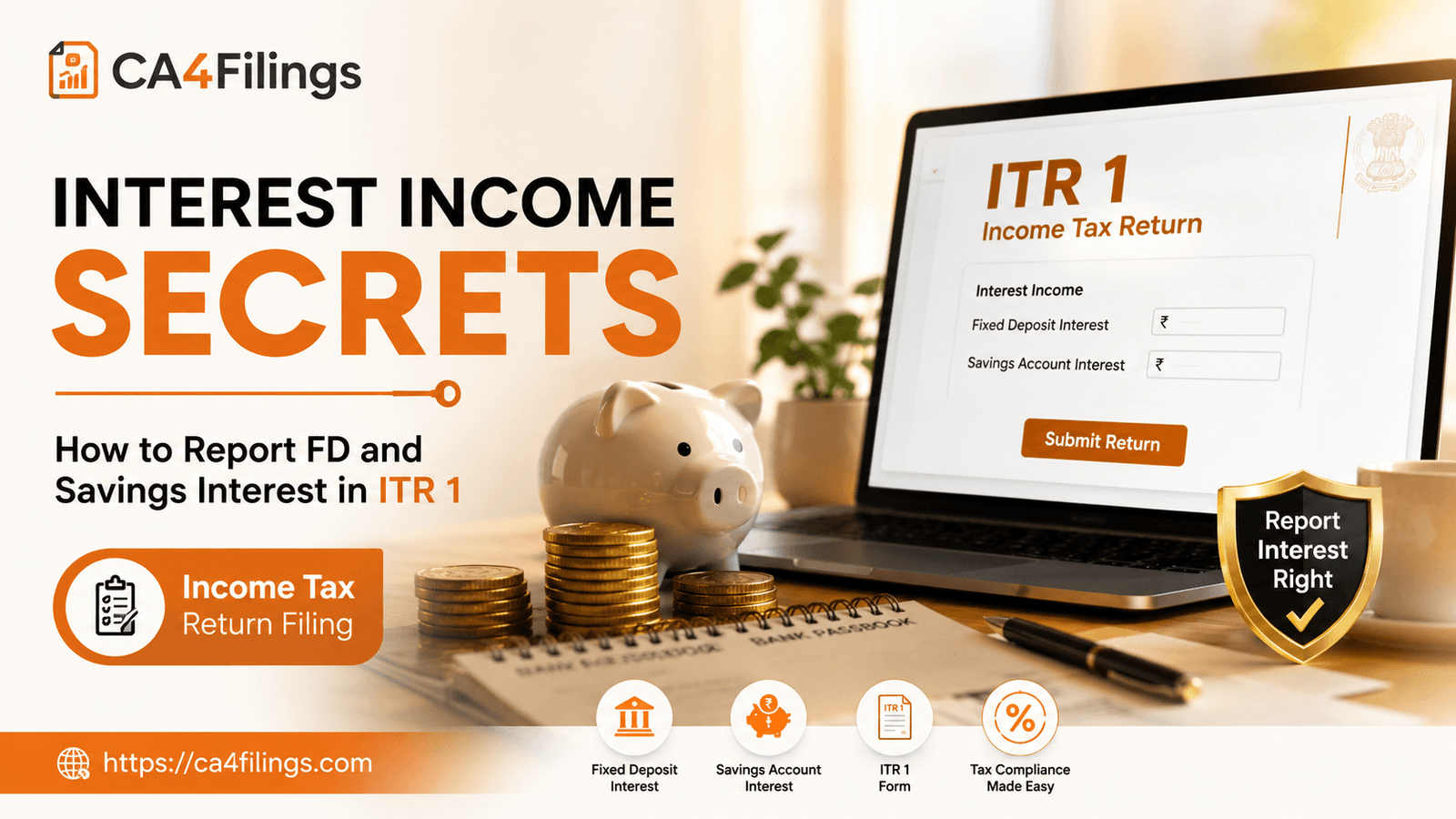
Filing your taxes can feel like walking through a maze, especially when you start digging into the details of your bank statements. Many of my clients at CA4Filings come to me worried about how to report the interest they’ve earned throughout the year. If you are a salaried individual or a pensioner, you likely use itr 1 (Sahaj) for your tax compliance. Getting your Income Tax Return Filing right is essential to avoid unnecessary scrutiny from the tax department. Many taxpayers mistakenly believe that interest income is "tax-free" or doesn't need to be reported because the bank has already deducted TDS. That is a common trap, and today, I want to clear the air on how to handle these figures correctly when you prepare your itr 1.
Understanding Interest Income Under "Income from Other Sources"
In the eyes of the Income Tax Act, interest earned on your savings account, Fixed Deposits (FDs), and even Recurring Deposits (RDs) is classified as income from other sources. Unlike your salary, which is structured and documented by your employer, interest income is often scattered across multiple banks.
Because this income is not part of your professional earnings, it is often missed or under-reported. However, with the integration of the Annual Information Statement (AIS), the tax department now has a crystal-clear view of every penny of interest you earn. If your itr 1 does not match the data in their system, you are essentially inviting a notice.
Why Recurring Deposit Tax and FD Interest Matter
When you put money in an FD or an RD, the interest you earn is taxable at your applicable slab rate. People often ask me, "CA, if my bank already deducted TDS, do I still need to declare it"
The answer is a resounding yes. TDS is merely a mechanism for tax collection; it is not the final tax liability. In your itr 1, you must report the gross interest income. You then claim the TDS already deducted by the bank as a credit against your final tax liability. Failing to report the gross interest means you are understating your total income, which is a compliance red flag.
Navigating Deductions: The Role of Section 80TTA
Before you get too worried about the tax bill, let’s talk about a small relief provided by the government. Under section 80TTA, individual taxpayers (other than senior citizens) can claim a deduction of up to ₹10,000 on interest earned from a savings account.
Who can claim it? Individuals and HUFs.
What is covered? Interest from savings accounts held in banks, post offices, or co-operative societies.
What is excluded? Interest from FDs, RDs, or corporate bonds.
If you are a senior citizen, you have it even better! You can claim a deduction of up to ₹50,000 under Section 80TTB, which covers interest from both savings accounts and fixed deposits. It is crucial to subtract these deductions correctly in your itr 1 to ensure you aren't paying more tax than necessary.
The Reality of Pre-filled Income in ITR 1
Technology has made life easier, but it has also made us lazier. The income tax portal now provides pre-filled income data in your forms. While this is helpful, it is not always 100% accurate.
Banks upload interest data periodically, and sometimes there are discrepancies or late updates. Never hit the 'submit' button blindly. Always download your AIS/TIS (Taxpayer Information Summary) and cross-verify it with your own bank passbooks and FD certificates. If the pre-filled income in your itr 1 looks wrong, you have the option to edit it, provided you have the supporting documents to prove your version of the truth.
Practical Steps to Report Interest Correctly
Consolidate: Gather all your interest certificates or passbook entries for the financial year.
Separate: Keep interest from savings accounts separate from FDs and RDs.
Check TDS: Verify if the bank has deducted tax. If they have, ensure your Form 26AS reflects that amount.
Calculate Deductions: Apply the Section 80TTA or 80TTB benefit.
Report: Enter the net interest income in the "Income from Other Sources" schedule of your itr 1.
Are Tax-Free Bonds Really Tax-Free?
I often get asked about tax-free bonds as a way to park excess cash. Yes, the interest earned on these bonds is exempt from tax under Section 10(15). However, this does not mean you ignore them. You must still report this income as "Exempt Income" in your itr 1. While it won't increase your tax liability, the tax department wants to know about these inflows to track the source of your funds.
Frequently Asked Questions
Do I need to report interest if it is less than ₹10,000?
Yes. There is a common myth that interest below ₹10,000 doesn't need to be reported. That is incorrect. You must report all interest income, even if it is small, though it may be eligible for the 80TTA deduction.
What if I don't have an FD certificate?
You can easily download your interest certificate from your bank's net banking portal or mobile app. If you have multiple accounts, ensure you check each one.
Can I claim expenses against my interest income?
Generally, no. However, if you took a loan to invest in an interest-earning asset, you might be able to claim a deduction for the interest paid on that loan, subject to specific conditions.
What happens if I make a mistake in my ITR 1?
If you realize you missed reporting some interest, you can file a 'Revised Return' before the deadline, or an 'Updated Return' (ITR-U) if the original deadline has passed.
Reporting interest income accurately in your itr 1 isn't just about paying the right amount of tax; it’s about maintaining a clean financial record that keeps you safe from future scrutiny. While tax laws can be complex, staying organized is the best way to keep your peace of mind.
If you ever feel overwhelmed by the process or are unsure about how to categorize your investments, remember that you don't have to go it alone. At CA4Filings, we specialize in making tax compliance simple and stress-free for everyone. Reach out to our team today, and let us ensure your itr 1 is filed with precision and professional care.
Latest Updates
ca4filings.com Services
























-registration.png)