Income Tax Return ITR for Salaried Individuals with Multiple Form 16s
Confused about filing your income tax return itr with multiple Form 16s? CA4Filings explains how to aggregate salary, fix deductions, and file accurately.
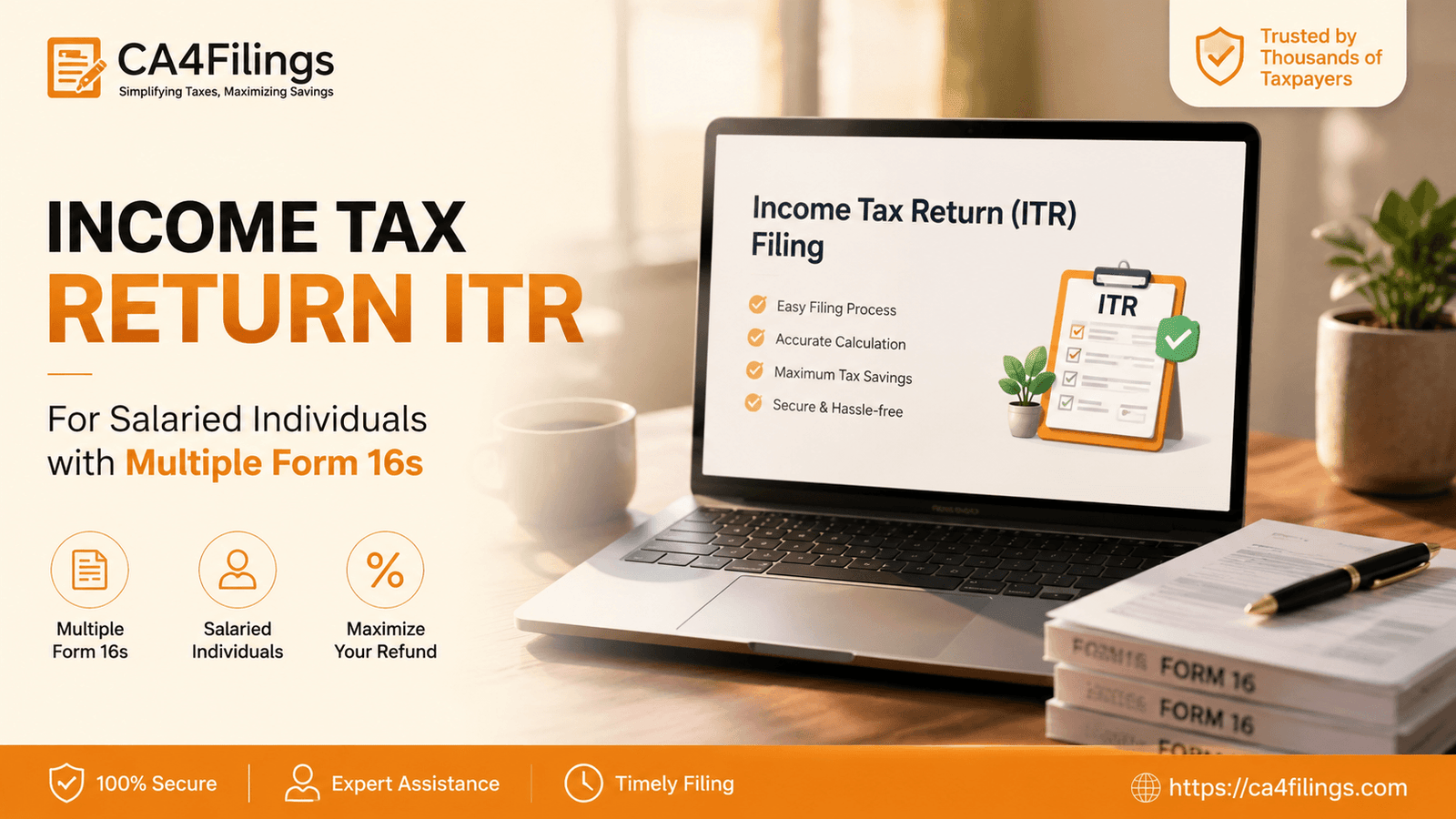
Managing finances can feel like a maze, especially when you have changed jobs within a single financial year. As you prepare to file your income tax return itr, you might be staring at two or even three different Form 16s, wondering how they all fit together. At CA4Filings, we understand that tax compliance shouldn't feel like a burden, which is why we offer comprehensive Income Tax Return Filing services to help you navigate these transitions smoothly. When you have multiple employers, the biggest challenge isn't just the paperwork; it is ensuring that your tax liability is calculated correctly across your entire earnings for the year.
Understanding the Impact of Multiple Form 16s
When you switch jobs, each employer issues a Form 16 based only on the salary they paid you. The problem arises because each employer may have already deducted a standard deduction or considered your tax-saving investments in isolation. If you simply add these forms together without adjustment, you might inadvertently claim excess deductions or miscalculate your tax slab.
Proper income tax return itr filing requires you to consolidate your total income. Your new employer might not have had complete information about your previous earnings, leading to a situation where your tax withheld (TDS) is lower than what is actually due.
The Challenge of Switching Jobs Tax Calculation
The primary hurdle in switching jobs tax calculation is the duplication of exemptions. Under the Income Tax Act, you are entitled to a standard deduction of ₹50,000 per financial year. If both your previous and current employers have deducted this amount, you have essentially claimed a double standard deduction fix requirement.
Here is what happens if you ignore this:
Your taxable income is understated.
The tax department may send a notice for tax shortfalls.
Interest under Section 234B and 234C may apply for delayed tax payments.
As your CA, we always recommend verifying your total income against your Form 26AS and AIS (Annual Information Statement) before hitting the submit button.
How to Aggregate Taxable Salary Correctly
To file an accurate income tax return itr, you must follow a systematic process of aggregation. Think of this as consolidating your financial history for the year.
Step 1: Gather All Documents
Collect your Form 16 Part B from all previous employers and your final Form 16 from your current employer. Ensure you also have your investment proofs for Section 80C, 80D, etc.
Step 2: Consolidate Income
Calculate your aggregate taxable salary by adding the 'Gross Salary' components from all Form 16s. Be sure to remove any duplicate allowances (like HRA or LTA) that might have been processed by multiple employers.
Step 3: Adjust for Deductions
If you find that multiple employers have claimed the standard deduction, you must manually adjust your total income in the ITR utility by excluding the excess claim. Similarly, verify that your total 80C contributions across all employers do not exceed the ₹1.5 lakh limit.
Leveraging Relief Under Section 192
Many taxpayers worry about the tax shortfall that occurs because the new employer did not account for the salary from the previous employer. Fortunately, Section 192(2) of the Income Tax Act allows you to furnish details of your previous employment to your current employer, who can then deduct the correct amount of TDS.
However, if you missed doing this during the year, don't panic. You can simply pay the balance tax via the self-assessment tax challan before filing your income tax return itr. This proactive step prevents unnecessary penalties and ensures your filing process remains clean and compliant.
Frequently Asked Questions
Do I need to file separate forms for each employer?
No. You must consolidate all income from all employers into a single income tax return itr. The ITR forms are designed to handle aggregate salary income from multiple sources.
What if I forgot to disclose previous salary to my current employer?
It is not an issue, but you must pay the differential tax yourself. Calculate your total tax liability on the aggregate income, subtract the TDS already deducted by all employers, and pay the remaining amount as self-assessment tax.
Can I claim HRA twice if I changed cities?
Yes, you can claim HRA for the periods you actually lived in rented accommodation for each job, provided you have the rent receipts and the landlord's PAN for the relevant periods.
Is the ITR form different for multiple employers?
No, you typically use ITR-1 or ITR-2 depending on your income profile. The "Salary" section in these forms allows you to declare total salary from all employers.
Filing your income tax return itr shouldn't be a source of anxiety. While multiple Form 16s add a layer of complexity, they are simply part of the professional journey of growth and career advancement. The key is accuracy—ensuring your deductions are claimed only once and your total tax liability is fully covered.
If you are feeling overwhelmed or want to ensure that every deduction is optimized to reduce your tax outgo, our team at CA4Filings is ready to assist. We specialize in simplifying the complex, helping you stay compliant while maximizing your tax efficiency.
Latest Updates
ca4filings.com Services



























-registration.png)