How to Maximize Your Tax Refund When Filing Your Income Tax Return
Learn how to maximize your tax refund when filing your income tax return with these 7 expert strategies, deductions, and tips from CA4Filings.
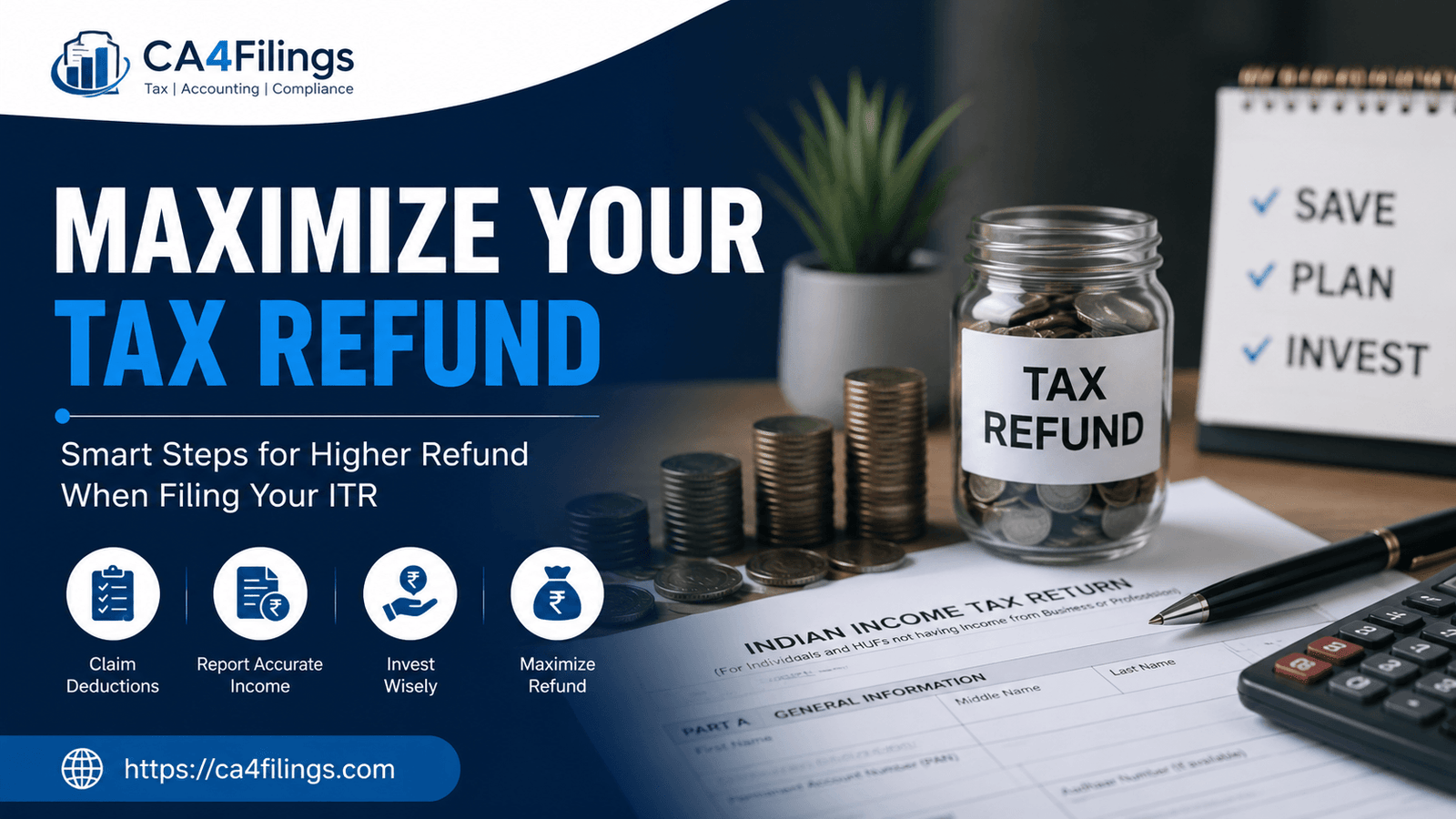
Every year as tax season approaches, a common question echoes through the minds of salaried professionals and business owners alike: "How can I get more of my hard-earned money back from the Income Tax Department"
As Chartered Accountants, we see many people treat tax filing like a last-minute chore. They hurry through it just to get it over with, missing out on substantial chunks of their own money. If you are eager to learn how to maximize your tax refund when filing your income tax return, you are in the right place. Getting a healthy tax refund isn’t about using tricks; it is about knowing the law and planning ahead.
At CA4Filings, we believe that optimizing your tax outgo is a vital part of your financial health. By using smart strategies and claiming the right deductions and credits, you can easily minimize tax liability and boost refund amounts. The secret lies in early planning and accurate documentation. Let us dive into the legal, highly effective strategies that real experts use to maximize your wealth during tax season.
To help you visualize your options, we have built an interactive tax regime estimator below. You can use it to compare your liabilities before exploring the detailed strategies.
Choosing the Right Regime: The Foundation of Your Refund Strategy
Before you look at specific deductions, you must face a crucial choice: the Old Tax Regime vs. the New Tax Regime. This choice is the foundation of your plan to maximize your tax refund when filing your income tax return.
The New Tax Regime offers lower slab rates but requires you to give up almost all deductions and exemptions. The Old Tax Regime has higher tax rates but allows you to lower your taxable income using exemptions like HRA, LTA, and deductions under Chapter VI-A.
If you have home loans, family medical insurance, and active investments in ELSS or PPF, the Old Regime might yield a lower tax liability and a bigger refund. If you do not have these investments, the New Regime’s lower slabs might be better. Picking the wrong regime can cost you thousands of rupees. We recommend running your numbers through both systems before making your final selection.
7 Proven Strategies to Maximize Your Tax Refund
If you choose the Old Tax Regime, you can use these essential steps to boost your refund.
1. Max Out Section 80C Safely
Section 80C is the most popular tax-saving route in India, offering a deduction of up to ₹1,500,000. Many people fail to exhaust this limit or do not track what counts toward it. It includes:
Your children's school tuition fees (excluding development fees).
The principal repayment component of your home loan EMI.
Your Employee Provident Fund (EPF) contributions deducted by your employer.
Investments in Equity Linked Savings Schemes (ELSS), Public Provident Fund (PPF), and National Savings Certificates (NSC).
2. Look Beyond 80C with National Pension System (NPS)
If you have already exhausted your ₹1.5 lakh limit under Section 80C, you can claim an additional deduction of up to ₹50,000 under Section 80CCD(1B) by investing in the National Pension System (NPS). For someone in the 30% tax bracket, this simple move can instantly slash your tax bill by an extra ₹15,000.
3. Claim Health Insurance Deductions (Section 80D)
Medical inflation is rising, and Section 80D offers a great way to save tax while protecting your health. You can claim deductions for health insurance premiums paid for yourself, your spouse, and your dependent children up to ₹25,000.
If you pay premiums for your parents, you can claim an additional deduction of up to ₹25,000 (if they are under 60) or up to ₹50,000 (if they are senior citizens). Even if you don't have insurance, preventive health check-ups offer a deduction of up to ₹5,000 within these limits.
4. Smart Management of House Rent Allowance (HRA) & Home Loans
Are you a salaried employee living in a rented house? Make sure you claim your HRA exemption accurately. If your employer did not account for your rent receipts during the year, you can still claim HRA directly while filing your income tax return.
If you own a home with a home loan, you can deduct up to ₹2,00,000 on the interest paid under Section 24(b). If you rent out that property, the entire interest amount can often be adjusted, subject to specific set-off rules.
5. Report and Offset Capital Losses
If you trade stocks, mutual funds, or properties, remember that you don't just have to report your profits. You can also report your losses. Short-term capital losses can be set off against both short-term and long-term capital gains. Long-term capital losses can be set off against long-term capital gains. If you cannot set off the full loss this year, you can carry it forward for up to 8 subsequent assessment years, which helps reduce your future tax liabilities.
Step-by-Step Checklist to Secure Your Refund
To ensure nothing holds up your money, follow this sequence when preparing your return:
1.Reconcile with Form 26AS and AIS:Prerequisite.
Log into the income tax portal and download your Annual Information Statement (AIS) and Form 26AS. Ensure all TDS (Tax Deducted at Source) and TCS entries match your Form 16 exactly. Any mismatch will trigger a tax notice instead of a refund.
2.Gather Missing Investment Proofs:Documentation.
Collect any rent receipts, medical insurance bills, or donation certificates (Section 80G) that you forgot to submit to your HR department. You can claim these deductions directly on your final return.
3.Pre-Validate Your Bank Account:Critical for Payout.
Go to your e-filing profile and check your linked bank account. Ensure it is fully pre-validated and that your PAN card details match your bank account records exactly. The Income Tax Department only issues refunds electronically to pre-validated accounts.
4.File Accurately and E-Verify:Final Step.
File the correct ITR form (ITR-1, ITR-2, etc.) based on your income streams. Once submitted, e-verify your return using your Aadhaar OTP within 30 days. Your refund process will not begin until your return is verified.
Frequently Asked Questions (FAQs)
How long does it take to receive a tax refund after filing?
Generally, it takes anywhere from 15 days to a few months for the Income Tax Department to process your return and credit your refund. Filing early in the tax season usually results in faster processing because there is less traffic on the portal.
Can I claim deductions if I missed submitting proofs to my employer?
Yes. If you missed the deadline to submit your investment proofs to your company’s HR department, you can claim them directly when filing your income tax return. Just ensure you keep all original receipts and documents safe in case the tax department requests them later.
Why is my tax refund status showing "Refund Determined but Not Credited"?
This usually happens if your bank account is not pre-validated, or if the name on your PAN card does not match the name in your bank records. Log into the e-filing portal, re-validate your bank details, and check for any mismatch errors.
What should I do if I receive a lower refund amount than expected?
Compare the intimation notice under Section 143(1) sent to your email with your filed ITR. The notice will list any discrepancies, such as mismatched TDS data or disallowed deductions. If the department made an error, you can file a rectification request on the portal.
Get Expert Guidance for Your Filing
Learning how to maximize your tax refund when filing your income tax return comes down to avoiding errors, tracking your financial records, and utilizing every legal deduction available. Small adjustments—like claiming a medical check-up or reporting a carried-forward loss—can make a noticeable difference in your final refund.
Tax laws change frequently, and keeping track of every new clause can be overwhelming. That is where professional guidance pays off. At CA4Filings, we review your financial profile, compare both tax regimes, and identify hidden deductions to help you secure the highest possible refund.
Don't leave your money on the table this tax season. Reach out to CA4Filings today, and let our experienced team manage your Income Tax Return Filing smoothly and accurately!
Latest Updates
ca4filings.com Services



























-registration.png)