How to E File ITR Online Without the Help of an Expensive Chartered Accountant
Learn how to e file ITR online independently. A comprehensive step-by-step DIY guide by CA4Filings for hassle-free self tax filing in India.
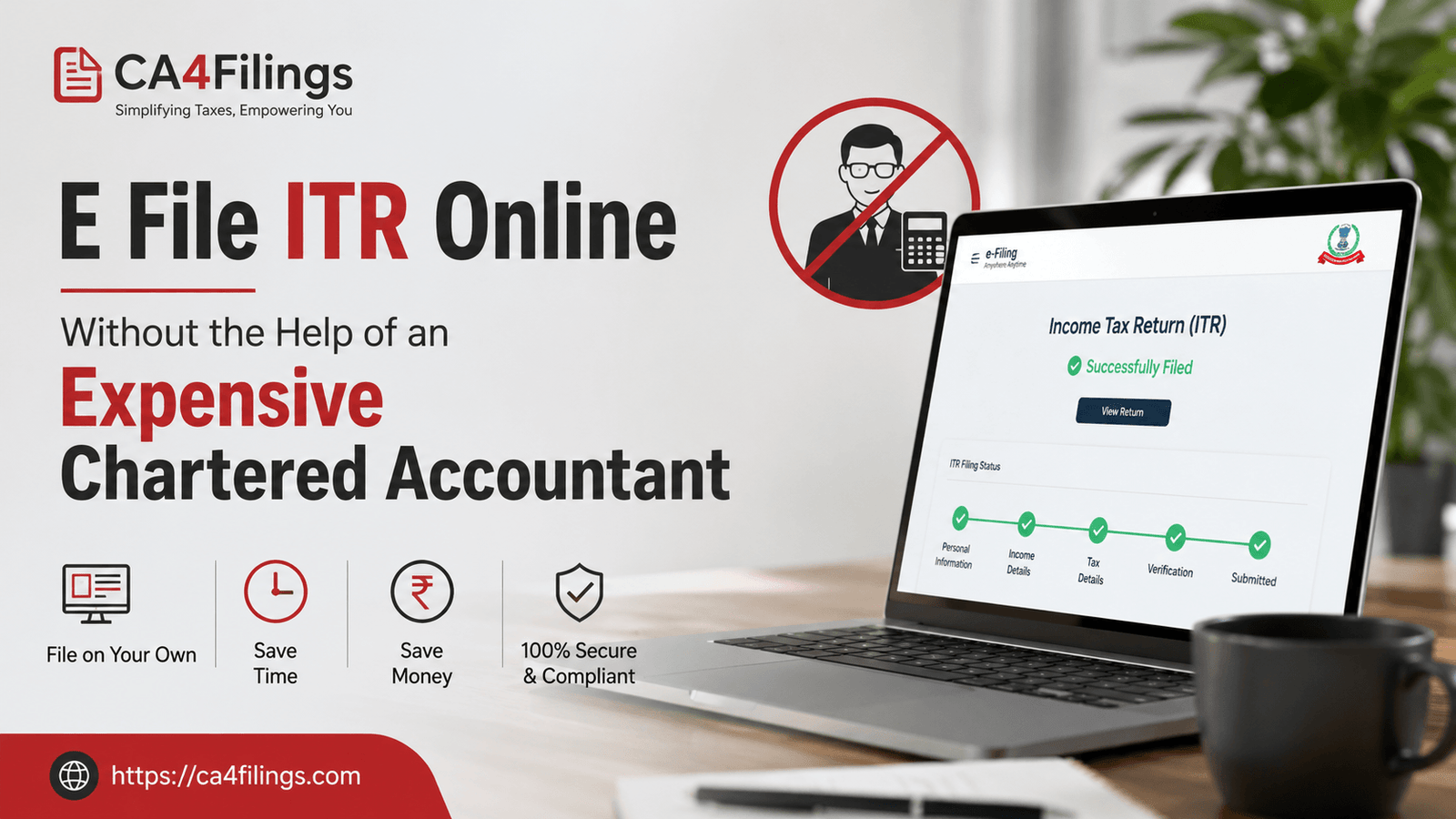
Every year when July approaches, the collective anxiety of taxpayers across India begins to spike. "Have you sorted your Form 16", "Which tax regime did you opt for", "Do I need to hire a professional" are questions that echo in every corporate cafeteria and family WhatsApp group. Traditionally, the default response was to hand over all your documents to a professional and pay heavy consulting fees. However, with the Income Tax Department drastically modernizing its e-filing portal, you can now comfortably e file itr on your own from the comfort of your home. At CA4Filings, we believe in empowering taxpayers. If your finances are relatively straightforward—such as having a single salaried income, some interest from fixed deposits, or a house property—you do not need to shell out hard-earned money for an expensive consultant. It is entirely possible to handle your own taxes independently.
While taking the DIY route saves money, we understand that navigating changing tax laws can feel overwhelming. If you ever find your financial situation getting too complex—perhaps involving capital gains, foreign assets, or intricate business accounts—you can always seek professional assistance for seamless Income Tax Return Filing. But for a vast majority of individual tax filers, a self tax filing approach is not only free but also incredibly educational. Managing your own return forces you to look closely at your financial health, understand your deductions, and take full control of your investments. Let us break down how you can complete your independent tax filing smoothly, confidently, and accurately.
Why You Should Choose Self Tax Filing This Year
Let's be completely honest: as Chartered Accountants, we see hundreds of clients who pay us simply to click buttons that they could easily click themselves. If you are a salaried individual, the Income Tax Department already possesses almost all your financial data through pre-filled forms. Employers file TDS returns, banks report your interest income, and registrar offices report property transactions.
When you log in to e file itr on the official portal, you will notice that most fields are already populated. Your primary job is simply to cross-check, verify, and hit submit. Choosing a diy tax return means you no longer have to wait for weeks for a busy accountant to respond during the peak tax season rush. It eliminates the risk of sharing sensitive financial passwords with third parties, ensures absolute privacy, and saves you money. With the evolution of interactive portals and free tax filing tools provided by the government, the entire ecosystem has become remarkably user-friendly.
The Essential Checklist Before You E File ITR
Before jumping straight onto the portal, you need to gather your financial armor. Having these documents ready beforehand will ensure your session doesn't time out and that you don't make rookie errors.
Form 16: This is your holy grail if you are salaried. Issued by your employer, it details your total salary earned and the tax deducted at source (TDS).
Annual Information Statement (AIS) & Taxpayer Information Summary (TIS): Available directly on the compliance portal, these documents capture all your financial footprints—from savings bank interest and share market transactions to mutual fund dividend payouts.
Form 26AS: This is your official tax passbook. It reflects all the tax that has been deducted and deposited against your PAN by employers, banks, or buyers.
Deduction Certificates: Keep your life insurance receipts, health insurance premiums (Section 80D), housing loan interest certificates, and ELSS mutual fund statements handy to claim your rightful deductions if you choose the Old Tax Regime.
Step by Step Tax Guide to File Your Return Independently
Ready to take the plunge? Follow this clear, logical progression to complete your return effortlessly.
Step 1: Access the E-Filing Portal
Head over to the official Income Tax e-filing website. If you are a first-time user, register using your PAN, which acts as your unique user ID. If you are already registered, log in using your credentials. If you have forgotten your password, don't panic; you can easily reset it using an Aadhaar-linked OTP.
Step 2: Navigate to Income Tax Returns
Once you land on your personalized dashboard, go to the 'e-File' menu, click on 'Income Tax Returns', and select 'File Income Tax Return'. Select the current Assessment Year (for FY 2025-26, the Assessment Year will be AY 2026-27). Select your filing mode as 'Online' and choose 'Individual' as your filing status.
Step 3: Select the Right ITR Form
Choosing the correct form is critical to avoid receiving a defective return notice. For salaried individuals with a total income up to ₹50 Lakhs from salary, one house property, and other sources (like interest), ITR-1 (Sahaj) is the correct choice. If you have capital gains from stocks or mutual funds, you will need to step up to ITR-2.
Step 4: Validate Pre-Filled Data and Verify Schedules
The system will present your return broken down into multiple schedules. Review your personal information, verify the pre-filled gross total income against your Form 16, and check if your bank account details are correct and validated for receiving your refund. Ensure all your TDS entries perfectly match Form 26AS.
Step 5: Compute Tax, Pay Balances, and Submit
Once all schedules are confirmed, the portal will automatically compute your final tax liability. If there is a shortfall, you can pay the self-assessment tax online immediately via Net Banking or UPI. If excess tax was deducted, the system will reflect a tax refund. Review your final summary and click submit.
The Most Crucial Final Step: E-Verification
Many taxpayers successfully complete the submission process but forget the most vital step: verification. Your job to e file itr is not legally complete until the return is verified. You have a strict window of 30 days from submission to verify your return. The easiest and most efficient way to do this is via Aadhaar OTP.
Alternatively, you can verify via Electronic Verification Code (EVC) through your pre-validated bank account or demat account. Failing to verify means your return is treated as invalid, as if you never filed it at all! Keep track of your status via email alerts or SMS updates from the portal.
Frequently Asked Questions (FAQs)
1. What happens if I make a mistake while filing my own ITR?
Do not panic. The Income Tax law allows you ample opportunity to rectify mistakes. You can file a "Revised Return" under Section 139(5) to correct any omissions or wrong statements made in your original return without any penalty, provided it is done within the prescribed timelines for the assessment year.
2. Is it mandatory to file an ITR if my income is below the taxable limit?
If your gross total income is below the basic exemption limit, filing is generally not mandatory. However, filing a return is highly beneficial as it serves as standard proof of income for visa applications and loan approvals. Furthermore, if you have had any TDS deducted, you must file a return to claim that refund.
3. Can I switch between the Old and New Tax Regimes when filing online?
Yes, salaried individuals can choose between the Old and New Tax Regimes at the time of filing their return on the portal, regardless of what they declared to their employer earlier. However, please evaluate carefully, as the New Regime is now the default option unless you explicitly opt out.
4. How long does it take to receive an income tax refund?
With the automated Centralized Processing Centre (CPC), processing speeds have drastically improved. While it used to take months, many taxpayers now receive their refunds directly into their validated bank accounts within a few weeks, or sometimes even days, after successful e-verification.
Empower Your Finances with CA4Filings
Taking care of your own taxes is a powerful step toward financial independence. By using this step by step tax guide, you can comfortably e file itr on your own and avoid unnecessary professional bills. However, we also know that life happens. If you run a business, trade in derivatives, have complex capital gains, or simply feel unsure about tax compliance, you don't have to stress. The team at CA4Filings is always here to step in and handle the heavy lifting for you. Explore our tailored compliance solutions or get in touch today to make your financial journey completely stress-free!
Latest Updates
ca4filings.com Services



















-registration.png)