Crypto and Stock Trading: Which ITR to File if You Cannot Use ITR 1?
Trading crypto or stocks? Find out why you can't use ITR 1 and learn which form you actually need for your tax filing with expert guidance from CA4Filings.
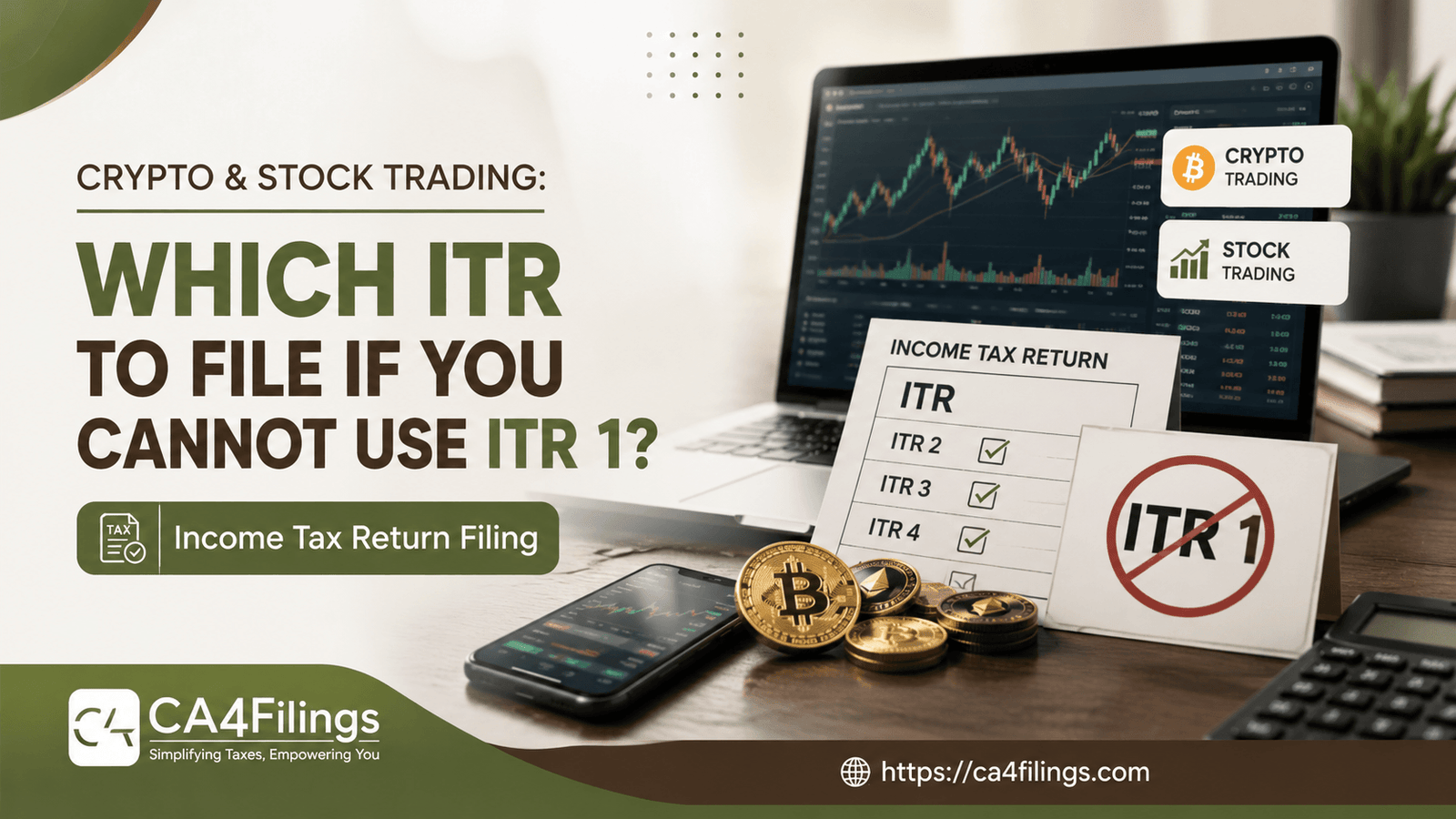
It is that time of the year when the tax season brings a flurry of questions. If you have been active in the stock market or ventured into the world of digital assets, you might have realized that the simplicity of itr 1 is no longer available to you. For most salaried individuals, the Sahaj form is the default choice, but once you start trading, your tax profile shifts significantly. If you are struggling to navigate the complexities of Income Tax Return Filing, it is time to reassess your documentation to ensure you remain compliant with the Income Tax Department’s mandates.
Why Can’t You Use itr 1 for Trading Income?
Many taxpayers mistakenly believe they can keep using itr 1 even after they start investing. However, the Income Tax Act is very specific. itr 1 is designed exclusively for individuals having income from salary, one house property, and other sources like interest, with a total income not exceeding ₹50 lakhs.
The moment you engage in stock trading or crypto transactions, you generate either capital gains or business income. Since itr 1 does not provide the necessary schedules to report these specific heads of income, filing it would be legally incorrect. Using the wrong form can trigger an automated notice from the tax department, leading to unnecessary scrutiny and penalties.
The Shift: Moving from itr 1 to itr 2
If your trading activity is categorized as an investment and not a business, you will likely need to move to itr 2. Unlike the simplified itr 1, itr 2 is meant for individuals and HUFs not having income from profits and gains of business or profession.
When you trade stocks, you are subject to capital gains tax. Depending on your holding period, these are classified as either:
Short term capital gains: Taxed at specific rates depending on the asset class.
Long term capital gains: Subject to different tax slabs and indexation benefits (where applicable).
By using itr 2, you get access to the detailed "Schedule CG" (Capital Gains), which allows you to bifurcate your profits correctly. If you try to force your data into an itr 1 format, you will miss out on reporting your cost of acquisition and other expenses, which could lead to you paying more tax than you actually owe.
Handling Crypto Tax Filing and Schedule VDA
The introduction of the new tax regime for Virtual Digital Assets (VDAs) has made crypto tax filing a priority for many young investors. Under Section 115BBH, income from the transfer of any VDA is taxed at a flat rate of 30% plus applicable surcharge and cess.
To report this, the government introduced Schedule VDA in the ITR forms. Since itr 1 does not contain Schedule VDA, it is technically impossible to report your crypto profits accurately through it. Whether you are dealing in Bitcoin, Ethereum, or various altcoins, you must report the sale proceeds and the cost of acquisition in the relevant schedule provided in itr 2 or itr 3. Ignoring this or attempting to hide such income under "other sources" in an itr 1 return is a major compliance risk that we at CA4Filings strongly advise against.
Is Your Trading a Business or an Investment?
One common confusion we see at CA4Filings is distinguishing between capital gains and business income. If you trade stocks frequently, with high volume and high turnover, the tax authorities might view your activity as a business.
Investment: If you hold stocks for the long term and trade occasionally, it is treated as Capital Gains (itr 2).
Business: If you are a day trader or perform high-frequency trading, this is treated as "Business Income." In this case, you cannot use itr 1 or even itr 2; you would be required to file itr 3.
Quick Comparison Table
| Feature | itr 1 | itr 2 |
|---|---|---|
| Capital Gains | Not Allowed | Allowed |
| Crypto/VDA | Not Allowed | Allowed |
| Business Income | Not Allowed | Not Allowed |
| Primary Use | Salary/House Property | Investments/Capital Gains |
Frequently Asked Questions
1. Can I use itr 1 if I only had a loss in crypto trading?
No. Even if you incurred a loss, you must report it in the correct schedule (Schedule VDA) to potentially set it off or carry it forward. itr 1 does not provide a mechanism for this, making it unsuitable for any crypto-related activity.
2. What happens if I file the wrong form?
If you file using itr 1 when you should have used a higher form, the Income Tax Department may treat your return as "defective." You will receive a notice under Section 139(9) and will be required to file a revised return using the correct form.
3. Does CA4Filings help with complex stock portfolios?
Yes. Our team specializes in reconciling complex brokerage statements, calculating accurate short term capital gains, and ensuring that every transaction is mapped to the correct schedule in your tax return.
4. Is the tax rate for crypto different from stocks?
Yes. Crypto income is generally taxed at a flat 30%, whereas stock market gains are taxed at different rates (such as 15% for short-term equity) depending on the nature of the security and the holding period.
Tax compliance is not just about filing; it is about filing correctly to protect your wealth. While itr 1 is convenient, it is rarely sufficient for the modern investor who participates in the stock and crypto markets. Moving to the appropriate form ensures you utilize the right tax rates and schedules, preventing legal headaches down the line.
Do not let tax confusion stall your investment journey. If you are unsure about your status or need expert assistance in finalizing your tax return, reach out to CA4Filings. Our team is here to ensure your transition from itr 1 to the correct form is seamless, compliant, and optimized for your financial health. Contact us today to get started!
Latest Updates
ca4filings.com Services


























-registration.png)