Understanding the Role of CA in GST Return Filing
Understanding the Role of CA in GST Return Filing helps businesses ensure timely compliance, accurate filing, and reduced tax risks.
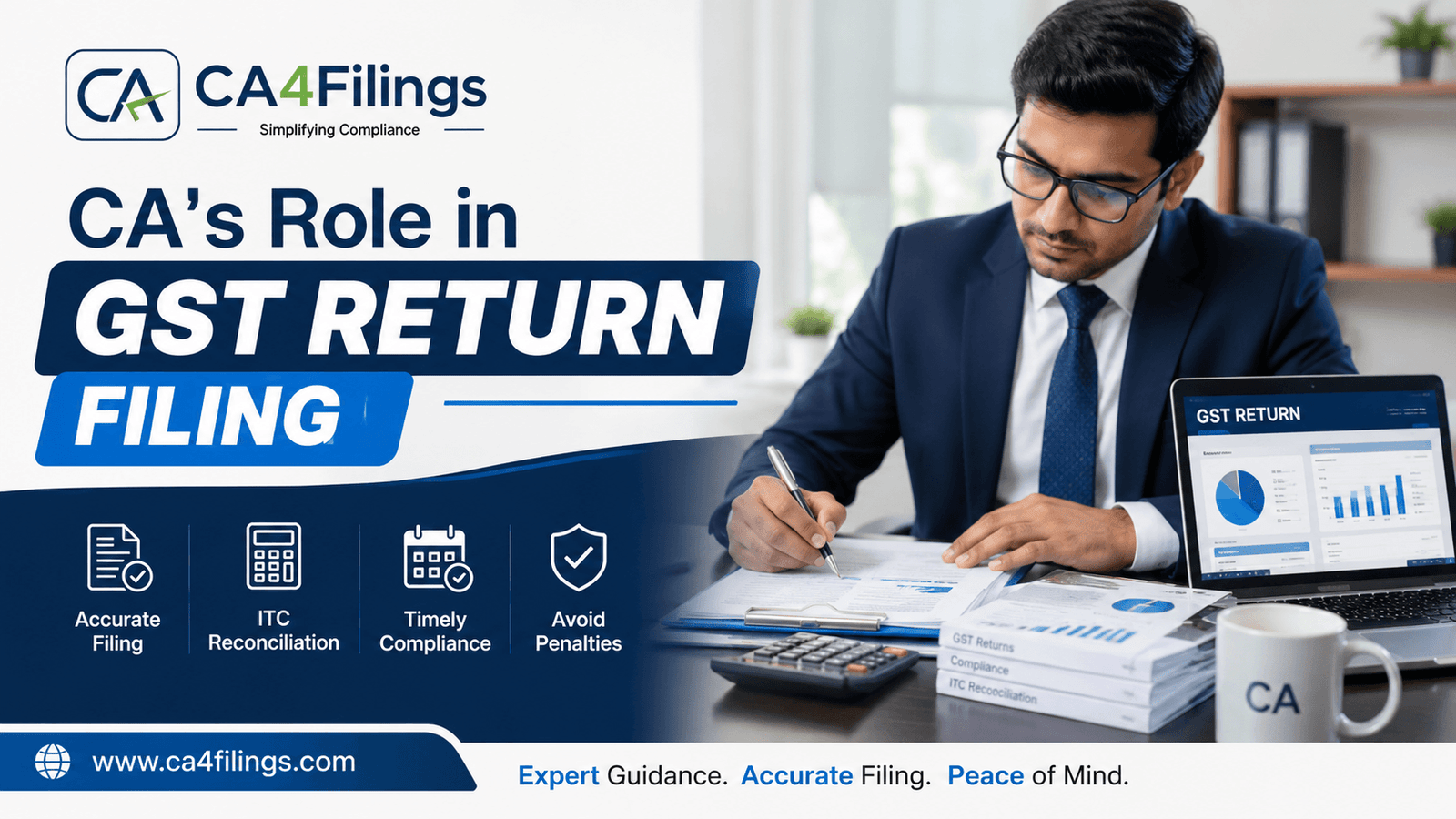
Goods and Services Tax (GST) has completely transformed India’s indirect tax system. While GST has simplified taxation to some extent, return filing and compliance still remain challenging for many businesses. From matching invoices to claiming Input Tax Credit (ITC) correctly, even a small mistake can lead to notices, penalties, or blocked credits.
This is where Understanding the Role of CA in GST Return Filing becomes important for every business owner, startup, freelancer, and trader. A Chartered Accountant not only helps in filing returns but also ensures that the business remains compliant with GST laws and avoids costly errors.
At CA4Filings, we regularly assist businesses with GST Return Filing and help them handle complex GST compliance smoothly and efficiently. Whether you are a small business owner or a growing enterprise, professional guidance can save both time and money.
Understanding the Role of CA in GST Return Filing for Businesses
When people think about GST return filing, they often assume it is only about uploading sales and purchase details. In reality, GST compliance involves much more than that.
Understanding the Role of CA in GST Return Filing means recognizing how a CA helps businesses maintain accurate records, claim eligible ITC, reconcile data, and comply with government regulations.
A Chartered Accountant acts as:
- A compliance advisor
- A tax consultant
- A return filing expert
- A financial risk manager
- A representative before GST authorities
Their expertise helps businesses focus on growth while avoiding unnecessary legal or financial complications.
Why GST Return Filing Is More Complicated Than It Looks
Many business owners initially try to manage GST returns on their own. However, GST regulations frequently change, making compliance difficult without professional knowledge.
Common GST Challenges Faced by Businesses
- Incorrect GST classification
- Wrong tax rate application
- Missing invoice details
- ITC mismatches
- Late filing penalties
- Notices from GST departments
- Errors in GSTR-1 and GSTR-3B reconciliation
Understanding the Role of CA in GST Return Filing becomes crucial because a CA identifies these issues before they become major compliance problems.
Key Responsibilities of a CA in GST Return Filing
Accurate GST Data Preparation
A Chartered Accountant ensures that all sales and purchase records are properly maintained and classified under GST rules.
This includes:
- Checking tax invoices
- Verifying GSTIN details
- Reviewing debit and credit notes
- Ensuring proper HSN/SAC codes
Accurate documentation reduces the chances of return rejection or departmental scrutiny.
Filing GST Returns on Time
Timely return filing is one of the most important compliance requirements under GST.
A CA helps businesses file:
- GSTR-1
- GSTR-3B
- GSTR-9
- GSTR-9C
- CMP-08
- GSTR-4
Missing deadlines can lead to heavy penalties and interest. Understanding the Role of CA in GST Return Filing helps businesses stay compliant without stress.
Input Tax Credit Reconciliation
One of the biggest benefits under GST is claiming Input Tax Credit. However, ITC can only be claimed correctly when invoices match with supplier filings.
A CA performs detailed reconciliation between:
- Purchase records
- GSTR-2B
- Vendor invoices
- Books of accounts
This process helps businesses avoid wrongful ITC claims and prevents future notices.
How a CA Helps Avoid GST Notices and Penalties
GST departments now use advanced data analytics and automated systems to identify mismatches and suspicious transactions.
Common Reasons Businesses Receive GST Notices
- Mismatch in GSTR-1 and GSTR-3B
- Excess ITC claims
- Non-filing of returns
- Incorrect turnover reporting
- Fake invoice transactions
Understanding the Role of CA in GST Return Filing is essential because a CA proactively checks these areas and minimizes compliance risks.
At CA4Filings, we often notice that businesses receiving GST notices usually lack proper reconciliation and professional review.
Importance of GST Audit and Annual Returns
Businesses crossing prescribed turnover limits may require GST audit and annual return filing.
Role of CA in GST Audit
A Chartered Accountant helps by:
- Reviewing financial statements
- Verifying GST records
- Reconciling turnover data
- Identifying compliance gaps
- Preparing audit reports
Understanding the Role of CA in GST Return Filing also includes understanding their role in long-term tax planning and audit preparedness.
Benefits of Hiring a CA for GST Return Filing
Saves Time and Effort
Business owners already manage operations, sales, staff, and customer relationships. Handling GST compliance separately can become overwhelming.
A CA simplifies the process and saves valuable time.
Reduces Errors
GST mistakes can become expensive. Professional review reduces calculation and reporting errors significantly.
Better Tax Planning
A CA helps businesses optimize tax liabilities legally and improve working capital management through proper ITC utilization.
Helps During Departmental Notices
If any GST notice or query arises, a CA can represent the business and prepare appropriate responses.
Understanding the Role of CA in GST Return Filing means understanding how professional expertise protects businesses financially.
Real-World Example of GST Filing Problems
Consider a small trading company that filed GST returns internally without professional assistance. The company claimed ITC based on purchase invoices, but several suppliers failed to upload invoices in GSTR-1.
As a result:
- ITC got blocked
- The company received notices
- Additional tax liability was imposed
After consulting a Chartered Accountant, proper reconciliation systems were implemented, vendor follow-ups were conducted, and future compliance improved significantly.
This example clearly highlights the importance of Understanding the Role of CA in GST Return Filing.
How CA4Filings Supports Businesses in GST Compliance
At CA4Filings, we understand that every business has different GST requirements. Our approach focuses on practical compliance solutions rather than just routine filing.
Our GST Services Include
- GST registration assistance
- Monthly and quarterly return filing
- ITC reconciliation
- GST notice handling
- Annual return filing
- GST audit support
- Compliance advisory
We help startups, freelancers, traders, manufacturers, and service providers manage GST smoothly with professional guidance.
Common Mistakes Businesses Should Avoid
Ignoring Vendor Reconciliation
Always ensure suppliers file returns correctly. Otherwise, ITC claims may get blocked.
Delayed Return Filing
Late filing attracts penalties and interest, even if there is no tax liability.
Wrong GST Classification
Incorrect tax rates can lead to future disputes and tax demands.
Depending Only on Accounting Software
Software helps with calculations, but professional review is still necessary for compliance accuracy.
Understanding the Role of CA in GST Return Filing helps businesses avoid these costly mistakes.
FAQs
Is hiring a CA mandatory for GST return filing?
No, it is not mandatory for all businesses. However, professional assistance helps avoid errors, penalties, and compliance issues.
Can a CA help reduce GST liability legally?
Yes. A CA helps businesses optimize eligible ITC claims and improve tax planning within legal provisions.
How often should GST reconciliation be done?
Ideally, businesses should reconcile GST records every month to avoid mismatches and notices.
What happens if GST returns are filed incorrectly?
Incorrect filing can lead to penalties, notices, blocked ITC, and additional tax demands from authorities.
Why is Understanding the Role of CA in GST Return Filing important for startups?
Startups often lack dedicated tax teams. A CA ensures proper compliance from the beginning and prevents future legal complications.
Understanding the Role of CA in GST Return Filing is essential for every business operating under GST in India. GST compliance is no longer limited to simple tax filing. It requires proper reconciliation, accurate reporting, legal understanding, and continuous monitoring.
A Chartered Accountant plays a critical role in helping businesses remain compliant, avoid penalties, and manage taxation efficiently. Professional guidance not only reduces stress but also strengthens the financial health of the business.
At CA4Filings, we believe that proactive GST compliance is the key to long-term business success. Our experienced professionals are committed to helping businesses manage GST filings accurately, efficiently, and confidently.
Latest Updates
ca4filings.com Services























-registration.png)