The Consequences of Non-Compliance: What Happens If You Skip GST Filing?
Curious about the consequences of skipping GST filing? Learn how late fees, e-way bill blocking, and assessment risks impact your business.
Running a business in India is a juggling act, and we at CA4Filings understand that keeping up with the constant stream of tax deadlines can sometimes feel overwhelming. However, skipping your mandatory filings is never the solution. When you miss a deadline for GST Return Filing, you aren’t just missing a date on the calendar; you are triggering a chain reaction that can quietly erode your business’s financial health and operational freedom.
It is easy to think that a single missed return won’t matter, but the reality of modern compliance is that the GST portal is entirely automated. From the moment a due date passes, the system begins a clock that leads to penalties, restrictions, and eventually, unwanted attention from the tax authorities. Let’s break down exactly what happens when you neglect your gst filing obligations and why staying proactive is the only way to protect your business.
The Immediate Financial Sting: Late Fees and Interest
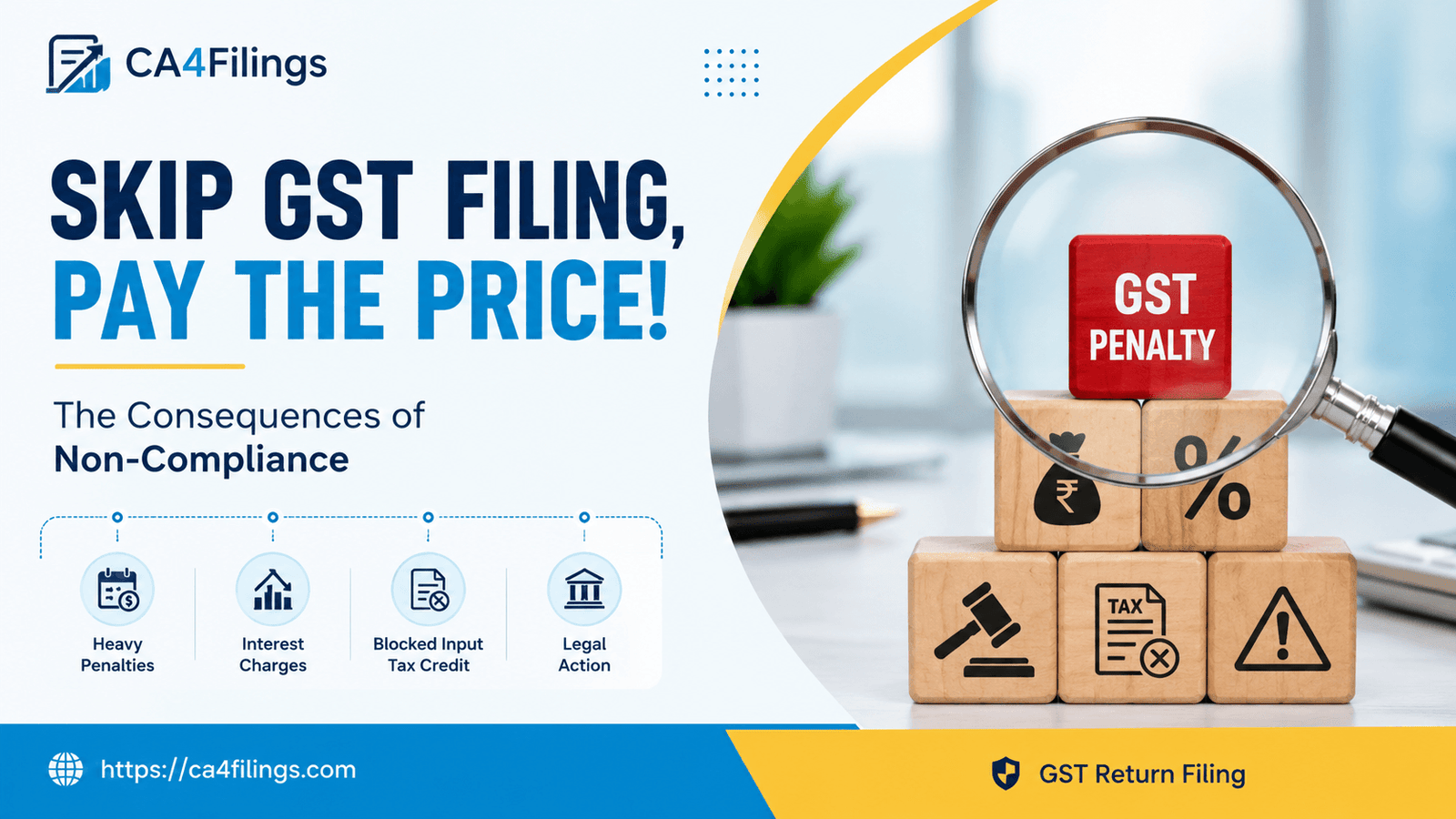
The first and most obvious consequence of failing to complete your gst filing on time is the financial penalty. Unlike some other tax regimes where penalties are discretionary, GST late fees are automated and system-driven.
Daily Late Fees: For every day of delay, a late fee is charged under both the CGST and SGST acts. Currently, this typically amounts to ₹50 per day (₹25 under each act). If you are filing a "Nil" return, the penalty is slightly lower, but it still accumulates daily.
Interest on Tax Liability: If you have an outstanding tax liability, the government charges interest at a rate of 18% per annum on the unpaid tax amount, calculated from the day following the original due date until the actual date of payment.
Think of these as "dead money"—funds that could have been reinvested into your business but are instead being paid out as a penalty for simple administrative neglect.
Operational Roadblocks: E-way Bill Blocking
One of the most disruptive consequences of irregular gst filing is the e way bill blocking facility. If you fail to file your GSTR-3B for two consecutive months (or quarters, depending on your scheme), the GST portal automatically restricts your ability to generate e-way bills.
For any business dealing in the movement of goods, this is effectively a "stop-work" order. You cannot ship products to your customers, and you cannot receive incoming raw materials. This can bring your entire supply chain to a screeching halt, leading to delayed orders and frustrated clients.
The Ripple Effect: GSTR 2A Buyer Impact
Your compliance is not just your own business; it is the business of everyone you trade with. When you fail to file your GSTR-1, your customers face a severe gstr 2a buyer impact.
Because your sales invoices won’t reflect in their GSTR-2A or GSTR-2B statements, your buyers will be unable to claim the Input Tax Credit (ITC) for the purchases they made from you. In a B2B relationship, this is a major red flag. Your buyers may withhold payments until the records are cleared, or worse, they may simply stop doing business with you to avoid the compliance burden caused by your inaction.
Escalation: The Notice in Form 3A and Assessment Risks
If you continue to ignore your filing obligations, the system will escalate the matter. You will eventually receive a formal notice in form 3a. This is a statutory demand asking you to file your returns within 15 days.
Ignoring this notice is a dangerous game. If you fail to respond or file within the grace period provided, the tax officer is empowered to initiate a best judgment assessment. Under this process, the officer will estimate your tax liability based on the information available to them—which is often an inflated, worst-case scenario. You then become liable to pay that estimated tax, plus interest and heavy penalties, often requiring a formal appeal process to rectify.
The Ultimate Threat: Registration Cancellation Risk
Continuous non-compliance, usually spanning six months, leads to a significant registration cancellation risk. If your GST registration is cancelled, you lose your identity as a legitimate tax-paying business. You will be unable to issue valid tax invoices or claim ITC. Restoring a cancelled registration is a time-consuming and costly process that involves clearing all arrears, filing all pending returns, and potentially facing departmental audits.
Frequently Asked Questions
1. Does the late fee stop increasing if I don't file?
No. The late fee is a daily accumulation. It will continue to grow until you either file the return or reach the statutory maximum cap for that specific return type.
2. Can I file my returns late after receiving a notice?
Yes, you should file immediately. Even if you receive a notice in form 3a, filing the returns and paying the associated taxes and interest as quickly as possible is the best way to prevent the officer from proceeding with a best judgment assessment.
3. What if I have no transactions for the month?
You are still required to file a "Nil" return. Skipping this is still considered non-compliance and will attract a daily late fee.
4. How do I unblock my e-way bill generation?
Once you file all pending GSTR-3B returns, the system typically updates the status automatically by the next morning. You can also manually trigger an "Update Block Status" on the e-way bill portal.
Stay Compliant with CA4Filings
Don't let a missed deadline compromise your hard-earned business reputation. At CA4Filings, we specialize in making compliance stress-free and automated. Whether you need help with regular filings or clearing up past backlogs, our team is here to ensure your gst filing is handled with precision and care.
Latest Updates
ca4filings.com Services























-registration.png)