Supplier Didn't File GSTR 1? Here’s How to Handle Your Missing Credit
Missing input tax credit because your supplier didn't file their gst return? Follow our expert guide to manage GSTR 2B mismatches and secure your ITC.
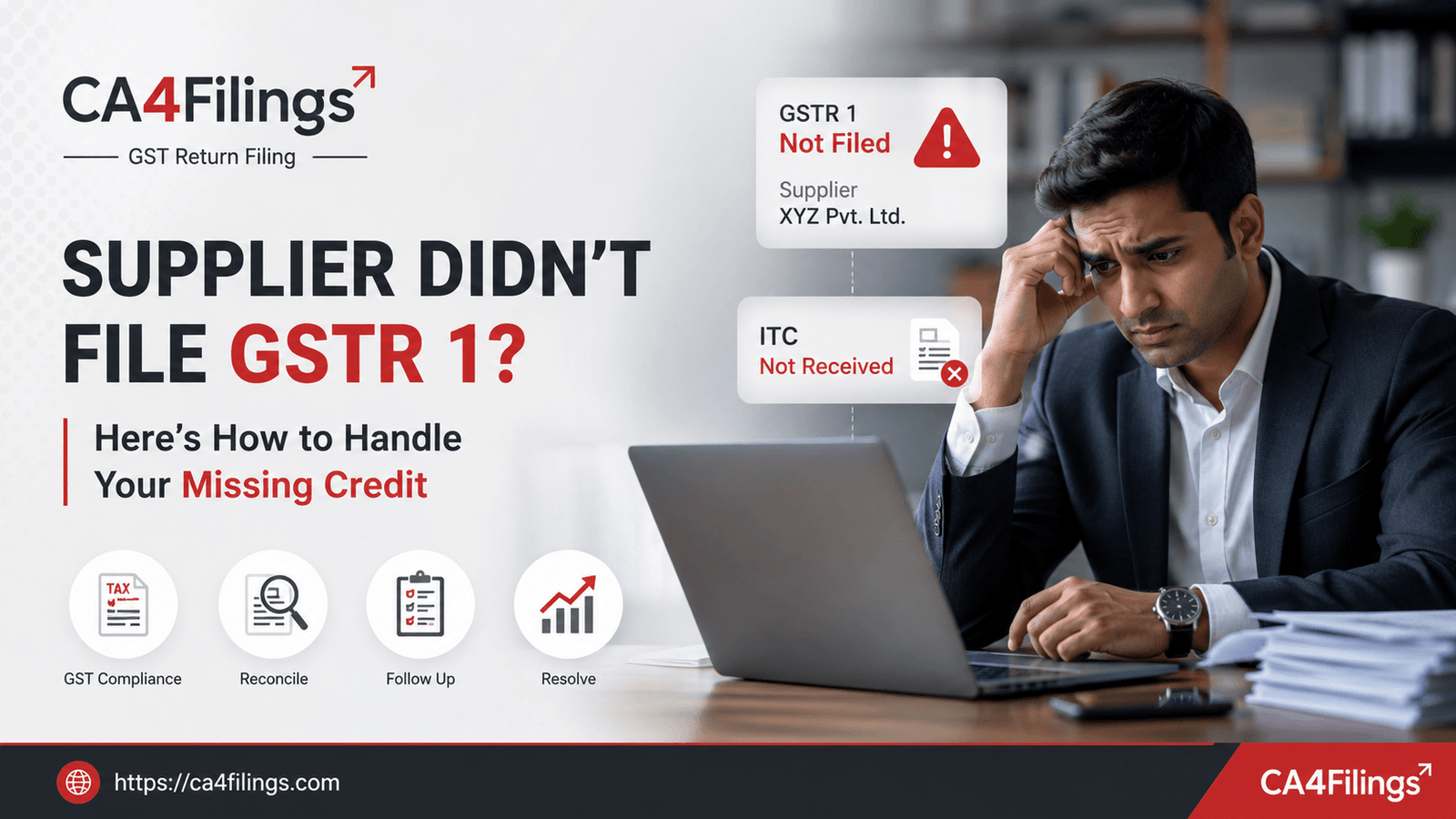
It is a nightmare scenario for any business owner: you have paid your suppliers, accounted for the GST on your purchases, but when you log into the portal, your Input Tax Credit (ITC) is missing. If you are struggling with this, remember that at CA4Filings, we emphasize that consistent and accurate GST Return Filing is the backbone of a compliant business. When your supplier fails to file their gst return, it directly impacts your cash flow and compliance rating. Let’s break down exactly how you can manage this situation without hurting your business relationships or your tax position.
Understanding the Impact of Missing GSTR 1
When a supplier misses their filing deadline, the details of your purchases do not reflect in your GSTR 2B. Under the current GST regime, you are generally only eligible to claim ITC that is reflected in your GSTR 2B. If it isn't there, you cannot claim it. This leads to a scenario often referred to as a provisional itc ban, where you are essentially forced to pay the tax out of your pocket again because the credit isn't available to offset your liability.
It is crucial to monitor your gstr 2b unmatched report regularly. Ignoring these discrepancies until the end of the financial year is a recipe for disaster, as your supplier might have missed the window for corrections.
Immediate Steps to Handle Unmatched Credits
If you notice a vendor hasn't filed their return, don’t panic, but do act immediately. Here is the professional approach we recommend at CA4Filings:
1. Verification and Communication
First, cross-verify your purchase register with the portal. Sometimes, the invoice might be uploaded under a different GSTIN or perhaps there is a typo in the document number. If the data is truly missing, reach out to the vendor immediately.
2. Using a Formal Approach
It is common for businesses to be hesitant about pushing vendors, but remember that your tax credit is your money. You can use a polite but firm vendor follow up email format to request compliance.
Can You Legally Withhold Payments?
Many clients ask us about holding tax payouts or blocking vendor payments legally. While you might want to withhold the GST component of the payment until the credit reflects in your GSTR 2B, you must be careful.
Check your purchase agreement or contract. Most standard contracts stipulate that payment is contingent upon the vendor fulfilling their tax obligations. If your contract includes a clause stating that payments are subject to the reflection of ITC in your portal, you are on safer legal ground. However, always consult with your CA before taking drastic measures like withholding full payments, as this could lead to a breach of contract and potential legal disputes.
Best Practices for Prevention
The best way to handle a supplier not filing their gst return is to prevent the issue before it starts. Here are three expert tips:
Vendor Due Diligence: Before onboarding a new supplier, check their GST filing history on the portal. A supplier with a history of late filings is a risk to your business.
Monthly Reconciliation: Never wait for the annual audit. Perform a reconciliation between your purchase books and the GSTR 2B every month.
Clear Payment Terms: Explicitly state in your purchase orders that the GST component of the invoice will be released only after the vendor ensures the invoice appears in your GSTR 2B.
Frequently Asked Questions
What happens if the supplier never files the return?
If the supplier consistently fails to file their gst return, you will unfortunately lose the ITC for those purchases. You may need to take legal action to recover the tax component or terminate the business relationship.
Can I claim ITC manually if the supplier forgot to file?
No, the current system is automated. If it doesn't show in GSTR 2B, the system does not allow a manual claim for B2B transactions.
How often should I check my GSTR 2B?
We recommend checking it at least once every month, ideally a few days before the due date for your own gst return filing, to give your vendors time to rectify errors.
Is there a penalty for the supplier?
Yes, late filing attracts interest and late fees for the supplier, but that does not compensate you for the loss of your working capital.
Managing missing credits due to a supplier’s failure to file a gst return is an essential part of modern tax management. By staying proactive, maintaining clear communication, and ensuring your contracts protect your interests, you can keep your finances healthy.
Latest Updates
ca4filings.com Services


























-registration.png)