SEZ Supplies Decoded: Zero-Rated Rules for Special Economic Zones
Confused by SEZ supplies? Learn how to handle zero-rated rules and accurately file your goods and service tax return with this expert guide from CA4Filings.
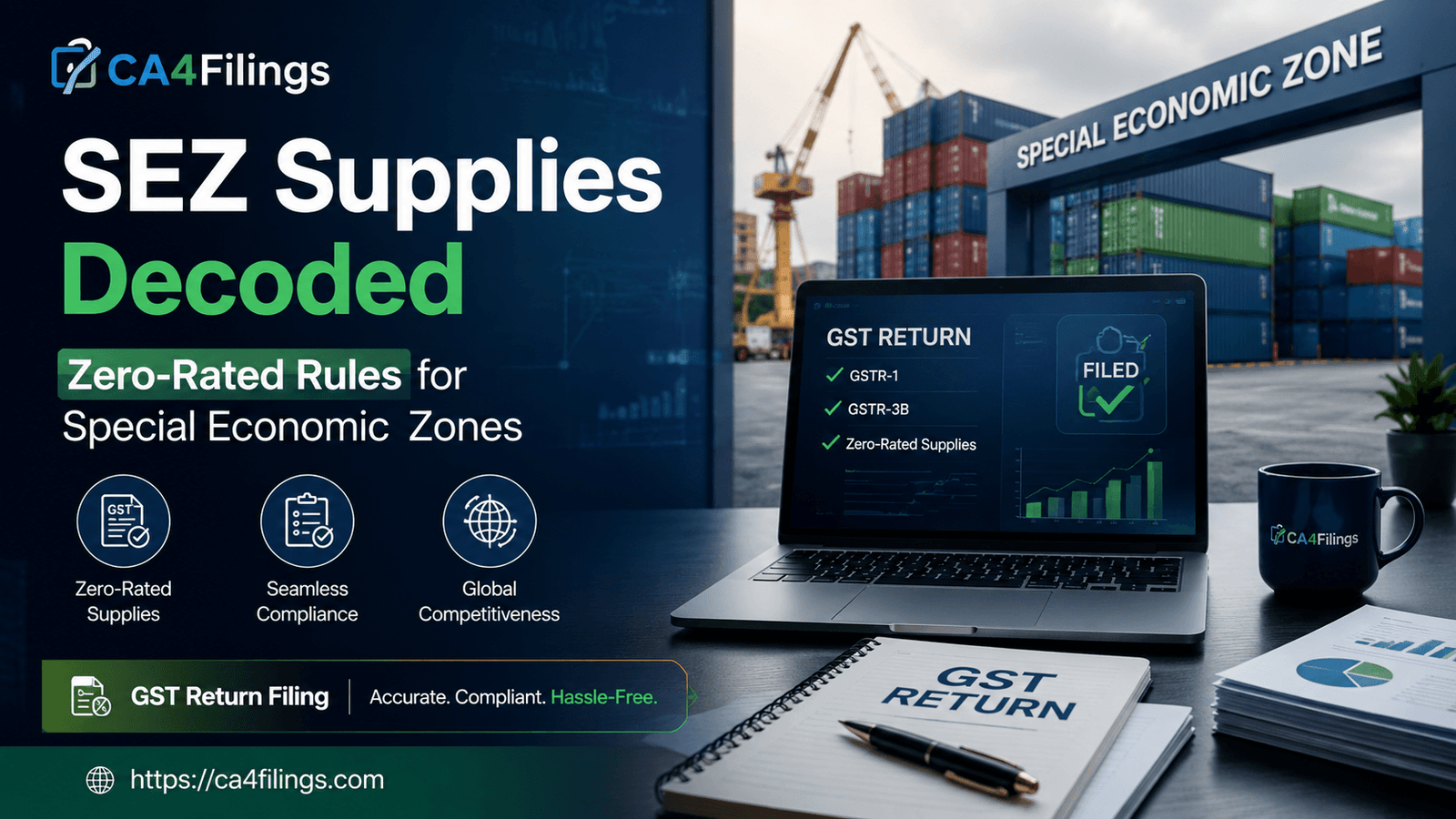
Navigating the complexities of GST in India can be daunting, especially when your business involves Special Economic Zones (SEZs). Many entrepreneurs often find themselves tangled in the technicalities of zero-rated supplies versus exempt supplies, leading to errors in their regulatory filings. At CA4Filings, we specialize in helping businesses stay compliant with GST Return Filing, ensuring that your goods and service tax return is accurate, timely, and optimized to claim the benefits you are rightfully entitled to under the law.
Understanding the "why" and "how" behind these rules is the first step toward tax efficiency. Let’s decode the world of SEZ supplies and how they impact your compliance burden.
What Defines Zero-Rated Supplies?
Under the GST regime, supplies to SEZ units or developers are classified as "zero-rated." It is a common misconception to conflate these with "exempt" supplies. Here is the crucial difference:
Exempt Supplies: These attract a nil rate of tax, and you generally cannot claim Input Tax Credit (ITC) on the inputs used.
Zero-Rated Supplies: The tax rate is 0%, but the entire value chain remains within the GST net. This means you are fully eligible to claim ITC on your purchases, which makes zero-rating a powerful tool for maintaining cash flow.
When you prepare your goods and service tax return, treating these correctly ensures you don't unnecessarily lose out on ITC.
The Two Routes for SEZ Supplies
When you are a supplier in the Domestic Tariff Area (DTA) selling to an SEZ, the law provides two primary paths for your transactions. Choosing the right one is essential for your financial planning:
1. The LUT/Bond Route
You can supply goods or services without payment of IGST by executing a Letter of Undertaking (LUT) or a Bond. This route is preferred by many businesses because it avoids the need to pay tax upfront and then wait for a refund. However, you must maintain meticulous records to substantiate that the supply was for "authorized operations."
2. The IGST Claim Route
Alternatively, you can choose to pay IGST at the time of supply and subsequently claim a refund. This is often done when there is a delay in generating an LUT or if the internal systems are better suited for tax-paid invoicing. In this case, your goods and service tax return must clearly reflect the payment, and the refund claim must be filed in the appropriate form on the GST portal.
Mandatory Compliance and Documentation
Documentation is the backbone of any audit. For SEZ supplies, the process goes beyond just issuing a standard invoice.
Zero Rated Invoice Style: Your invoices must explicitly state that the supply is "Zero Rated for Authorized Operations under Section 16 of the IGST Act."
Endorsement Form Tracking: A critical piece of the puzzle is the proof of receipt. You must obtain an endorsement from the authorized SEZ officer confirming that the goods or services were admitted into the SEZ for authorized operations. Without this, your refund claims—whether for unutilized ITC or IGST paid—will almost certainly face rejection.
Processing Zone Billing: Always ensure that the recipient’s GSTIN and address details on the invoice specifically match the SEZ registration, not their DTA office.
Why Your Goods and Service Tax Return Accuracy Matters
Whether you are involved in domestic tariff area sales or exporting services to an SEZ, the GST portal’s automation relies on the data you upload. Discrepancies between your sales ledger, the e-way bill portal, and your filings can trigger scrutiny.
When you file your goods and service tax return, ensure that your sales to SEZs are reported under the correct tables for zero-rated supplies. A small slip here can lead to a mismatch in the system, forcing you to go through the painful process of rectifying returns months later.
Frequently Asked Questions (FAQs)
Q: Can I claim ITC if I supply goods to an SEZ unit without paying IGST?
A: Yes. Because SEZ supplies are zero-rated (not exempt), the law explicitly allows you to claim the ITC on inputs used to make those supplies, even if you do not pay output tax.
Q: What happens if the SEZ unit does not provide the endorsement?
A: Obtaining the endorsement is a statutory requirement for substantiating that the supplies were used for authorized operations. Without it, you cannot prove the "zero-rated" status, which may lead to the demand for tax payment, interest, and penalties.
Q: Does every supply to an SEZ count as zero-rated?
A: No. Only supplies made for "authorized operations" of the SEZ unit or developer qualify for zero-rating. Always keep a copy of the SEZ unit's Letter of Approval (LOA) to ensure the supplies you are providing are indeed authorized.
Q: Is there a time limit for filing refund claims on SEZ supplies?
A: Generally, you have two years from the relevant date to file your refund application. We recommend filing as soon as the endorsement is received to avoid cash flow bottlenecks.
Partner with CA4Filings for Expert Guidance
The nuances of SEZ taxation are vast, and the margin for error is thin. Why take chances with your compliance? Let the experts at CA4Filings handle the complexities for you. From validating your goods and service tax return to managing your refund documentation and endorsement form tracking, we are here to ensure your business remains audit-ready and tax-efficient.
Latest Updates
ca4filings.com Services

















-registration.png)