Scaling Up Safely: New Invoice Numbering Series Rules for the New Financial Year
Master the new invoice numbering rules for the new FY. Ensure your goods and service tax return remains error-free with our expert compliance guide.
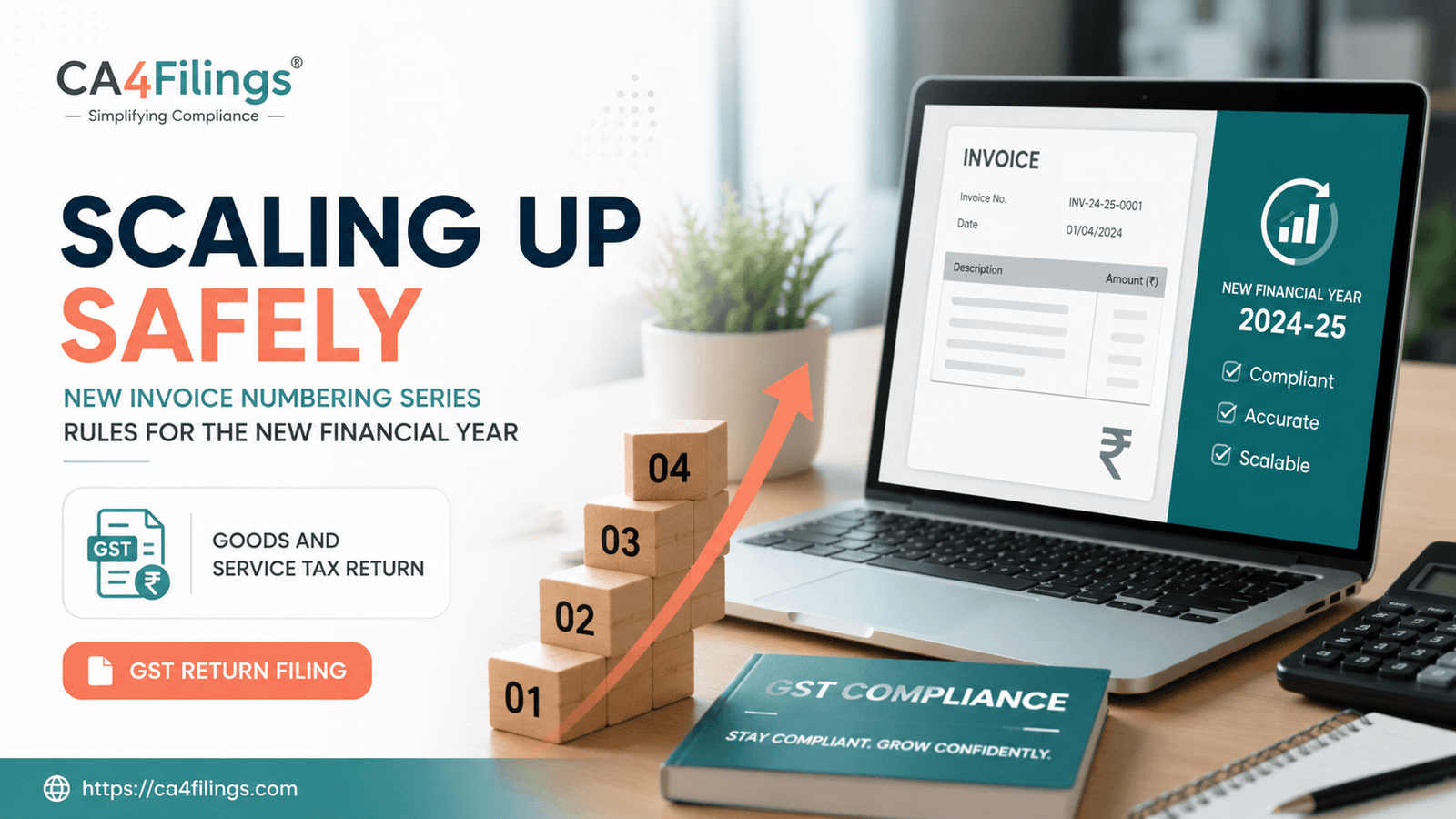
As we step into a new financial year, many business owners are busy preparing their books, but there is one critical area that often slips through the cracks: your invoice numbering series. Whether you are a small startup or an established enterprise, failing to get this right can complicate your goods and service tax return process down the line. At CA4Filings, we often see businesses struggle with compliance issues that could have been avoided with a simple, structured approach to GST Return Filing. Getting your documentation in order now is not just about following the law; it is about scaling your operations safely and avoiding unnecessary scrutiny from tax authorities.
Why Invoice Numbering Matters for GST Compliance
Under the GST regime, an invoice is more than just a payment request—it is a legal document that dictates the flow of credit and tax liability. If your numbering system is chaotic, it leads to errors in data entry, which directly impacts your goods and service tax return.
The law mandates that every tax invoice must be a unique serial number for a financial year. It should not exceed 16 characters, and it must contain only alphabets, numerals, or special characters like hyphens, dashes, or slashes. When you fail to maintain consecutive numbering rules, you create gaps or duplicates. If you file a goods and service tax return with duplicate or missing invoice numbers, you are essentially inviting an audit or an inquiry from the department.
Setting Up Your Prefix Suffix Standards
To manage your growth, especially if you have multiple business units, you need to establish clear prefix suffix standards. A well-thought-out invoice format helps you trace transactions quickly.
For example, instead of a simple numerical series like 001, 002, consider a format like FY2026-27/BR01/001. Here is why this works:
Year Identification: Including the financial year helps in segregating records for annual audits.
Branch Identification: If you have multi-branch alphanumeric codes, you can instantly identify which location generated the invoice.
Audit Trail: It simplifies duplicate invoice prevention, as every branch or department works within its own dedicated sequence.
Best Practices for Scaling Your Invoicing System
As your business scales, manual spreadsheets become a liability. To ensure your goods and service tax return remains accurate, follow these practical steps:
1. Standardize Across All Departments
Ensure that every department, from sales to logistics, follows the same format. If you allow different teams to generate invoices using different styles, you will face a nightmare during GSTR 1 prep.
2. Automate to Prevent Overlap
Human error is the primary cause of incorrect invoice numbering. Use accounting software that automatically suggests the next number in the sequence. This ensures you never accidentally skip a number or reuse an old one.
3. Maintain a Master Register
Even with software, keep a digital master register. This acts as a secondary check, especially when you are reconciling your sales register before submitting your monthly goods and service tax return.
Troubleshooting Common Numbering Mistakes
We have seen clients face panic situations because they inadvertently changed their invoice series mid-year. If you realize your sequence is broken, do not try to "fix" it by manually overwriting past entries. Instead:
Document the discrepancy in a ledger.
Inform your tax consultant immediately.
Adjust your current series to ensure future invoices remain compliant.
Ensure that any manual corrections are reflected properly in your goods and service tax return to avoid a mismatch in the GSTR-2A/2B reconciliations.
Frequently Asked Questions
Can I change my invoice format in the middle of a financial year?
While it is not recommended, it is possible. However, you must ensure that the new series remains unique and does not overlap with the previous one. Always consult with us at CA4Filings before making mid-year changes.
Is there a penalty for non-consecutive numbering?
While there isn't a specific "numbering penalty," inconsistent numbering leads to data discrepancies. These discrepancies are often flagged during scrutiny, which can lead to delayed input tax credit claims or demands for interest and penalties.
How does invoice numbering affect GSTR 1 prep?
If your numbering is erratic, mapping your sales data to the GST portal becomes difficult. Clean, consecutive numbering makes the filing of your goods and service tax return faster and significantly reduces the chance of tax department notices.
Can I use the same invoice series for different branches?
You can, but we advise against it. Using unique, branch-specific prefixes makes it much easier to track performance and ensures you remain compliant with the requirements for distinct registration numbers.
Professional Support for a Seamless Financial Year
Scaling your business is an exciting journey, but don't let compliance hurdles slow you down. At CA4Filings, we specialize in helping businesses navigate the complexities of GST. Whether you need help with your initial setup, GSTR 1 prep, or ongoing advisory, our team of expert Chartered Accountants is here to provide the support you need.
Do not let a simple numbering error lead to a complicated tax dispute. Reach out to CA4Filings today to ensure your systems are robust, compliant, and ready for growth. Let us handle the tax paperwork while you focus on scaling your vision.
Latest Updates
ca4filings.com Services























-registration.png)