Navigating the Challenges of GST Return Filing for SMEs
Struggling with compliance? Navigating the Challenges of GST Return Filing for SMEs can be complex. Get expert tips from CA4Filings to streamline your process.
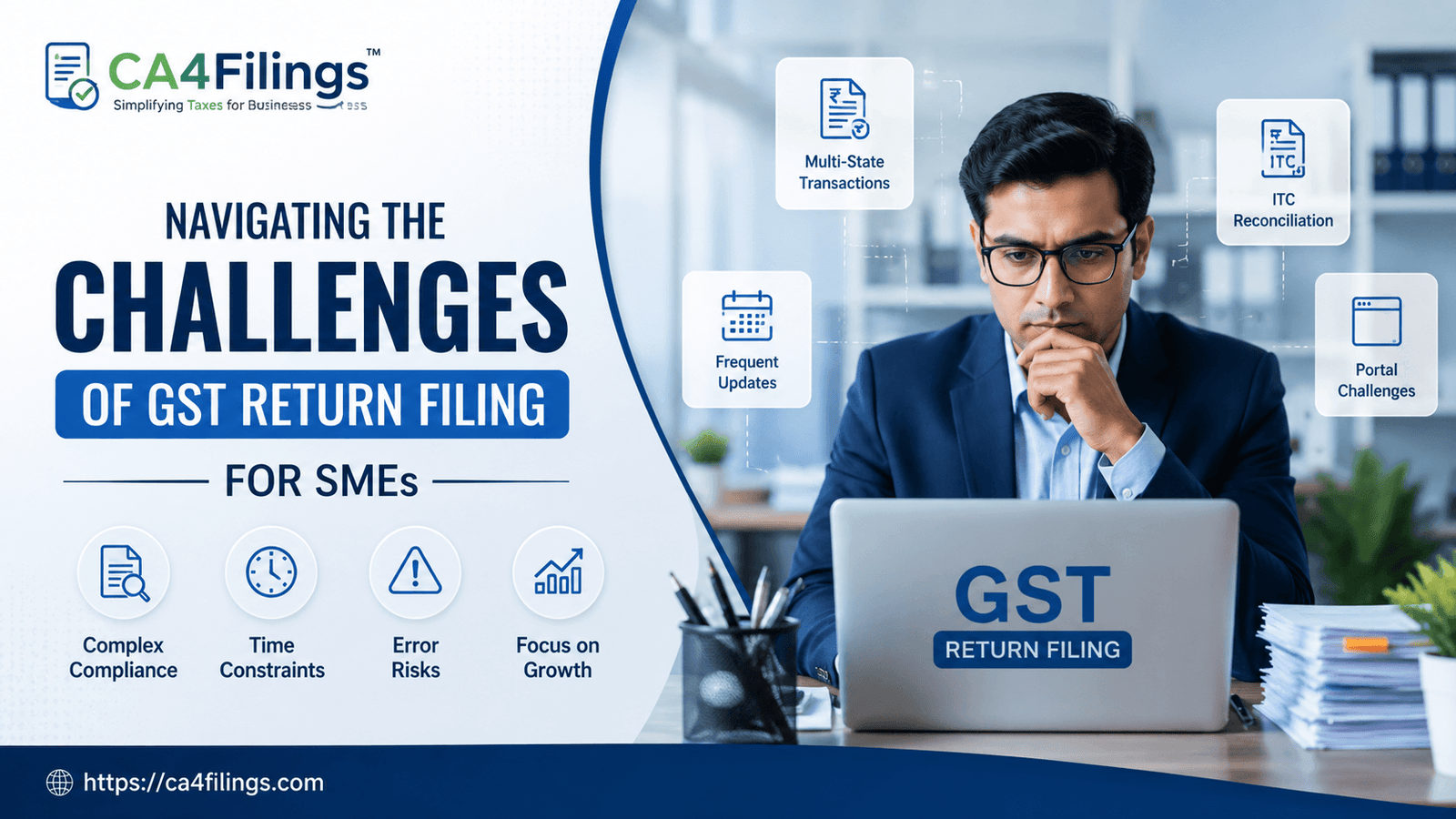
Running a Small and Medium Enterprise (SME) in India is a whirlwind of activity. From managing day-to-day operations to keeping your team motivated, you wear many hats. However, there is one area that often feels like a constant roadblock: tax compliance. Many business owners find themselves stressed when Navigating the Challenges of GST Return Filing for SMEs. At CA4Filings, we understand that your focus should be on scaling your business, not getting tangled in complex tax portals. If you find the process overwhelming, our GST Return Filing service is designed to take that burden off your shoulders completely.
Why GST Compliance Feels Like an Uphill Battle for SMEs
When the Goods and Services Tax (GST) was introduced, it promised a "One Nation, One Tax" simplified regime. Yet, for SMEs, the reality has been different. Frequent updates to the GST portal, changing notification rules, and the pressure of real-time data reporting make Navigating the Challenges of GST Return Filing for SMEs a daunting task.
The primary hurdle isn't just paying the tax—it is the administrative weight of filing. From GSTR-1 to GSTR-3B, the reconciliation process between your books and the portal often leads to errors that trigger notices from the tax department.
Common Obstacles Faced by Small Businesses
1. Inconsistent Data Reconciliation
One of the biggest issues we see at CA4Filings is a mismatch between GSTR-2B (input tax credit available) and the actual invoices recorded in the company’s accounting software. If your purchase register does not align perfectly with what the GST portal displays, your Input Tax Credit (ITC) claim can be rejected or flagged.
2. Frequent Portal Glitches
Let’s be honest: the GST portal is not always user-friendly. During peak filing seasons, server slowdowns or last-minute technical glitches can make the process of Navigating the Challenges of GST Return Filing for SMEs even more stressful. Trying to file on the 19th or 20th of the month often leads to heart-in-mouth moments when the page fails to load.
3. Understanding Changing Notifications
The GST Council frequently updates rules regarding e-invoicing thresholds, HSN code requirements, and late fee structures. For an SME owner, keeping track of these circulars while running a business is nearly impossible. Missing a single update can lead to avoidable interest and penalties.
Best Practices for Seamless Filing
To succeed in Navigating the Challenges of GST Return Filing for SMEs, you must move away from manual spreadsheets. Here is how we recommend you handle the process:
Digitize your Accounting: Use cloud-based accounting software that integrates directly with the GST portal. This minimizes manual data entry errors.
Monthly Reconciliation: Do not wait until the end of the quarter or the year. Perform a reconciliation of your sales and purchase registers every month. This ensures that any discrepancies in ITC are spotted early.
Maintain Digital Records: Keep digital copies of all tax invoices and credit/debit notes. The GST department may demand these during an audit, and having them organized saves hours of panic.
Stay Updated: Delegate the responsibility of tracking GST notifications to a dedicated finance person or a professional firm.
Navigating the Challenges of GST Return Filing for SMEs: The Role of Professional Expertise
Many SME owners try to manage filings in-house to save costs. However, the cost of a single mistake—be it a misclassified HSN code or an incorrect ITC claim—often far exceeds the cost of hiring a professional.
At CA4Filings, we believe in proactive compliance. By Navigating the Challenges of GST Return Filing for SMEs with an experienced team, you ensure that:
Your returns are filed well before the deadline.
Your ITC is maximized and accurately captured.
You are insulated from unnecessary departmental notices.
Frequently Asked Questions (FAQs)
What is the biggest mistake SMEs make in GST filing?
The most common mistake is failing to reconcile the Purchase Register with the auto-populated GSTR-2B. This often leads to claiming ineligible input tax credit, inviting scrutiny from tax authorities.
How often should an SME reconcile their GST data?
Ideally, reconciliation should be done monthly. This helps in identifying missing invoices from suppliers immediately, allowing you to follow up with them before the filing deadline.
Does late filing always attract a penalty?
Yes. Both late fees and interest are applicable for delayed filings. Late fees are a fixed amount per day of delay, while interest is charged at 18% per annum on the net tax liability.
Can I correct an error after filing the GST return?
Certain errors can be corrected in the subsequent month's return. However, it is always better to get it right the first time to avoid interest implications and unwanted attention from the tax department.
Tax compliance does not have to be the reason you lose sleep at night. While Navigating the Challenges of GST Return Filing for SMEs can seem like a steep mountain to climb, a systematic approach and professional support make all the difference. Remember, your time is best spent on growing your business revenue, not on the nuances of tax portals.
At CA4Filings, we take pride in helping SME owners thrive by keeping them audit-ready and compliant. Don't let tax complexities hold your business back. Contact us today at CA4Filings to simplify your compliance journey and experience stress-free filing.
Latest Updates
ca4filings.com Services























-registration.png)