Final Return Decoded: How to File GSTR 10 After Cancelling Registration
Filing your GSTR 10 after cancellation is essential to avoid penalties. Learn the final return process and how to manage your gst return accurately.
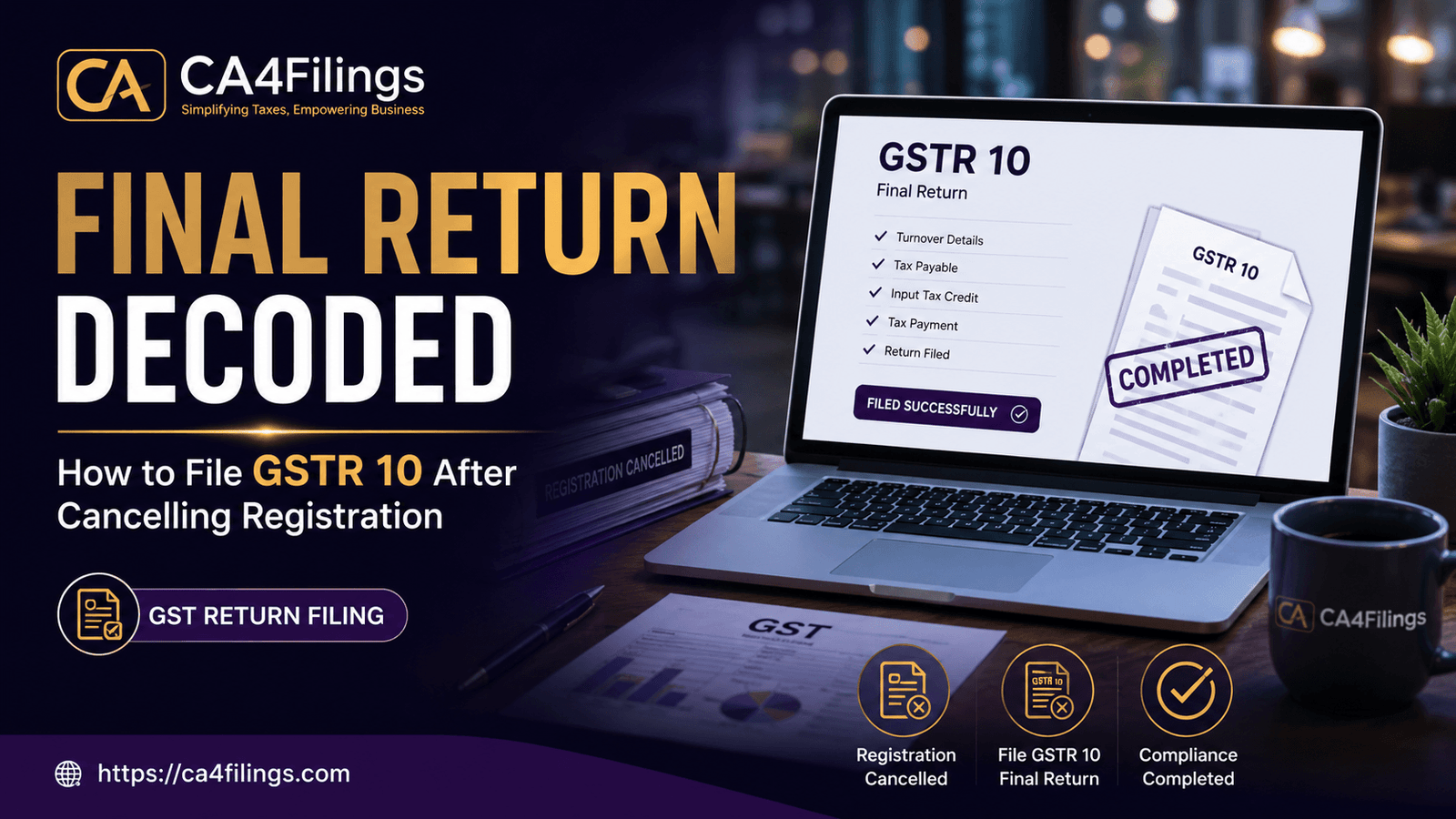
So, you’ve decided to close your business or your GST registration has been cancelled. While it might feel like the end of your compliance journey, there is one final, crucial step: filing the GSTR 10. Many business owners mistakenly assume that once the registration is cancelled, they can simply walk away. However, as experts at CA4Filings, we often see clients receive notices due to pending final returns. If you are struggling with this, our GST Return Filing services are designed to ensure you don’t miss these critical obligations, even when closing your doors.
Understanding the Final Return Process
The GSTR 10 is the Final Return that a taxpayer must file after their GST registration is either cancelled or surrendered. Think of it as a "closing balance" report for your GST journey. It informs the tax authorities about the inventory of inputs, semi-finished goods, and finished goods you held on the day your registration ceased to be effective.
When your GST registration is cancelled, the law requires you to account for any Input Tax Credit (ITC) you previously claimed on that remaining stock. Because you are no longer a registered taxpayer, the government needs you to reverse that credit or pay the tax equivalent to the output tax on those goods.
The 3 Month Timeline You Must Not Miss
Compliance under GST is strictly time-bound, and GSTR 10 is no exception. You are required to file this return within a 3 month timeline from the date of the cancellation order or the effective date of cancellation, whichever is later.
Missing this deadline isn't just a minor oversight; it attracts a late fee of ₹200 per day (₹100 under CGST and ₹100 under SGST). While this might sound small, there is no upper cap on these penalties in many scenarios, and the longer you delay, the more complex your "cancellation order mapping" becomes. Staying on top of this date is the single best way to ensure you don't face unnecessary legal notices post-closure.
How to Manage Stock Tax Liability
One of the most technical aspects of the final return is calculating your stock tax liability. When you stop being a registered person, you must pay an amount equal to the credit of input tax in respect of inputs held in stock, or the output tax payable on such goods—whichever is higher.
For goods with invoices: You simply use the original input tax amount.
For goods without invoices: You must estimate the value based on the prevailing market price.
If the value is significant, the law may require a certificate from a practicing Chartered Accountant. At CA4Filings, we help our clients calculate these values accurately so they don't overpay or invite scrutiny from the department.
Electronic Credit Balance Disposal
Before you can file your GSTR 10, you must settle all your dues. It is a common misconception that you can just adjust your final tax liability against your existing electronic credit ledger balance.
The reality is that for GSTR 10, the liability must generally be discharged through your electronic cash ledger. Any remaining balance in your credit ledger will essentially lapse after the cancellation. Therefore, you need a clear strategy for the electronic credit balance disposal. We advise our clients to utilize their ITC as much as possible before the final cancellation date to avoid "trapped" credit that cannot be refunded.
Step-by-Step Filing Guide
Login: Access the GST portal using your credentials. Even after cancellation, your login remains active for filing this specific return.
Navigate: Go to Services > Returns > Final Return (GSTR 10).
Prepare: The system will auto-populate your details. You will need to manually enter the details of your closing stock.
Compute Liability: Use the "Compute Liabilities" button to see what you owe based on your stock and ITC status.
Payment: Generate a challan if you have a balance payable and deposit the amount via the electronic cash ledger.
File: Use your Digital Signature Certificate (DSC) or Electronic Verification Code (EVC) to sign and submit.
Frequently Asked Questions (FAQs)
Q1. Do I need to file GSTR 10 if I was under the Composition Scheme?
No, taxpayers who were under the Composition Scheme are not required to file GSTR 10. It is only mandatory for regular taxpayers.
Q2. What if I have no stock left at the time of cancellation?
You must still file a "Nil" GSTR 10. Failure to file, even if the figures are zero, will still attract the daily late fee.
Q3. Can I revise GSTR 10 after filing?
No, GSTR 10 cannot be revised once it has been filed. This is why we always recommend a professional review before hitting the final submit button.
Q4. What happens if I ignore the GSTR 10 filing requirement?
Ignoring this will prevent you from fully closing your GSTIN record. This can lead to persistent notices from the tax department and complications if you decide to start a new business under the same PAN later.
Filing your gst return correctly is the final gatekeeper in your business lifecycle. While it may seem like a straightforward task, the implications of incorrect stock valuation or missing the deadline can lead to long-term tax headaches. At CA4Filings, we specialize in helping businesses exit the tax framework smoothly and compliantly. Don’t leave your tax affairs incomplete—reach out to our team today for expert guidance on your final gst return and ensure your business closure is handled with the precision it deserves.
Latest Updates
ca4filings.com Services

























-registration.png)