Deciding the Perfect GST Slab for Restaurants and Catering Units
Confused about the right GST slab for your restaurant? Learn how to choose the correct gst slab for your business with this expert guide from CA4Filings.
Running a restaurant or a catering business in India is as much about managing complex compliance as it is about serving great food. One of the most frequent questions we receive from our clients at CA4Filings is how to choose the right gst slab. Navigating the maze of indirect taxation can be daunting, especially when your compliance tasks—such as GST Return Filing—depend entirely on correctly identifying your tax category.
When you fail to align your operations with the appropriate gst slab, you risk unnecessary tax burdens or, worse, litigation from the department. Let’s break down the rules of the road so you can focus on your culinary ventures while we handle the regulatory heavy lifting.
Understanding the Restaurant GST Landscape
The GST regime for the hospitality sector is essentially bifurcated into two paths: the concessional rate with restricted benefits, and the standard rate with full benefits.
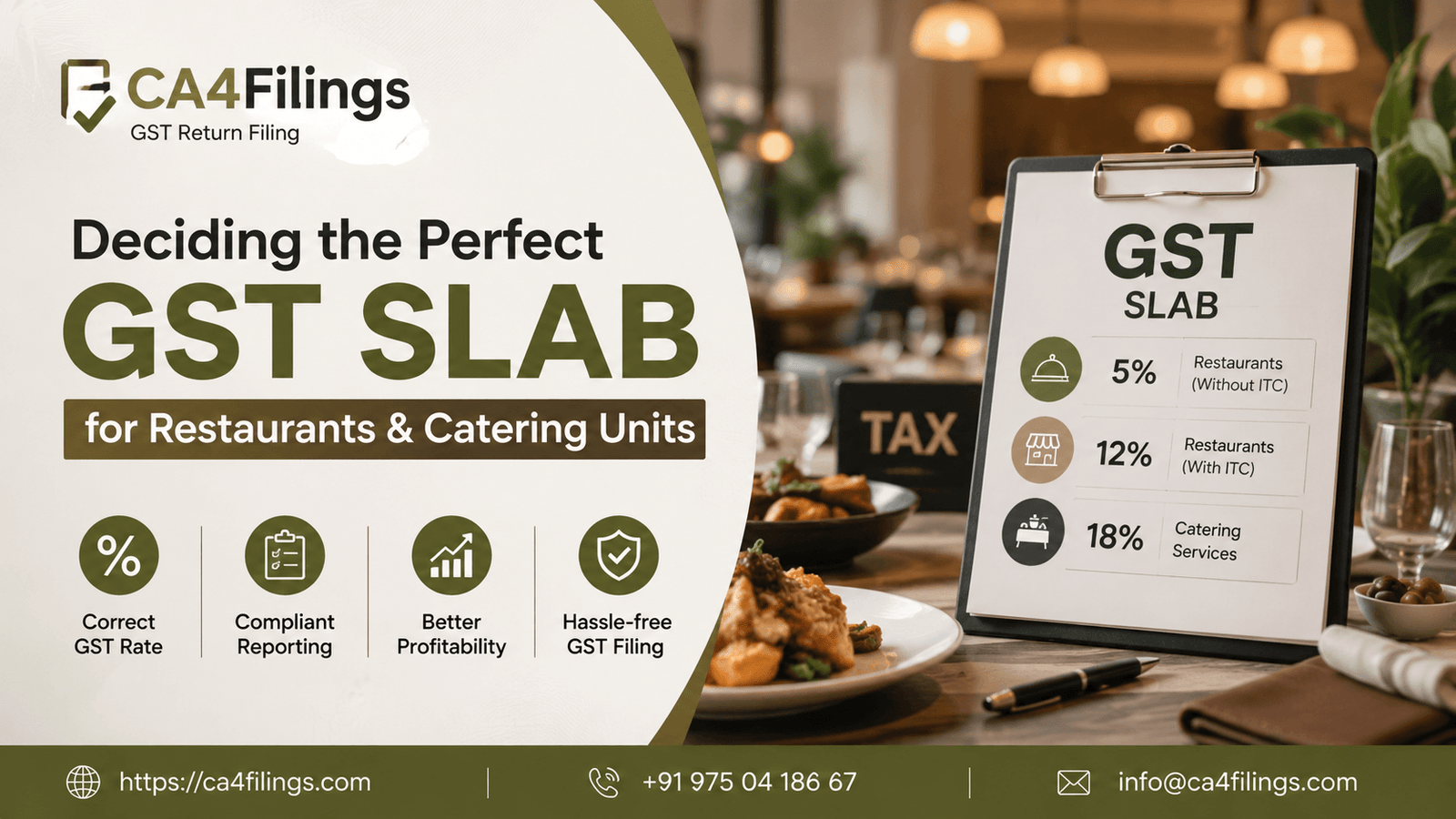
The most discussed category is the 5 percent no itc model. This gst slab was introduced to simplify taxation for small to mid-sized eateries. Under this scheme, you pay 5% GST on your turnover, but you are strictly barred from claiming Input Tax Credit (ITC) on your purchases—whether it’s raw materials, kitchen equipment, or interior decor.
Conversely, some businesses opt for the 18% rate, which allows you to claim full ITC. Choosing between these isn't just about the rate; it’s about your profit margins and your supply chain structure.
The Catering SAC Code and Tax Implications
For catering units, the situation is slightly different. The catering sac code (Service Accounting Code) generally falls under 9963. When you provide outdoor catering services, the rules regarding the gst slab become more specific.
If you are a standalone catering unit, you are generally taxed at 18% with the benefit of Input Tax Credit. However, if you are a catering unit operating within a larger hotel premise, the star hotel tax structure might apply.
Standalone Catering: Usually attracts 18% GST with ITC.
Hotel-attached Catering: Often falls under the 18% rate if the room tariff of the hotel exceeds a certain threshold.
Is Your Business a Composite Food Supply?
One of the most important concepts to understand is composite food supply. In many instances, restaurants provide not just food, but a combination of food, beverages, and service.
If your establishment offers a buffet, you are providing a service that is considered a "composite supply" where the principal supply is the service of food. The government mandates that such supplies be taxed according to the specific gst slab applicable to the restaurant services. If you are struggling to classify your menu items—especially when dealing with beverages or luxury add-ons—it is wise to consult a professional to ensure your classification doesn't trigger an input tax credit blocking issue later.
Factors Influencing Your Choice of GST Slab
Deciding on the perfect gst slab is not a "one size fits all" exercise. Before you finalize your tax structure, consider these three pillars:
1. Your Supplier Base
If most of your raw materials (like vegetables, grains, or dairy) are exempt or attract low tax, the 5% no-ITC gst slab might be beneficial. However, if you rely heavily on expensive imported ingredients or high-end equipment that carries a significant tax load, the 18% rate with ITC is usually more cost-effective.
2. Nature of Sales
Are you selling primarily through food delivery portals? Remember that these platforms collect and deposit GST on your behalf. You must ensure that the menu pricing you set reflects the gst slab correctly to maintain your margins after the portal's commission and tax deductions.
3. Compliance Capacity
The 5% no-ITC category significantly simplifies your accounting since you don't have to track credits on every single purchase invoice. If your accounting team is lean, this might be the practical choice.
Frequently Asked Questions
Can I change my gst slab mid-year?
Generally, the choice of the gst slab is expected to be consistent throughout the financial year. Changes are usually permitted at the start of a new fiscal year.
Does the 5% no-ITC rule apply to alcohol?
GST is not applicable to alcohol for human consumption. It remains under the purview of State Excise duties. However, if you serve food alongside alcohol, the food portion is subject to the gst slab rules.
How do I handle taxes on food delivery portals?
Platforms like Zomato and Swiggy are treated as Electronic Commerce Operators. They collect GST from the customer. Your responsibility is to ensure that your menu prices are updated and that you report these sales correctly in your returns.
Is input tax credit blocking applicable to everyone?
No, it only applies if you opt for the 5% concessional gst slab. If you pay 18% GST, you are eligible to claim ITC on your business-related purchases.
Choosing the right gst slab is a strategic business decision that directly impacts your bottom line. Whether you are a small cafe or a premium catering service, clarity in tax planning is non-negotiable. Don’t let complex tax laws hinder your growth.
At CA4Filings, we specialize in helping businesses like yours navigate these complexities with ease. From selecting the optimal tax structure to ensuring your returns are filed accurately, we are here to support your success.
Latest Updates
ca4filings.com Services





















-registration.png)