Capital Goods and Input Tax Credit: Multi-Year Amortization Rules
Confused about ITC on capital goods? Our guide explains amortization rules, credit reversals, and how they impact your monthly gst return filing process.
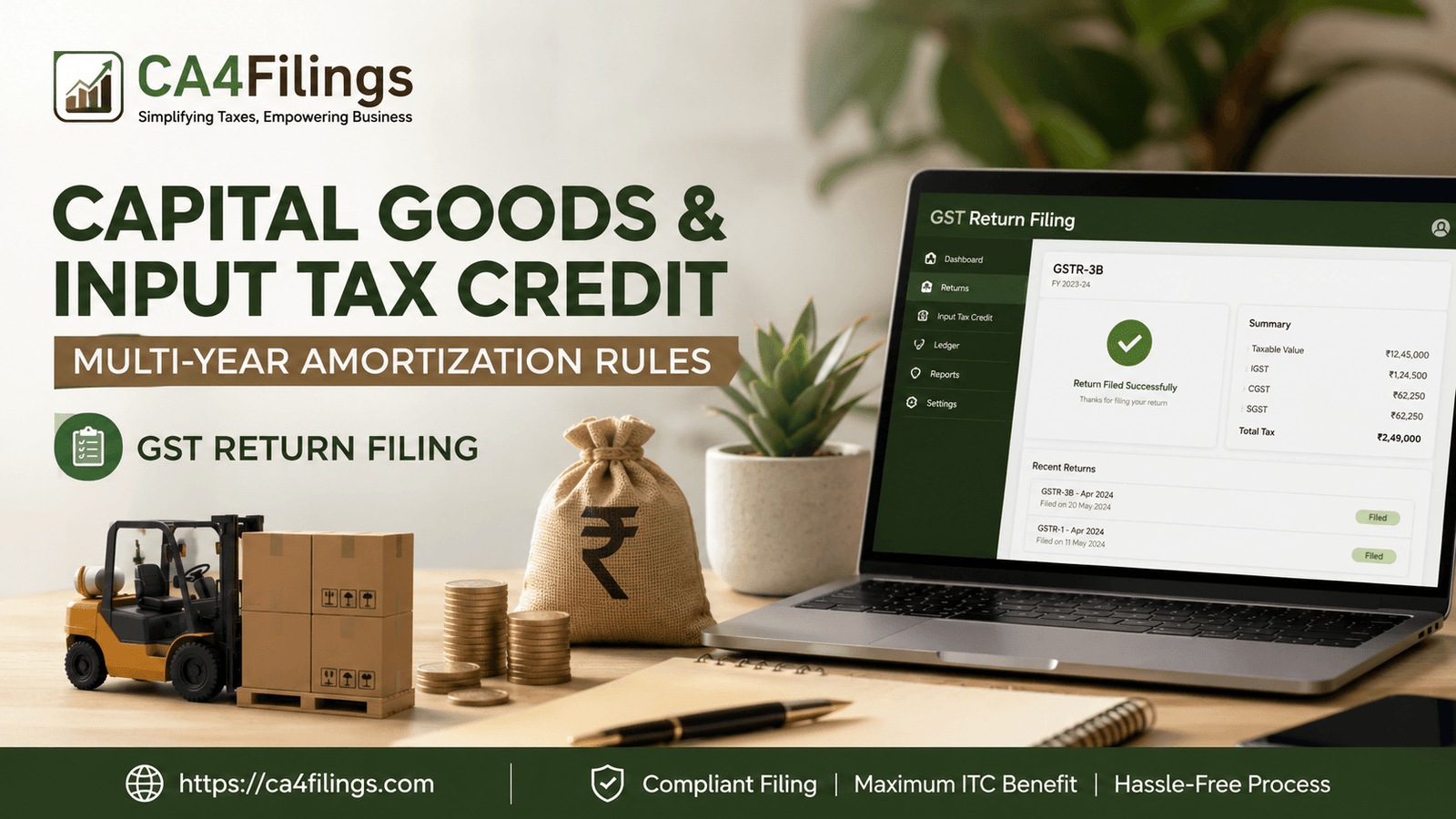
Buying expensive assets for your business is a major milestone, but it often brings a headache regarding tax compliance. Whether you are upgrading your plant and machinery tax structure or investing in commercial real estate itc, understanding how to claim Input Tax Credit (ITC) on capital goods is crucial. As you prepare your regular GST Return Filing process, ensuring these claims are accurate will save you from future scrutiny. At CA4Filings, we see many business owners accidentally leave money on the table or invite notices by mishandling these specific entries.
Understanding Capital Goods vs. Inputs
In the eyes of the GST law, capital goods are assets—like machinery, equipment, or vehicles—that you capitalize in your books of accounts. Unlike raw materials (inputs) that are consumed in the production process, capital goods are meant for long-term use.
When you purchase these items, you are generally allowed to claim the full ITC in the same tax period. However, the complexity arises if you decide to sell the asset or use it for non-business purposes later. Proper documentation here is just as vital as your routine gst return filing practices.
The Rule of 5 Years: Why It Matters
One of the most common myths is that you have to amortize the credit over the life of the asset. Under GST law, you generally claim the entire credit upfront. However, the "life" of the asset becomes relevant if you dispose of it.
The law dictates a useful life 5 years for capital goods. If you sell or discard the asset before this five-year period ends, you are required to pay back a portion of the ITC claimed. This is where many businesses trip up during their gst return filing audits.
The Credit Reversal Formula: Calculating Your Liability
If you sell a capital asset within the five-year window, you cannot simply keep the entire credit. You must pay an amount equal to the higher of the following:
The ITC involved in the remaining useful life of the asset.
The tax payable on the transaction value of the sale.
The Credit Reversal Formula
To calculate the ITC to be reversed, use the following approach:
(Total ITC taken) × (Number of quarters remaining out of 20 quarters / 20)
Example: If you purchased machinery for ₹10 Lakhs plus 18% GST (₹1.8 Lakhs) and sell it after 2 years (8 quarters), you have used it for 8 out of 20 quarters. The remaining quarters are 12. You must reverse 12/20ths of the ITC, which is ₹1.08 Lakhs.
Handling Asset Discard Entry and Documentation
What happens when an asset is damaged or becomes obsolete? You need to pass a formal asset discard entry in your books. Simply writing it off isn't enough for GST purposes.
Valuation: Even if you are discarding the asset as scrap, the scrap value is considered a "supply" under GST.
Taxation: You must pay GST on the transaction value of the scrap sale.
Audit Trail: Always keep photographs, surveyor reports, or disposal certificates handy. During your annual gst return filing review, these documents serve as proof if the tax department questions why the asset was removed from your books.
Managing GST Return Filing for Assets
Efficiency in your gst return filing depends on your internal accounting hygiene. Always track your capital goods in a separate fixed asset register that maps:
Date of purchase.
Invoice number and GSTIN of the supplier.
ITC claimed amount.
Date of capitalization.
If you are shifting your business model or disposing of assets, consult a professional to ensure your gst return filing correctly reflects these changes to avoid interest and penalties.
Frequently Asked Questions
Can I claim full ITC on a car purchased for business?
Generally, ITC on motor vehicles is blocked unless they are used for transportation of goods or for providing passenger transportation services. It is a common area of dispute in gst return filing.
Does the 5-year rule apply to commercial real estate?
ITC on construction services for immovable property (other than plant and machinery) is generally blocked. You should seek expert advice before claiming ITC on commercial real estate itc to avoid unnecessary notices.
What if I sell the machinery after 6 years?
If you have held the asset for more than five years, no reversal of ITC is required. However, you must still pay GST on the sale value of the scrap or the asset itself.
Is there a specific format for the asset discard entry?
There is no "fixed" format, but your accounting software should clearly capture the date, the reason for disposal, and the invoice generated for the scrap sale.
Expert Guidance with CA4Filings
Managing capital goods compliance requires more than just basic bookkeeping—it requires a deep understanding of the GST Act. Whether you are dealing with plant and machinery tax implications or complex asset disposals, the team at CA4Filings is here to ensure your compliance is airtight.
Don't let a minor error during your gst return filing lead to a major tax demand. Contact us today for a comprehensive review of your books and ensure your business stays ahead of the curve. Reach out to CA4Filings and let our experts handle the complexities for you.
Latest Updates
ca4filings.com Services





















-registration.png)