Banking and Financial Sector: Complexities of GST on Service
Are you confused about GST on service in the banking sector? CA4Filings breaks down the complexities of tax rates, exemptions, and compliance for you.
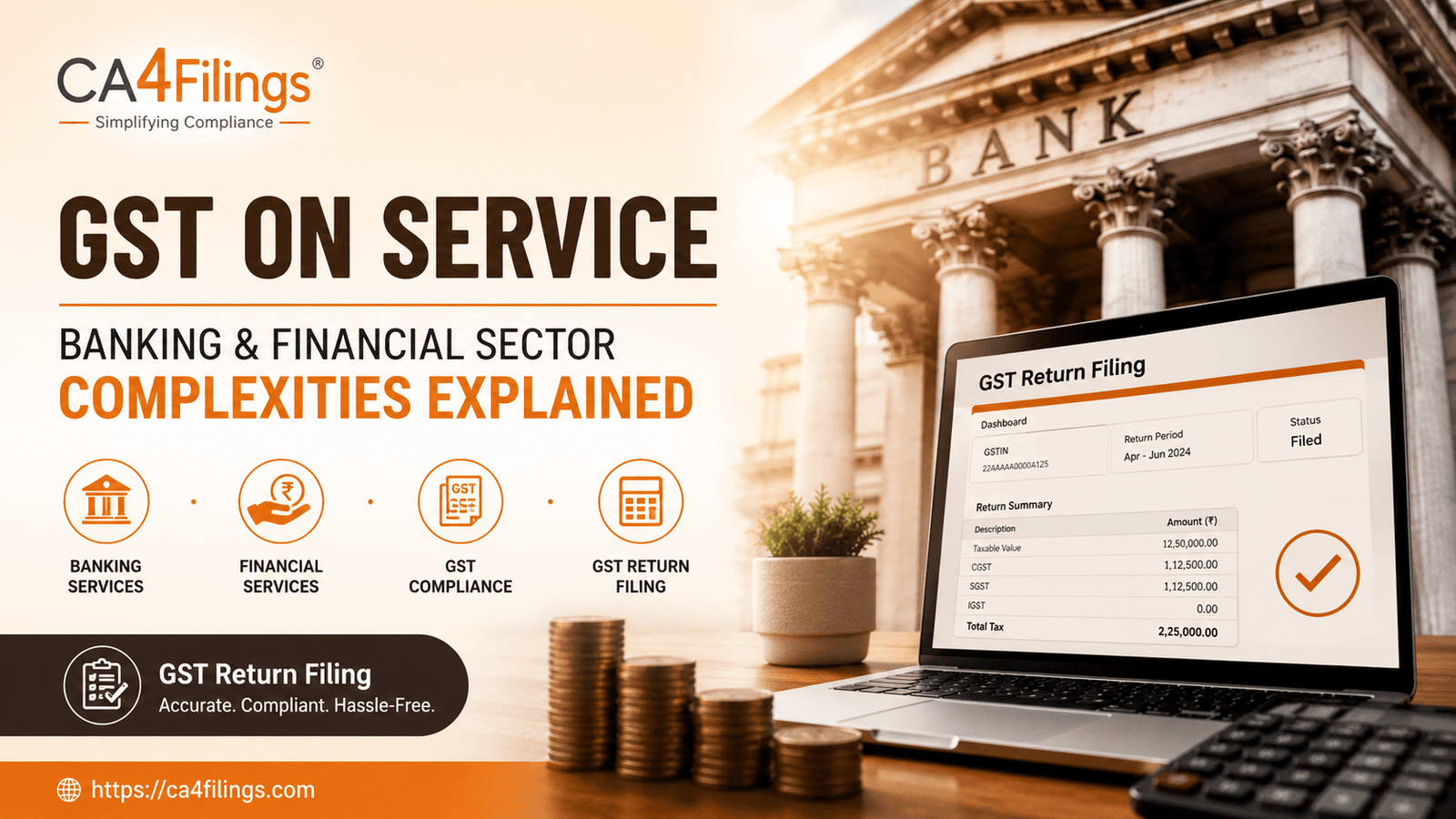
The landscape of the Indian banking and financial sector is intricate, and when you add the layer of Goods and Services Tax (GST) to it, things can get remarkably complicated for business owners and individuals alike. Understanding the nuances of gst on service is essential, as even a small oversight can lead to unnecessary penalties or missed opportunities for tax optimization. At CA4Filings, we often emphasize that staying updated is the first step toward financial compliance, which is why our team is committed to helping you manage your GST Return Filing with absolute precision and peace of mind.
Whether you are a startup owner looking at your business bank charges or an individual wondering why your loan processing fees have a specific tax component, navigating this sector requires a clear head. Let’s decode these complexities together.
Understanding the Basics of GST on Service in Banking
In the world of finance, GST is not a one-size-fits-all tax. Most banking services fall under the umbrella of "financial services," which are typically taxed at a standard rate of 18%. This applies to a wide range of services you likely encounter daily, such as ATM charges, cheque book issuance, debit card annual fees, and even those pesky late payment penalties on your credit cards.
However, the golden rule here is that GST is levied on the service fee or the commission charged by the bank, not on the principal amount or the interest itself. If your bank charges you a fee for a transaction, the 18% GST is calculated only on that specific fee amount.
The Role of Exempt Interest Income
One of the most frequently asked questions we receive at CA4Filings concerns exempt interest income. It is vital to distinguish between a service charge and an interest payment. According to current GST laws, interest earned on savings accounts, fixed deposits, or the interest you pay on loans is generally exempt from GST.
This exemption is in place because interest is considered a cost of money, not a service fee. However, the line blurs when banks charge "processing fees" or "foreclosure charges." Unlike the pure interest component, a processing fee tax is very much applicable. When you see an 18% charge on your loan statement, it is usually because the bank is taxing the administrative effort (the service) involved in processing your credit, rather than the money being lent to you.
Tackling the Input Tax Credit 50 Percent Option
For banks and Non-Banking Financial Companies (NBFCs), managing input tax credit is a massive headache. Because financial institutions deal in both taxable supplies (like commission-based services) and exempt supplies (like interest income), they cannot simply claim the full input tax credit on all their business expenses.
To simplify this, the government introduced the input tax credit 50 percent option. Under this provision, banking companies and financial institutions can opt to reverse 50% of their eligible input tax credit, while claiming the other 50%. This is often a strategic choice for many institutions, as it saves them from the arduous task of calculating the exact proportion of input credit attributable to exempt versus taxable supplies on a month-to-month basis.
Reverse Charge on Recovery Agents: Who Pays?
Another area that often catches businesses off guard is the reverse charge on recovery agents. In many cases involving debt collection, banks and financial institutions hire third-party recovery agents to handle overdue accounts. While the recovery agent provides a service, the liability to pay GST often shifts to the recipient—the bank or the financial institution—under the Reverse Charge Mechanism (RCM).
Why RCM? It ensures that the tax reaches the government even if the service provider is unorganized.
The Compliance Impact: As a recipient, the bank must self-invoice and pay the GST directly to the government. This is a critical compliance check that must be recorded accurately in your books to avoid future scrutiny.
The Importance of the Correct Bank SAC Code
Classification is the bedrock of GST compliance. Every financial service has a specific bank sac code (Services Accounting Code). For most financial and banking services, the code used is 9971.
Using the correct SAC code is not just a formality; it is how the GST portal recognizes the nature of your transaction. If you or your accountant misclassify a service under the wrong code, it could lead to incorrect tax rates being applied, potentially triggering a notice from the tax authorities. Always ensure your invoices and accounting software are updated with the correct 9971 classification for all financial service entries.
Frequently Asked Questions (FAQs)
1. Does GST apply to the interest I pay on my home loan?
No. The interest component of your EMI is exempt from GST. GST only applies to the processing fees, documentation charges, and other service-related fees levied by the bank.
2. Is there any GST on UPI transactions?
For individual users, UPI transactions are generally free and do not attract GST. However, if a bank were to charge a service fee for a digital transfer, that fee would be subject to 18% GST.
3. What is the benefit of the 50% ITC reversal rule for banks?
It provides a "safe harbor" approach. Instead of performing complex calculations to determine which part of their office expenses (like rent or software) relates to taxable vs. exempt income, banks can simply claim half their eligible credits.
4. Who is responsible for paying GST when hiring recovery agents?
Under the Reverse Charge Mechanism (RCM), the financial institution (the recipient of the service) is responsible for paying the GST, not the recovery agent.
Let CA4Filings Be Your Guide
Navigating the complexities of gst on service within the financial sector requires more than just basic knowledge—it requires professional oversight. From managing input tax credit and RCM liabilities to ensuring your SAC codes are perfectly aligned with government regulations, the margin for error is slim.
At CA4Filings, we take the complexity out of your tax compliance. We don't just file your returns; we act as your strategic partners in ensuring your business remains audit-proof and tax-efficient. Don’t let shifting regulations compromise your financial stability. Reach out to our expert team today, and let us handle your taxation journey while you focus on what you do best—growing your business.
Latest Updates
ca4filings.com Services


























-registration.png)