A Deep Dive into GST on Service for EdTech and Online Coaching
Confused about GST on service for EdTech? Learn about tax slabs, and compliance for online coaching with expert insights from CA4Filings.
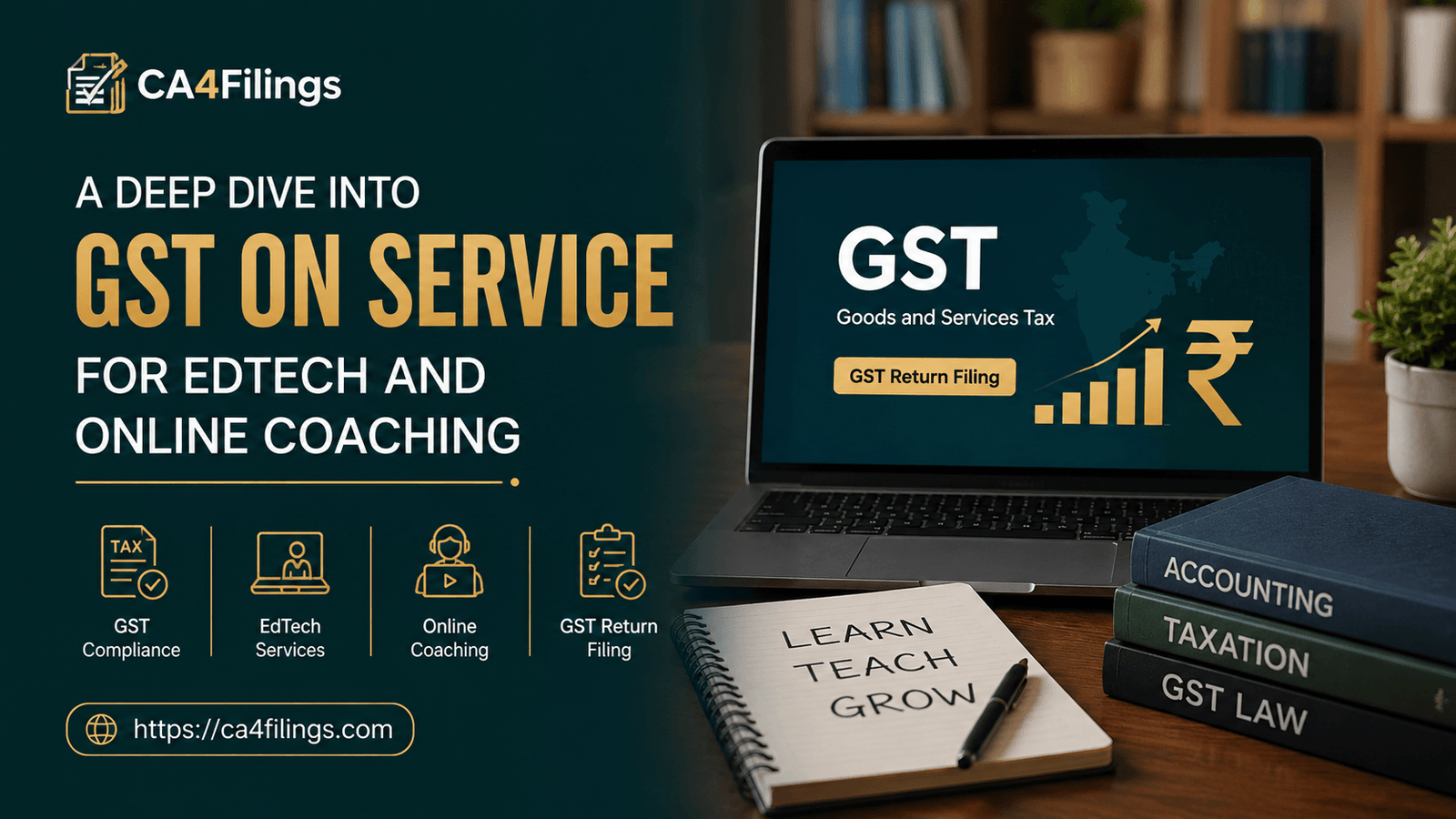
The world of EdTech and online coaching has revolutionized how we learn, but for business owners in this space, it brings a complex web of tax compliance. As an experienced Chartered Accountant, I often see coaching centers and digital platforms struggling to classify their offerings correctly. If you are struggling with the nuances of tax liability and need professional help, you can streamline your operations with our GST Return Filing services to ensure you remain compliant while you focus on scaling your business.
Understanding gst on service is not just a legal requirement; it is a fundamental aspect of your financial planning. Whether you are a solo tutor hosting Zoom sessions or a full-scale EdTech platform, the tax implications can significantly impact your margins and pricing strategies.
The Reality of GST on Service for EdTech
In the Indian tax regime, the central question is whether your activity qualifies as "education" in the eyes of the law. Under the current GST framework, the term "educational institution" is strictly defined. It generally covers schools, colleges, and institutions offering qualifications recognized by law.
If your coaching center or online platform does not lead to a government-recognized degree or diploma, you are providing a commercial service, not "education" as defined by the exemption notifications. Consequently, most private coaching, test preparation (for JEE, NEET, UPSC, CA, etc.), and skill development training fall under the taxable category. For these entities, the gst on service is a mandatory consideration.
Understanding the Taxability and SAC Codes
To correctly calculate your tax liability, you must first identify the correct Service Accounting Code (SAC). For commercial training and coaching, the most commonly used SAC code is 999293.
Commercial Training & Coaching: This attracts the 18 percent gst slab.
The Threshold Rule: You are not required to register for GST unless your aggregate turnover exceeds ₹20 lakh in a financial year (or ₹10 lakh in special category states). Once you cross this threshold, you must collect and remit tax.
Integrated GST (IGST): If you are an online educator selling courses to students across different states, you are providing inter-state services. In such cases, IGST is applicable.
Navigating the Educational Exemption
Many clients often ask us at CA4Filings if they can claim an educational exemption. The answer is almost always "no" if you are a for-profit commercial entity. The educational exemption is reserved for institutions providing services as part of a curriculum for a recognized qualification or approved vocational courses.
If you are running a private academy, even if you are doing excellent social work, you are technically a commercial service provider. Trying to classify your coaching as exempt can lead to significant penalties and interest payments during an audit.
Practical Insights on Study Material Billing
A common area of confusion is study material billing. When you sell a course, you often bundle digital or physical books, notes, and test series.
Under the law, this is treated as a "composite supply" if the components are naturally bundled. The principal supply is the coaching service itself. Therefore, the gst on service rate of 18% applies to the entire bundle. You cannot artificially split the invoice to apply a lower rate to the study materials. If you were to sell the study material separately as a stand-alone product, the tax rate for those goods might differ, but in a bundled coaching service, the tax follows the principal supply.
Challenges of Remote Learning Tax
The concept of remote learning tax has become a hot topic in 2026. Because EdTech allows you to scale beyond geographical boundaries, your tax footprint is naturally wider. If you provide services to students located outside India, you must be careful with the "Place of Supply" rules.
If your platform is based in India but serves international students, it could potentially be treated as an export of services, which might have different compliance requirements compared to domestic supplies.
Essential Compliance Tips for EdTech Businesses
Maintain Clear Invoicing: Always issue a tax invoice that clearly shows the GST registration number (GSTIN) and the tax breakdown.
Input Tax Credit (ITC): As a GST-registered business, you are eligible to claim ITC on your business expenses, such as software subscriptions, marketing costs, and office equipment. This can significantly reduce your net tax liability.
Documentation: Keep detailed records of your student locations and service delivery logs to justify your place of supply in case of an assessment.
Frequently Asked Questions (FAQs)
1. Is online coaching exempt from GST?
Generally, no. Online coaching is considered a commercial service and is taxable at 18%. Exemption only applies to recognized educational institutions providing formal degrees or diplomas.
2. What is the GST rate for private tutors?
If your annual turnover is below the threshold of ₹20 lakh (or ₹10 lakh in special category states), you do not need to charge GST. Above this limit, you must charge 18% on your services.
3. Can I claim Input Tax Credit on the equipment I use for teaching?
Yes, if you are a registered GST taxpayer, you can claim ITC on hardware like cameras, microphones, and computers used for your coaching business.
4. How does the 18 percent gst slab affect my course pricing?
The 18% tax is an additional cost. You must decide whether to absorb this cost to keep your prices competitive or pass it on to your students. Most successful platforms pass it on but clearly communicate it as a "tax-inclusive" or "tax-exclusive" price.
5. What happens if I fail to register for GST?
If you cross the turnover threshold and fail to register, you are liable for penalties and interest on the unpaid tax from the date you should have been registered.
Managing your gst on service obligations is an integral part of maintaining a professional and sustainable EdTech brand. By understanding the nuances of the 18% slab, correct SAC code usage, and the limitations of exemptions, you protect your business from future liabilities. At CA4Filings, we are here to simplify this complexity for you. Let our experts guide your compliance journey—contact us today to keep your business on the right side of the law.
Latest Updates
ca4filings.com Services





















-registration.png)